 Add to Chrome
 Add to Firefox
 Add to Edge
Generalized Functional ANOVA in Closed-Form: A Unified View of Additive Explanations
May 18, 2026
The functional ANOVA, or Hoeffding decomposition, provides a principled framework for interpretability by decomposing a model prediction into main effects and higher-order interactions. For independent inputs, this classical decomposition is explicit. It is closely connected to SHAP values, generalized additive models, and orthogonal polynomial expansions, and therefore constitutes a fundamental tool for additive explainability. In the more general and realistic dependent setting, however, obtaining a tractable representation and estimating the decomposition from data remain challenging. In this work, we address this problem for continuous inputs. By combining Hilbert space methods with the generalized functional ANOVA, we build an explicit decomposition Riesz Basis allowing to easily compute the decomposition. Our formulation recovers the classical independent case and its associated orthogonal decomposition. Building on this representation, we propose a simple but mighty algorithm to estimate the decomposition from a data sample in a model-agnostic setting and we compare it empirically with several state-of-the-art explanation methods, demonstrating the power of the approach.

Exact Functional ANOVA Decomposition for Categorical Inputs Models
Mar 03, 2026Functional ANOVA offers a principled framework for interpretability by decomposing a model's prediction into main effects and higher-order interactions. For independent features, this decomposition is well-defined, strongly linked with SHAP values, and serves as a cornerstone of additive explainability. However, the lack of an explicit closed-form expression for general dependent distributions has forced practitioners to rely on costly sampling-based approximations. We completely resolve this limitation for categorical inputs. By bridging functional analysis with the extension of discrete Fourier analysis, we derive a closed-form decomposition without any assumption. Our formulation is computationally very efficient. It seamlessly recovers the classical independent case and extends to arbitrary dependence structures, including distributions with non-rectangular support. Furthermore, leveraging the intrinsic link between SHAP and ANOVA under independence, our framework yields a natural generalization of SHAP values for the general categorical setting.
Explaining Models under Multivariate Bernoulli Distribution via Hoeffding Decomposition
Oct 08, 2025
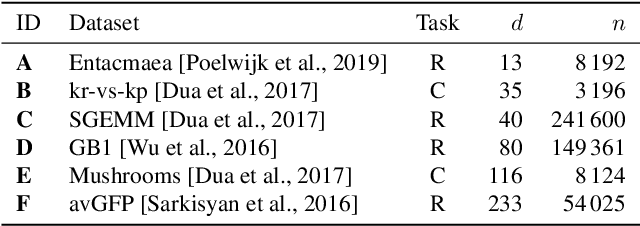

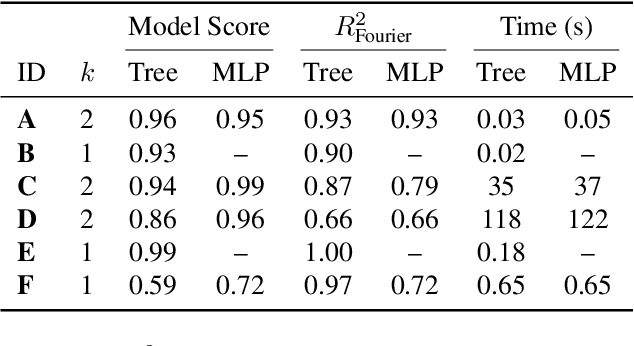
Explaining the behavior of predictive models with random inputs can be achieved through sub-models decomposition, where such sub-models have easier interpretable features. Arising from the uncertainty quantification community, recent results have demonstrated the existence and uniqueness of a generalized Hoeffding decomposition for such predictive models when the stochastic input variables are correlated, based on concepts of oblique projection onto L 2 subspaces. This article focuses on the case where the input variables have Bernoulli distributions and provides a complete description of this decomposition. We show that in this case the underlying L 2 subspaces are one-dimensional and that the functional decomposition is explicit. This leads to a complete interpretability framework and theoretically allows reverse engineering. Explicit indicators of the influence of inputs on the output prediction (exemplified by Sobol' indices and Shapley effects) can be explicitly derived. Illustrated by numerical experiments, this type of analysis proves useful for addressing decision-support problems, based on binary decision diagrams, Boolean networks or binary neural networks. The article outlines perspectives for exploring high-dimensional settings and, beyond the case of binary inputs, extending these findings to models with finite countable inputs.