 Add to Chrome
 Add to Firefox
 Add to Edge
Quantum simulation of real-world nonlinear dynamics via Koopman method
Jul 08, 2026
Nonlinear dynamics is ubiquitous in nature, ranging from chemical pattern formation to ocean circulation, yet its simulation on quantum computers is fundamentally limited by the unitary nature of quantum evolution. We propose the quantum Koopman method, a data-driven framework that embeds nonlinear dynamics into a learned linear representation and implements the resulting evolution using shallow quantum circuits. This method learns Koopman observables from trajectory data, projects the lifted dynamics onto a finite-dimensional subspace, and decomposes the corresponding non-unitary propagator into parallel spectral channels. We utilize the Koopman method on a superconducting processor to simulate three distinct nonlinear systems, comprising reaction-diffusion dynamics, fluid motion on a sphere, and satellite-derived observations of Gulf Stream currents, employing up to 32 parallel circuits of 10 qubits. These quantum simulations capture the dominant multiscale patterns and statistical signatures of the underlying dynamics, and reveal a transition from performance limited by hardware noise in weakly nonlinear systems to performance limited by finite-dimensional Koopman representations as nonlinear scale interactions increase. This transition identifies a practical boundary for quantum-amenable nonlinear dynamics, establishing a hardware-validated route for simulating moderately nonlinear dynamics on near-term quantum hardware.

Data-driven quantum Koopman method for simulating nonlinear dynamics
Jul 29, 2025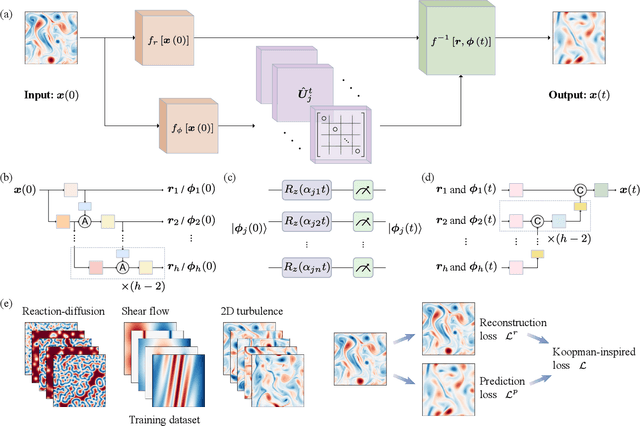
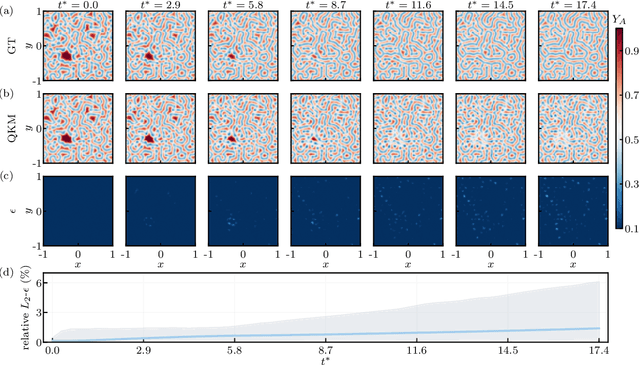
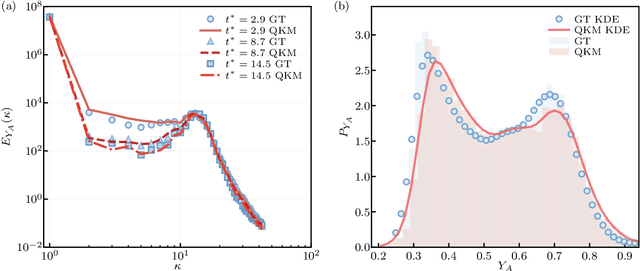
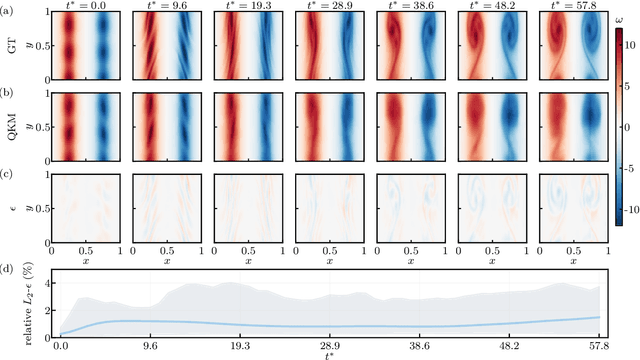
Quantum computation offers potential exponential speedups for simulating certain physical systems, but its application to nonlinear dynamics is inherently constrained by the requirement of unitary evolution. We propose the quantum Koopman method (QKM), a data-driven framework that bridges this gap through transforming nonlinear dynamics into linear unitary evolution in higher-dimensional observable spaces. Leveraging the Koopman operator theory to achieve a global linearization, our approach maps system states into a hierarchy of Hilbert spaces using a deep autoencoder. Within the linearized embedding spaces, the state representation is decomposed into modulus and phase components, and the evolution is governed by a set of unitary Koopman operators that act exclusively on the phase. These operators are constructed from diagonal Hamiltonians with coefficients learned from data, a structure designed for efficient implementation on quantum hardware. This architecture enables direct multi-step prediction, and the operator's computational complexity scales logarithmically with the observable space dimension. The QKM is validated across diverse nonlinear systems. Its predictions maintain relative errors below 6% for reaction-diffusion systems and shear flows, and capture key statistics in 2D turbulence. This work establishes a practical pathway for quantum-accelerated simulation of nonlinear phenomena, exploring a framework built on the synergy between deep learning for global linearization and quantum algorithms for unitary dynamics evolution.