 Add to Chrome
 Add to Firefox
 Add to Edge
InSPECT: Invariant Spectral Features Preservation of Diffusion Models
Dec 19, 2025
Modern diffusion models (DMs) have achieved state-of-the-art image generation. However, the fundamental design choice of diffusing data all the way to white noise and then reconstructing it leads to an extremely difficult and computationally intractable prediction task. To overcome this limitation, we propose InSPECT (Invariant Spectral Feature-Preserving Diffusion Model), a novel diffusion model that keeps invariant spectral features during both the forward and backward processes. At the end of the forward process, the Fourier coefficients smoothly converge to a specified random noise, enabling features preservation while maintaining diversity and randomness. By preserving invariant features, InSPECT demonstrates enhanced visual diversity, faster convergence rate, and a smoother diffusion process. Experiments on CIFAR-10, Celeb-A, and LSUN demonstrate that InSPECT achieves on average a 39.23% reduction in FID and 45.80% improvement in IS against DDPM for 10K iterations under specified parameter settings, which demonstrates the significant advantages of preserving invariant features: achieving superior generation quality and diversity, while enhancing computational efficiency and enabling faster convergence rate. To the best of our knowledge, this is the first attempt to analyze and preserve invariant spectral features in diffusion models.

Causal Adjacency Learning for Spatiotemporal Prediction Over Graphs
Nov 25, 2024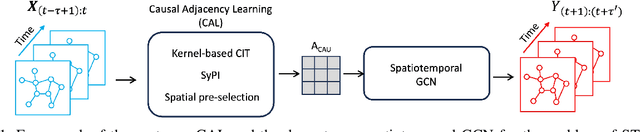
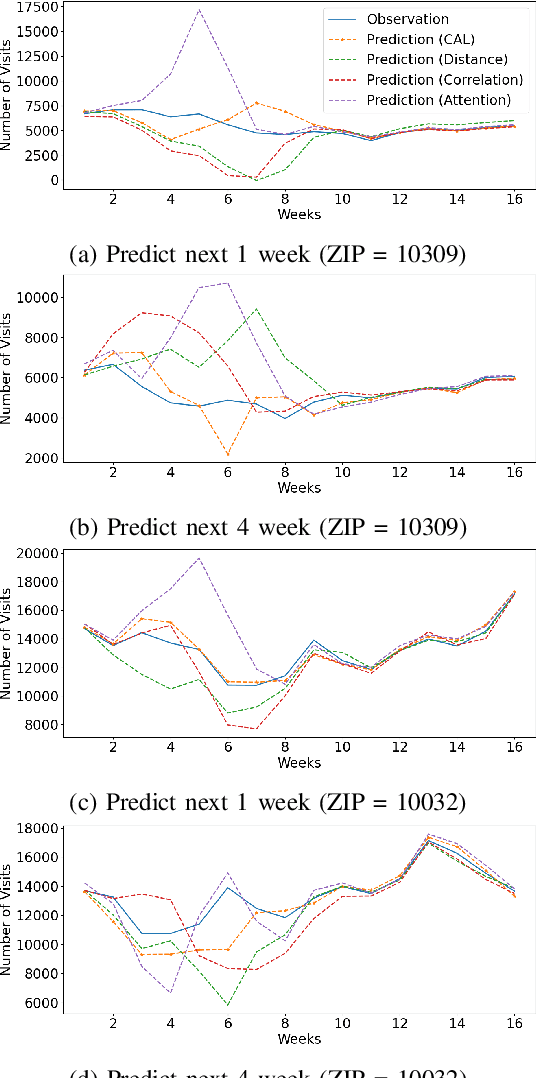
Spatiotemporal prediction over graphs (STPG) is crucial for transportation systems. In existing STPG models, an adjacency matrix is an important component that captures the relations among nodes over graphs. However, most studies calculate the adjacency matrix by directly memorizing the data, such as distance- and correlation-based matrices. These adjacency matrices do not consider potential pattern shift for the test data, and may result in suboptimal performance if the test data has a different distribution from the training one. This issue is known as the Out-of-Distribution generalization problem. To address this issue, in this paper we propose a Causal Adjacency Learning (CAL) method to discover causal relations over graphs. The learned causal adjacency matrix is evaluated on a downstream spatiotemporal prediction task using real-world graph data. Results demonstrate that our proposed adjacency matrix can capture the causal relations, and using our learned adjacency matrix can enhance prediction performance on the OOD test data, even though causal learning is not conducted in the downstream task.