 Add to Chrome
 Add to Firefox
 Add to Edge
Label-Efficient Dataset Pruning via Semi-Supervised Pseudo-Labeling
May 22, 2026
Dataset pruning reduces the storage and training costs of deep learning by selecting an informative subset from a large dataset. However, most existing pruning methods require fully labeled data, which limits their applicability in realistic settings where unlabeled data are abundant and annotation is costly. Recent label-free pruning methods address this issue, but they rely on features from pretrained models to estimate example difficulty. This dependence can be unreliable when the target dataset differs substantially from the pretraining distribution. We propose SemiPrune, a label-efficient dataset pruning framework, using only a small randomly labeled subset, that uses semi-supervised learning to generate pseudo-labels for unlabeled data, allowing existing supervised pruning methods that require label information to be seamlessly applied to the resulting pseudo-labeled training pool. We then estimate example difficulty from pseudo-label-induced training dynamics and select a coreset. By learning directly from the target dataset, our method better captures the target distribution and provides more reliable signals for difficulty estimation and coreset selection. We validate our approach on domain-specific, image-corrupted, and long-tailed datasets, where it achieves state-of-the-art performance among label-free and label-efficient baselines, while also demonstrating competitive performance on standard benchmarks.

AMUSE: Anytime Muon with Stable Gradient Evaluation
May 21, 2026Modern deep learning commonly relies on AdamW with prescribed learning rate schedules, but recent works challenge both components: Schedule-Free optimization removes explicit schedules via iterate averaging, and Muon improves the update geometry by orthogonalizing momentum for matrix parameters. Despite Muon's strong empirical performance, its underlying mechanism remains partially understood. We study Muon through the river-valley loss landscape, where useful training progress occurs along a flat, low-curvature bulk subspace (the river), while high-curvature dominant directions form steep valley walls that induce oscillations. We empirically show that while Muon's orthogonalization accelerates river progress by increasing the bulk component, it also amplifies dominant-direction noise, causing oscillatory trajectories. Building on this, we propose Anytime MUon with Stable gradient Evaluation (AMUSE), which integrates Muon's rapid bulk progress with the stabilizing effect of Schedule-Free averaging. AMUSE uses a time-varying interpolation coefficient that initially evaluates gradients near the fast Muon sequence for rapid adaptation, then gradually shifts toward the stable averaged sequence to suppress valley-wall oscillations. As a result, AMUSE requires no learning rate schedules and supports anytime training. Across vision tasks and large language model pretraining, AMUSE consistently improves the performance-iteration Pareto frontier over (Schedule-Free) AdamW and Muon.
Implicit Bias and Loss of Plasticity in Matrix Completion: Depth Promotes Low-Rankness
Mar 05, 2026We study matrix completion via deep matrix factorization (a.k.a. deep linear neural networks) as a simplified testbed to examine how network depth influences training dynamics. Despite the simplicity and importance of the problem, prior theory largely focuses on shallow (depth-2) models and does not fully explain the implicit low-rank bias observed in deeper networks. We identify coupled dynamics as a key mechanism behind this bias and show that it intensifies with increasing depth. Focusing on gradient flow under block-diagonal observations, we prove: (a) networks of depth $\geq 3$ exhibit coupling unless initialized diagonally, and (b) convergence to rank-1 occurs if and only if the dynamics is coupled -- resolving an open question by Menon (2024) for a family of initializations. We also revisit the loss of plasticity phenomenon in matrix completion (Kleinman et al., 2024), where pre-training on few observations and resuming with more degrades performance. We show that deep models avoid plasticity loss due to their low-rank bias, whereas depth-2 networks pre-trained under decoupled dynamics fail to converge to low-rank, even when resumed training (with additional data) satisfies the coupling condition -- shedding light on the mechanism behind this phenomenon.
Uniform Spectral Growth and Convergence of Muon in LoRA-Style Matrix Factorization
Feb 06, 2026Spectral gradient descent (SpecGD) orthogonalizes the matrix parameter updates and has inspired practical optimizers such as Muon. They often perform well in large language model (LLM) training, but their dynamics remain poorly understood. In the low-rank adaptation (LoRA) setting, where weight updates are parameterized as a product of two low-rank factors, we find a distinctive spectral phenomenon under Muon in LoRA fine-tuning of LLMs: singular values of the LoRA product show near-uniform growth across the spectrum, despite orthogonalization being performed on the two factors separately. Motivated by this observation, we analyze spectral gradient flow (SpecGF)-a continuous-time analogue of SpecGD-in a simplified LoRA-style matrix factorization setting and prove "equal-rate" dynamics: all singular values grow at equal rates up to small deviations. Consequently, smaller singular values attain their target values earlier than larger ones, sharply contrasting with the largest-first stepwise learning observed in standard gradient flow. Moreover, we prove that SpecGF in our setting converges to global minima from almost all initializations, provided the factor norms remain bounded; with $\ell_2$ regularization, we obtain global convergence. Lastly, we corroborate our theory with experiments in the same setting.
Lightweight Dataset Pruning without Full Training via Example Difficulty and Prediction Uncertainty
Feb 10, 2025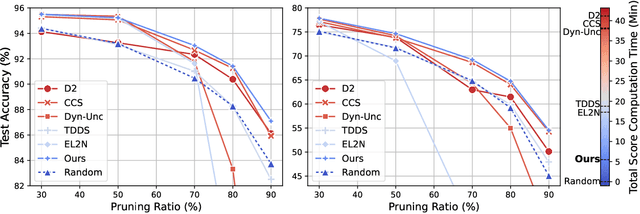
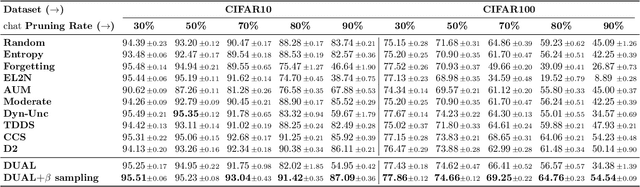
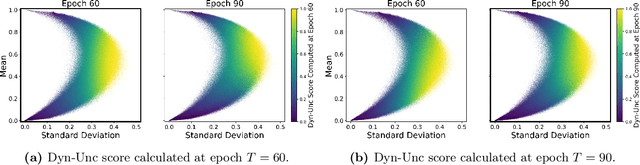

Recent advances in deep learning rely heavily on massive datasets, leading to substantial storage and training costs. Dataset pruning aims to alleviate this demand by discarding redundant examples. However, many existing methods require training a model with a full dataset over a large number of epochs before being able to prune the dataset, which ironically makes the pruning process more expensive than just training the model on the entire dataset. To overcome this limitation, we introduce a Difficulty and Uncertainty-Aware Lightweight (DUAL) score, which aims to identify important samples from the early training stage by considering both example difficulty and prediction uncertainty. To address a catastrophic accuracy drop at an extreme pruning, we further propose a ratio-adaptive sampling using Beta distribution. Experiments on various datasets and learning scenarios such as image classification with label noise and image corruption, and model architecture generalization demonstrate the superiority of our method over previous state-of-the-art (SOTA) approaches. Specifically, on ImageNet-1k, our method reduces the time cost for pruning to 66% compared to previous methods while achieving a SOTA, specifically 60% test accuracy at a 90% pruning ratio. On CIFAR datasets, the time cost is reduced to just 15% while maintaining SOTA performance.
DASH: Warm-Starting Neural Network Training in Stationary Settings without Loss of Plasticity
Oct 30, 2024Warm-starting neural network training by initializing networks with previously learned weights is appealing, as practical neural networks are often deployed under a continuous influx of new data. However, it often leads to loss of plasticity, where the network loses its ability to learn new information, resulting in worse generalization than training from scratch. This occurs even under stationary data distributions, and its underlying mechanism is poorly understood. We develop a framework emulating real-world neural network training and identify noise memorization as the primary cause of plasticity loss when warm-starting on stationary data. Motivated by this, we propose Direction-Aware SHrinking (DASH), a method aiming to mitigate plasticity loss by selectively forgetting memorized noise while preserving learned features. e validate our approach on vision tasks, demonstrating improvements in test accuracy and training efficiency.