 Add to Chrome
 Add to Firefox
 Add to Edge
When cheap gradients fail: the measurement cost of attacking quantum classifiers
Jul 13, 2026
Adversarial perturbations threaten machine learning classifiers, including variational quantum classifiers. We show that finite quantum measurement statistics (shot noise) act as a built-in defense against gradient-based test-time attacks whose cost scales unfavorably for the attacker. Because every gradient component must be inferred from repeated circuit executions under any unbiased gradient-estimation rule, white-box extraction consumes a dimension-dependent measurement budget that measurement grouping cannot remove in expressive circuits. Under stated assumptions, single-step attacks need at least quadratically many shots in the input dimension $d$, growing as $d^{5/2}$ under norm-concentration scaling, with a sufficient-budget analysis for iterative attacks via stochastic gradient Langevin dynamics. Simulations up to 784 input dimensions validate the law: the realized total budget is the $d^{5/2}$ geometric floor for plateau-mitigated models and grows as $d^{3.00}$ for the tested deep circuits, whose gradient norms decay with dimension absent barren-plateau mitigation; folding the measured gradient norm back in recovers the parameter-free $d^{3/2}$ shot-noise geometry. Against a matched classical baseline whose attack overhead is dimension-independent (the cheap-gradient principle of automatic differentiation), the quantum gradient cost ratio grows empirically as $d^{3.00}$, so the attacker's relative cost diverges as the model scales. Experiments on a 156-qubit IBM processor (ibm_boston, 4-qubit circuits, $d=12$) reproduce the effect: at matched budgets the device attack tracks the ideal within a few percent, with the high-shot gradient faithful to the exact one. The defense operates precisely when the forward map is classically hard to simulate: only then is a white-box attacker denied the simulate-and-backpropagate shortcut and must pay the measurement cost we quantify.

Computable Model-Independent Bounds for Adversarial Quantum Machine Learning
Nov 11, 2024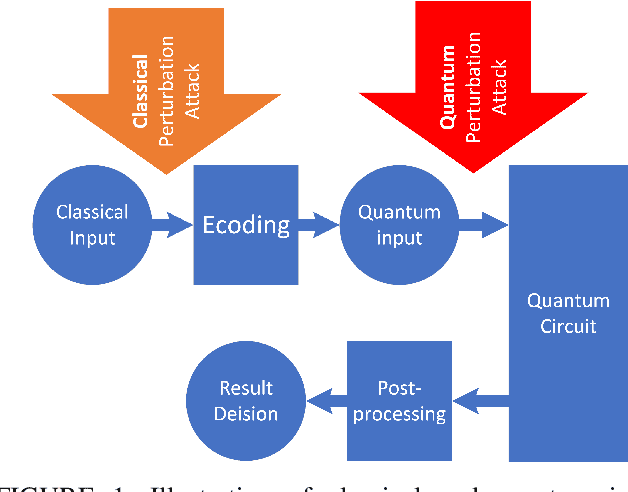
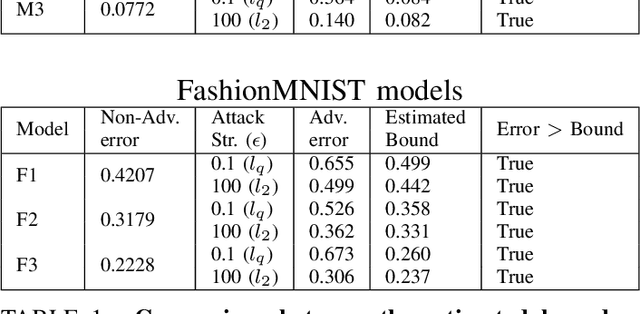
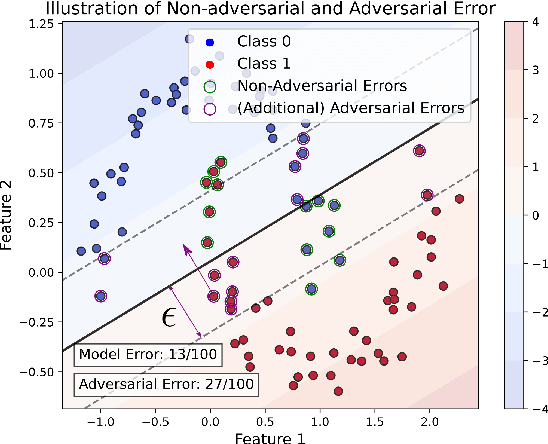
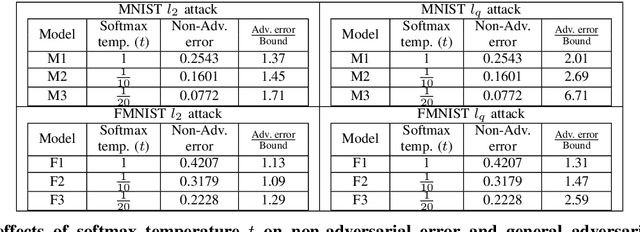
By leveraging the principles of quantum mechanics, QML opens doors to novel approaches in machine learning and offers potential speedup. However, machine learning models are well-documented to be vulnerable to malicious manipulations, and this susceptibility extends to the models of QML. This situation necessitates a thorough understanding of QML's resilience against adversarial attacks, particularly in an era where quantum computing capabilities are expanding. In this regard, this paper examines model-independent bounds on adversarial performance for QML. To the best of our knowledge, we introduce the first computation of an approximate lower bound for adversarial error when evaluating model resilience against sophisticated quantum-based adversarial attacks. Experimental results are compared to the computed bound, demonstrating the potential of QML models to achieve high robustness. In the best case, the experimental error is only 10% above the estimated bound, offering evidence of the inherent robustness of quantum models. This work not only advances our theoretical understanding of quantum model resilience but also provides a precise reference bound for the future development of robust QML algorithms.