 Add to Chrome
 Add to Firefox
 Add to Edge
Performance of DF Multihop Networks with TAS/GSC over Nakagami-m Fading Channels
May 30, 2026
In this work, transmit antenna selection (TAS) and generalized selection combining (GSC), i.e., TAS/GSC is revised over independent identically distributed Nakagami-$m$ flat fading channels with pretty simple newly derived closed-form expressions of outage probability (OP), symbol error rate (SER), and ergodic capacity. While compares to their multinomial theorem-based counterparts for GSC and TAS/GSC, the intelligibility, practicality, and simplicity of our derivations are invaluable, which from now on facilitates TAS/GSC implementations in various fields. As an example, performance analysis of decode-and-forward multihop networks with TAS/GSC implementation in each hop is presented over independent non-identically distributed Nakagami-$m$ fading channels in this work, with the closed-form expressions for OP, SER, and ergodic capacity. Finally, all derived analytical expressions are validated via Monte-Carlo simulation technique.

Performance of User-Assisted Nonlinear Energy Harvesting NOMA Network with Alamouti/MRC
Oct 28, 2024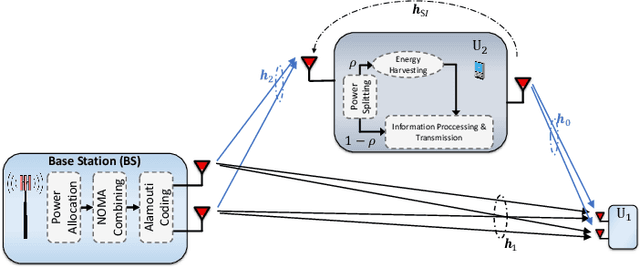
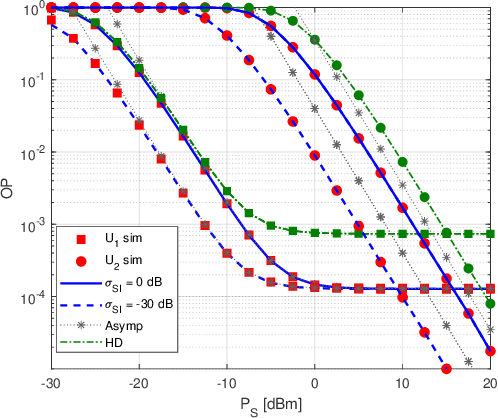
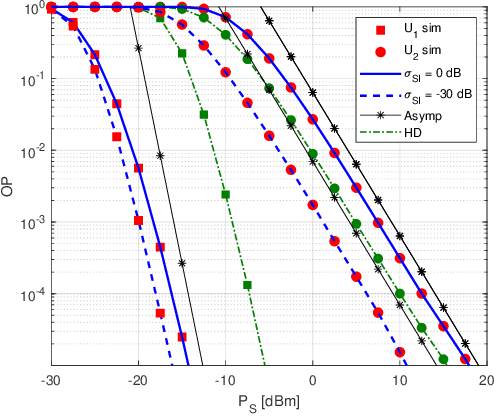
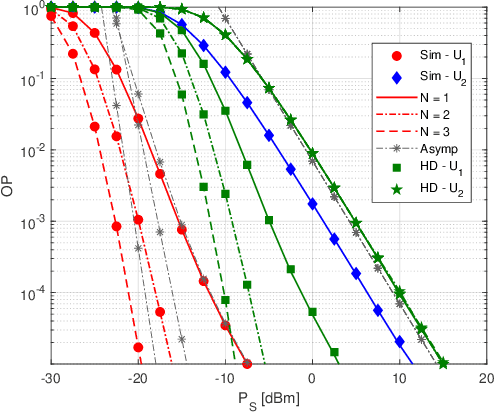
This paper focuses on evaluating the outage performance of a dual-hop single-phase non-orthogonal multiple-access (NOMA) system. The base station employs the Alamouti space-time block coding technique (Alamouti-STBC), enabling simultaneous communication with two mobile users, and the far user employs a maximal ratio combining (MRC) scheme. In this setup, the near user serves as a full-duplex (FD) (or half-duplex (HD)) energy harvesting (EH) relay, adopting decode-and-forward (DF) protocol for the far user. The study involves the development of a system model and the closed-form equations of exact and asymptotic outage probabilities (OP) over Nakagami-m fading channels with and without direct link considering a threshold-based nonlinear EH relaying model. We verify analytical results by Monte Carlo simulations and show that the presence of a direct link in the system enhances the performance of the far user considerably by mitigating the degradation caused by the self-interference in the near user.