 Add to Chrome
 Add to Firefox
 Add to Edge
A Hybrid Physical--Digital Framework for Annotated Fracture Reduction Data Evaluated using Clinically Relevant 3D metrics
Mar 19, 2026
A major bottleneck in Computer-Assisted Preoperative Planning (CAPP) for fracture reduction is the limited availability of annotated data. While annotated datasets are now available for evaluating bone fracture segmentation algorithms, there is a notable lack of annotated data for the evaluation of automatic fracture reduction methods. Obtaining precise annotations, which are essential for training and evaluating automatic CAPP algorithm, of the reduced bone therefore remains a critical and underexplored challenge. Existing approaches to assess reduction methods rely either on synthetic fracture simulation which often lacks realism, or on manual virtual reductions, which are complex, time-consuming, operator-dependant and error-prone. To address these limitations, we propose a hybrid physical-digital framework for generating annotated fracture reduction data. Based on fracture CTs, fragments are first 3D printed, physically reduced, fixed and CT scanned to accurately recover transformation matrix applied to each fragment. To quantitatively assess reduction quality, we introduce a reproducible formulation of clinically relevant 3D fracture metrics, including 3D gap, 3D step-off, and total gap area. The framework was evaluated on 11 clinical acetabular fracture cases reduced by two independent operators. Compared to preoperative measurements, the proposed approach achieved mean improvements of 168.85 mm 2 in total gap area, 1.82 mm in 3D gap, and 0.81 mm in 3D step-off. This hybrid physical--digital framework enables the efficient generation of realistic, clinically relevant annotated fracture reduction data that can be used for the development and evaluation of automatic fracture reduction algorithms.

Fully automated workflow for the design of patient-specific orthopaedic implants: application to total knee arthroplasty
Mar 25, 2024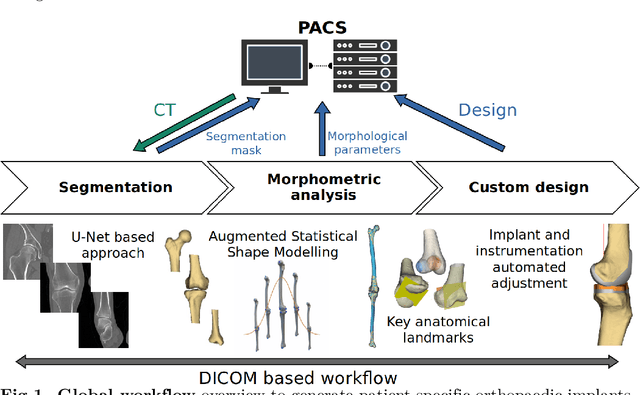


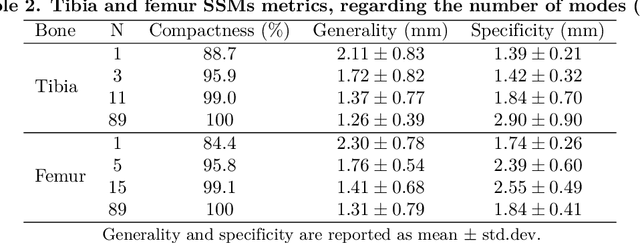
Arthroplasty is commonly performed to treat joint osteoarthritis, reducing pain and improving mobility. While arthroplasty has known several technical improvements, a significant share of patients are still unsatisfied with their surgery. Personalised arthroplasty improves surgical outcomes however current solutions require delays, making it difficult to integrate in clinical routine. We propose a fully automated workflow to design patient-specific implants, presented for total knee arthroplasty, the most widely performed arthroplasty in the world nowadays. The proposed pipeline first uses artificial neural networks to segment the proximal and distal extremities of the femur and tibia. Then the full bones are reconstructed using augmented statistical shape models, combining shape and landmarks information. Finally, 77 morphological parameters are computed to design patient-specific implants. The developed workflow has been trained using 91 CT scans of lower limb and evaluated on 41 CT scans manually segmented, in terms of accuracy and execution time. The workflow accuracy was $0.4\pm0.2mm$ for the segmentation, $1.2\pm0.4mm$ for the full bones reconstruction, and $2.8\pm2.2mm$ for the anatomical landmarks determination. The custom implants fitted the patients' anatomy with $0.6\pm0.2mm$ accuracy. The whole process from segmentation to implants' design lasted about 5 minutes. The proposed workflow allows for a fast and reliable personalisation of knee implants, directly from the patient CT image without requiring any manual intervention. It establishes a patient-specific pre-operative planning for TKA in a very short time making it easily available for all patients. Combined with efficient implant manufacturing techniques, this solution could help answer the growing number of arthroplasties while reducing complications and improving the patients' satisfaction.