 Add to Chrome
 Add to Firefox
 Add to Edge
LLMs and Cultural Values: the Impact of Prompt Language and Explicit Cultural Framing
Nov 06, 2025
Large Language Models (LLMs) are rapidly being adopted by users across the globe, who interact with them in a diverse range of languages. At the same time, there are well-documented imbalances in the training data and optimisation objectives of this technology, raising doubts as to whether LLMs can represent the cultural diversity of their broad user base. In this study, we look at LLMs and cultural values and examine how prompt language and cultural framing influence model responses and their alignment with human values in different countries. We probe 10 LLMs with 63 items from the Hofstede Values Survey Module and World Values Survey, translated into 11 languages, and formulated as prompts with and without different explicit cultural perspectives. Our study confirms that both prompt language and cultural perspective produce variation in LLM outputs, but with an important caveat: While targeted prompting can, to a certain extent, steer LLM responses in the direction of the predominant values of the corresponding countries, it does not overcome the models' systematic bias toward the values associated with a restricted set of countries in our dataset: the Netherlands, Germany, the US, and Japan. All tested models, regardless of their origin, exhibit remarkably similar patterns: They produce fairly neutral responses on most topics, with selective progressive stances on issues such as social tolerance. Alignment with cultural values of human respondents is improved more with an explicit cultural perspective than with a targeted prompt language. Unexpectedly, combining both approaches is no more effective than cultural framing with an English prompt. These findings reveal that LLMs occupy an uncomfortable middle ground: They are responsive enough to changes in prompts to produce variation, but too firmly anchored to specific cultural defaults to adequately represent cultural diversity.

THInC: A Theory-Driven Framework for Computational Humor Detection
Sep 02, 2024
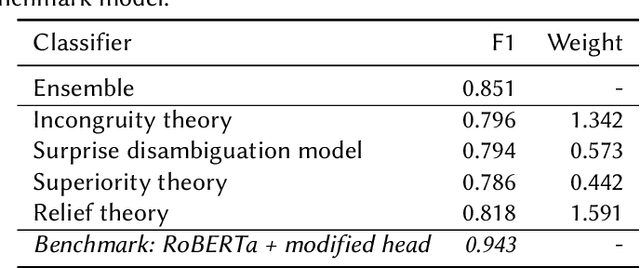

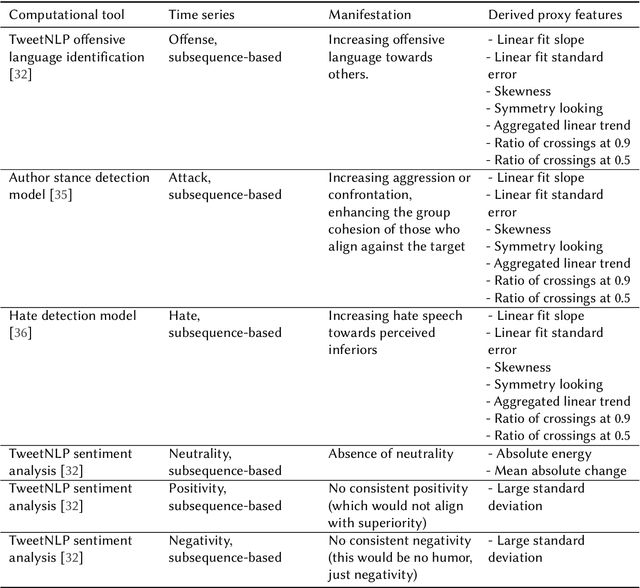
Humor is a fundamental aspect of human communication and cognition, as it plays a crucial role in social engagement. Although theories about humor have evolved over centuries, there is still no agreement on a single, comprehensive humor theory. Likewise, computationally recognizing humor remains a significant challenge despite recent advances in large language models. Moreover, most computational approaches to detecting humor are not based on existing humor theories. This paper contributes to bridging this long-standing gap between humor theory research and computational humor detection by creating an interpretable framework for humor classification, grounded in multiple humor theories, called THInC (Theory-driven Humor Interpretation and Classification). THInC ensembles interpretable GA2M classifiers, each representing a different humor theory. We engineered a transparent flow to actively create proxy features that quantitatively reflect different aspects of theories. An implementation of this framework achieves an F1 score of 0.85. The associative interpretability of the framework enables analysis of proxy efficacy, alignment of joke features with theories, and identification of globally contributing features. This paper marks a pioneering effort in creating a humor detection framework that is informed by diverse humor theories and offers a foundation for future advancements in theory-driven humor classification. It also serves as a first step in automatically comparing humor theories in a quantitative manner.