 Add to Chrome
 Add to Firefox
 Add to Edge
AE-LLM: Adaptive Efficiency Optimization for Large Language Models
Mar 20, 2026
Large Language Models (LLMs) have achieved remarkable success across diverse applications, yet their deployment remains challenging due to substantial computational costs, memory requirements, and energy consumption. Recent empirical studies have demonstrated that no single efficiency technique is universally optimal; instead, the effectiveness of methods such as efficient attention mechanisms, mixture-of-experts (MoE), parameter-efficient fine-tuning, and quantization varies significantly depending on task characteristics, resource constraints, and model scales. Building upon these insights, we propose AE-LLM, a unified framework that automatically selects and combines optimal efficiency techniques tailored to specific deployment scenarios. Our approach introduces a multi-objective optimization framework that jointly considers accuracy, latency, memory footprint, and energy consumption, while accounting for hardware constraints and task requirements. We develop an efficient search algorithm that explores the combinatorial space of efficiency techniques across architecture, fine-tuning, and inference stages, identifying Pareto-optimal configurations. Extensive experiments across 15 models (0.5B-70B parameters) and 10 diverse tasks demonstrate that AE-LLM achieves an average of $2.8\times$ improvement in efficiency metrics while maintaining competitive accuracy (within 1.2\% of baseline), compared to static efficiency configurations. Furthermore, our framework generalizes effectively to vision-language models, achieving similar efficiency gains. Our contributions provide practitioners with an automated tool for navigating the complex trade-off landscape of LLM efficiency optimization.

Contextual Discrepancy-Aware Contrastive Learning for Robust Medical Time Series Diagnosis in Small-Sample Scenarios
Jan 12, 2026Medical time series data, such as EEG and ECG, are vital for diagnosing neurological and cardiovascular diseases. However, their precise interpretation faces significant challenges due to high annotation costs, leading to data scarcity, and the limitations of traditional contrastive learning in capturing complex temporal patterns. To address these issues, we propose CoDAC (Contextual Discrepancy-Aware Contrastive learning), a novel framework that enhances diagnostic accuracy and generalization, particularly in small-sample settings. CoDAC leverages external healthy data and introduces a Contextual Discrepancy Estimator (CDE), built upon a Transformer-based Autoencoder, to precisely quantify abnormal signals through context-aware anomaly scores. These scores dynamically inform a Dynamic Multi-views Contrastive Framework (DMCF), which adaptively weights different temporal views to focus contrastive learning on diagnostically relevant, discrepant regions. Our encoder combines dilated convolutions with multi-head attention for robust feature extraction. Comprehensive experiments on Alzheimer's Disease EEG, Parkinson's Disease EEG, and Myocardial Infarction ECG datasets demonstrate CoDAC's superior performance across all metrics, consistently outperforming state-of-the-art baselines, especially under low label availability. Ablation studies further validate the critical contributions of CDE and DMCF. CoDAC offers a robust and interpretable solution for medical time series diagnosis, effectively mitigating data scarcity challenges.
Semantic-Preserving Cross-Style Visual Reasoning for Robust Multi-Modal Understanding in Large Vision-Language Models
Oct 26, 2025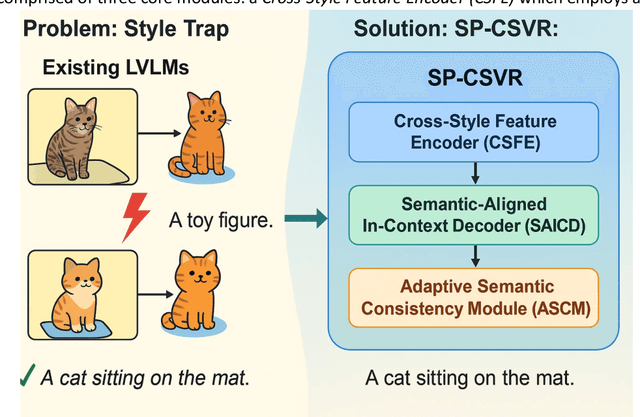
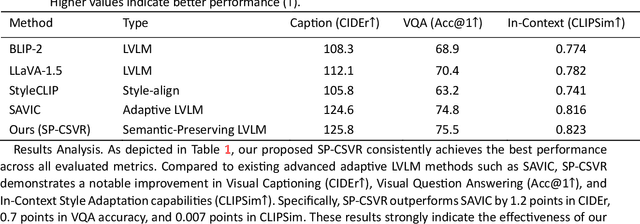
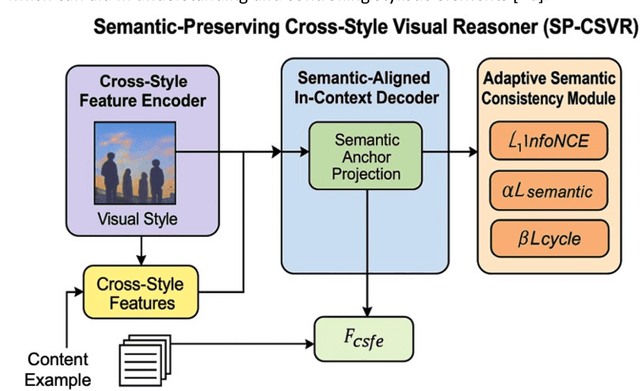
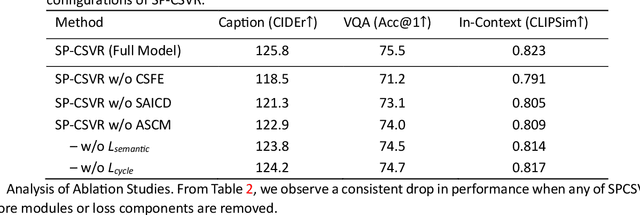
The "style trap" poses a significant challenge for Large Vision-Language Models (LVLMs), hindering robust semantic understanding across diverse visual styles, especially in in-context learning (ICL). Existing methods often fail to effectively decouple style from content, hindering generalization. To address this, we propose the Semantic-Preserving Cross-Style Visual Reasoner (SP-CSVR), a novel framework for stable semantic understanding and adaptive cross-style visual reasoning. SP-CSVR integrates a Cross-Style Feature Encoder (CSFE) for style-content disentanglement, a Semantic-Aligned In-Context Decoder (SAICD) for efficient few-shot style adaptation, and an Adaptive Semantic Consistency Module (ASCM) employing multi-task contrastive learning to enforce cross-style semantic invariance. Extensive experiments on a challenging multi-style dataset demonstrate SP-CSVR's state-of-the-art performance across visual captioning, visual question answering, and in-context style adaptation. Comprehensive evaluations, including ablation studies and generalization analysis, confirm SP-CSVR's efficacy in enhancing robustness, generalization, and efficiency across diverse visual styles.
XDR-LVLM: An Explainable Vision-Language Large Model for Diabetic Retinopathy Diagnosis
Aug 21, 2025Diabetic Retinopathy (DR) is a major cause of global blindness, necessitating early and accurate diagnosis. While deep learning models have shown promise in DR detection, their black-box nature often hinders clinical adoption due to a lack of transparency and interpretability. To address this, we propose XDR-LVLM (eXplainable Diabetic Retinopathy Diagnosis with LVLM), a novel framework that leverages Vision-Language Large Models (LVLMs) for high-precision DR diagnosis coupled with natural language-based explanations. XDR-LVLM integrates a specialized Medical Vision Encoder, an LVLM Core, and employs Multi-task Prompt Engineering and Multi-stage Fine-tuning to deeply understand pathological features within fundus images and generate comprehensive diagnostic reports. These reports explicitly include DR severity grading, identification of key pathological concepts (e.g., hemorrhages, exudates, microaneurysms), and detailed explanations linking observed features to the diagnosis. Extensive experiments on the Diabetic Retinopathy (DDR) dataset demonstrate that XDR-LVLM achieves state-of-the-art performance, with a Balanced Accuracy of 84.55% and an F1 Score of 79.92% for disease diagnosis, and superior results for concept detection (77.95% BACC, 66.88% F1). Furthermore, human evaluations confirm the high fluency, accuracy, and clinical utility of the generated explanations, showcasing XDR-LVLM's ability to bridge the gap between automated diagnosis and clinical needs by providing robust and interpretable insights.