 Add to Chrome
 Add to Firefox
 Add to Edge
FG-PE: Factor-graph Approach for Multi-robot Pursuit-Evasion
Nov 01, 2024
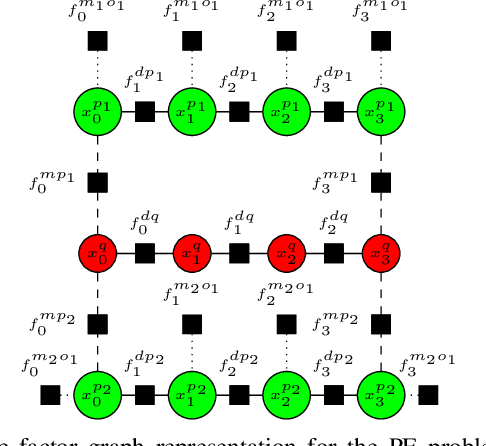
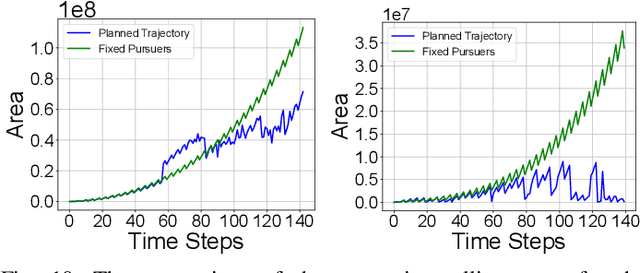
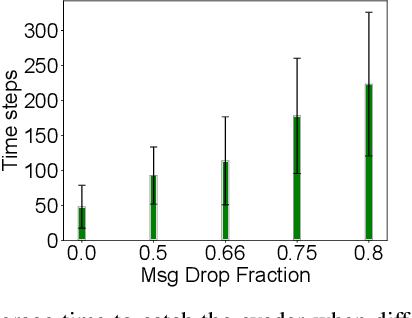
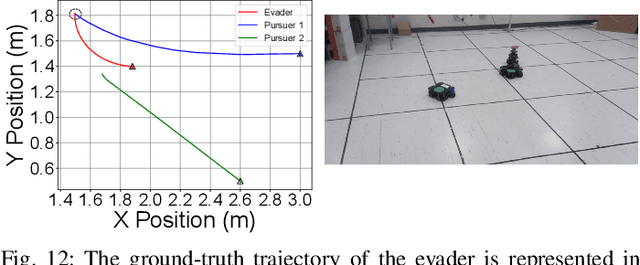
With the increasing use of robots in daily life, there is a growing need to provide robust collaboration protocols for robots to tackle more complicated and dynamic problems effectively. This paper presents a novel, factor graph-based approach to address the pursuit-evasion problem, enabling accurate estimation, planning, and tracking of an evader by multiple pursuers working together. It is assumed that there are multiple pursuers and only one evader in this scenario. The proposed method significantly improves the accuracy of evader estimation and tracking, allowing pursuers to capture the evader in the shortest possible time and distance compared to existing techniques. In addition to these primary objectives, the proposed approach effectively minimizes uncertainty while remaining robust, even when communication issues lead to some messages being dropped or lost. Through a series of comprehensive experiments, this paper demonstrates that the proposed algorithm consistently outperforms traditional pursuit-evasion methods across several key performance metrics, such as the time required to capture the evader and the average distance traveled by the pursuers. Additionally, the proposed method is tested in real-world hardware experiments, further validating its effectiveness and applicability.

Data Augmentation for Conflict and Duplicate Detection in Software Engineering Sentence Pairs
May 16, 2023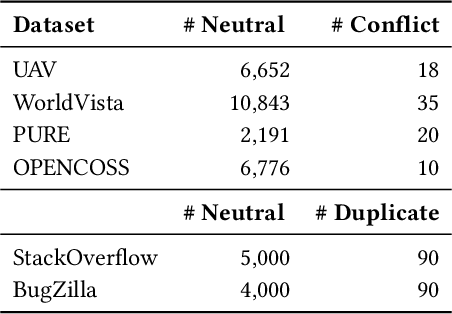
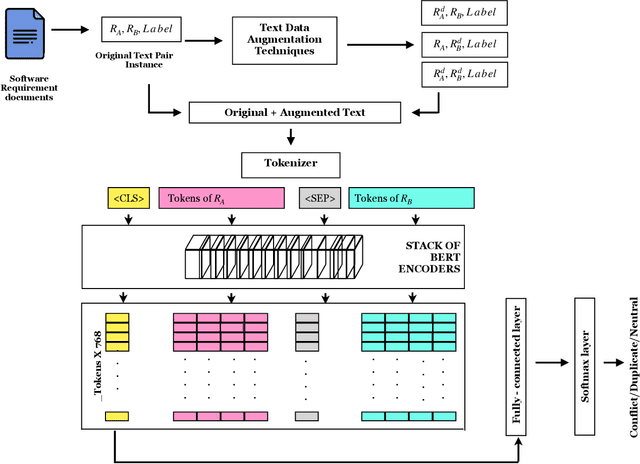

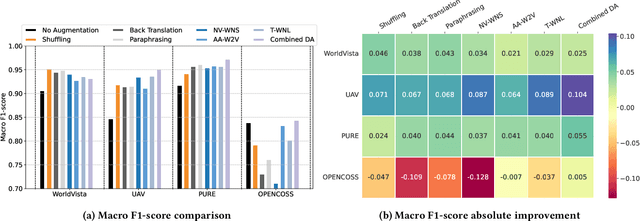
This paper explores the use of text data augmentation techniques to enhance conflict and duplicate detection in software engineering tasks through sentence pair classification. The study adapts generic augmentation techniques such as shuffling, back translation, and paraphrasing and proposes new data augmentation techniques such as Noun-Verb Substitution, target-lemma replacement and Actor-Action Substitution for software requirement texts. A comprehensive empirical analysis is conducted on six software text datasets to identify conflicts and duplicates among sentence pairs. The results demonstrate that data augmentation techniques have a significant impact on the performance of all software pair text datasets. On the other hand, in cases where the datasets are relatively balanced, the use of augmentation techniques may result in a negative effect on the classification performance.
ADPTriage: Approximate Dynamic Programming for Bug Triage
Nov 02, 2022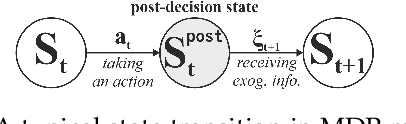
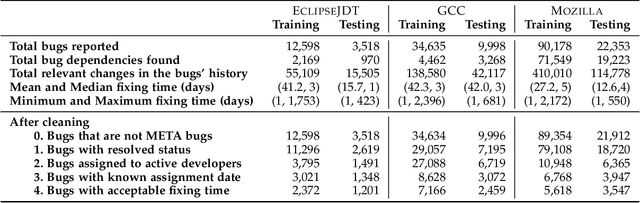
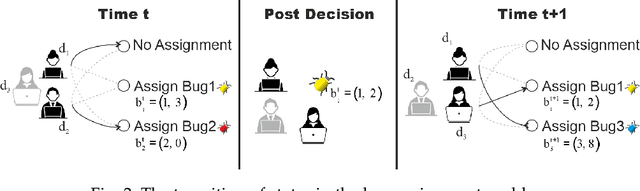
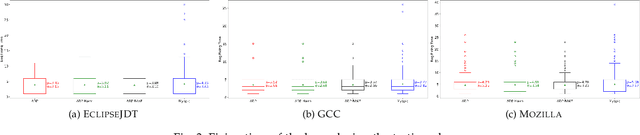
Bug triaging is a critical task in any software development project. It entails triagers going over a list of open bugs, deciding whether each is required to be addressed, and, if so, which developer should fix it. However, the manual bug assignment in issue tracking systems (ITS) offers only a limited solution and might easily fail when triagers must handle a large number of bug reports. During the automated assignment, there are multiple sources of uncertainties in the ITS, which should be addressed meticulously. In this study, we develop a Markov decision process (MDP) model for an online bug triage task. In addition to an optimization-based myopic technique, we provide an ADP-based bug triage solution, called ADPTriage, which has the ability to reflect the downstream uncertainty in the bug arrivals and developers' timetables. Specifically, without placing any limits on the underlying stochastic process, this technique enables real-time decision-making on bug assignments while taking into consideration developers' expertise, bug type, and bug fixing time. Our result shows a significant improvement over the myopic approach in terms of assignment accuracy and fixing time. We also demonstrate the empirical convergence of the model and conduct sensitivity analysis with various model parameters. Accordingly, this work constitutes a significant step forward in addressing the uncertainty in bug triage solutions
Time Series Clustering for Grouping Products Based on Price and Sales Patterns
Apr 18, 2022
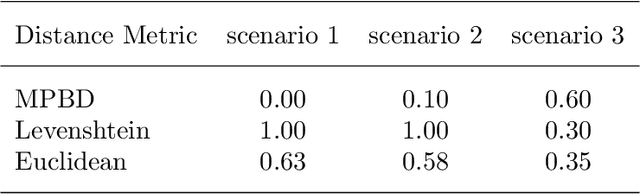
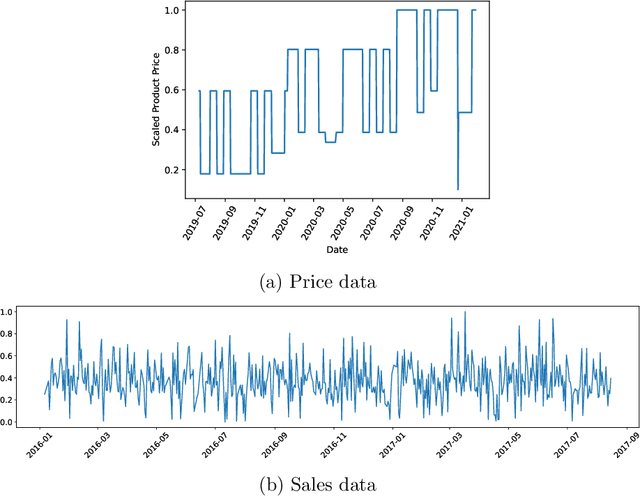
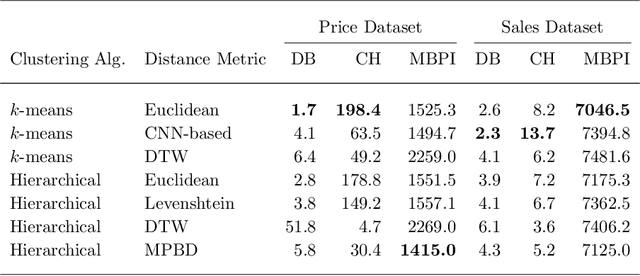
Developing technology and changing lifestyles have made online grocery delivery applications an indispensable part of urban life. Since the beginning of the COVID-19 pandemic, the demand for such applications has dramatically increased, creating new competitors that disrupt the market. An increasing level of competition might prompt companies to frequently restructure their marketing and product pricing strategies. Therefore, identifying the change patterns in product prices and sales volumes would provide a competitive advantage for the companies in the marketplace. In this paper, we investigate alternative clustering methodologies to group the products based on the price patterns and sales volumes. We propose a novel distance metric that takes into account how product prices and sales move together rather than calculating the distance using numerical values. We compare our approach with traditional clustering algorithms, which typically rely on generic distance metrics such as Euclidean distance, and image clustering approaches that aim to group data by capturing its visual patterns. We evaluate the performances of different clustering algorithms using our custom evaluation metric as well as Calinski Harabasz and Davies Bouldin indices, which are commonly used internal validity metrics. We conduct our numerical study using a propriety price dataset from an online food and grocery delivery company, and the publicly available Favorita sales dataset. We find that our proposed clustering approach and image clustering both perform well for finding the products with similar price and sales patterns within large datasets.
Text Classification for Predicting Multi-level Product Categories
Sep 02, 2021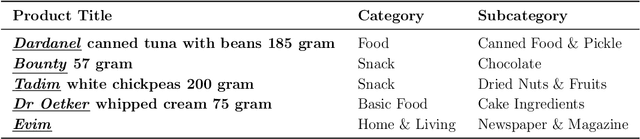
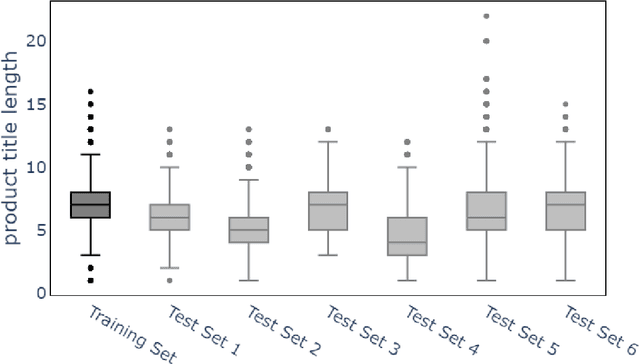
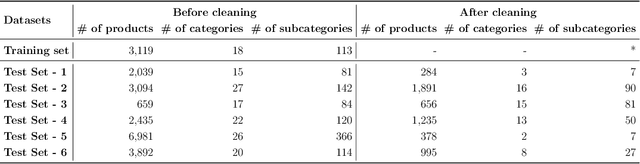
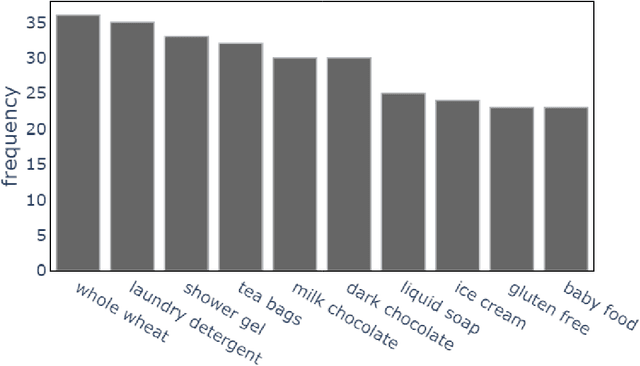
In an online shopping platform, a detailed classification of the products facilitates user navigation. It also helps online retailers keep track of the price fluctuations in a certain industry or special discounts on a specific product category. Moreover, an automated classification system may help to pinpoint incorrect or subjective categories suggested by an operator. In this study, we focus on product title classification of the grocery products. We perform a comprehensive comparison of six different text classification models to establish a strong baseline for this task, which involves testing both traditional and recent machine learning methods. In our experiments, we investigate the generalizability of the trained models to the products of other online retailers, the dynamic masking of infeasible subcategories for pretrained language models, and the benefits of incorporating product titles in multiple languages. Our numerical results indicate that dynamic masking of subcategories is effective in improving prediction accuracy. In addition, we observe that using bilingual product titles is generally beneficial, and neural network-based models perform significantly better than SVM and XGBoost models. Lastly, we investigate the reasons for the misclassified products and propose future research directions to further enhance the prediction models.
DABT: A Dependency-aware Bug Triaging Method
Apr 26, 2021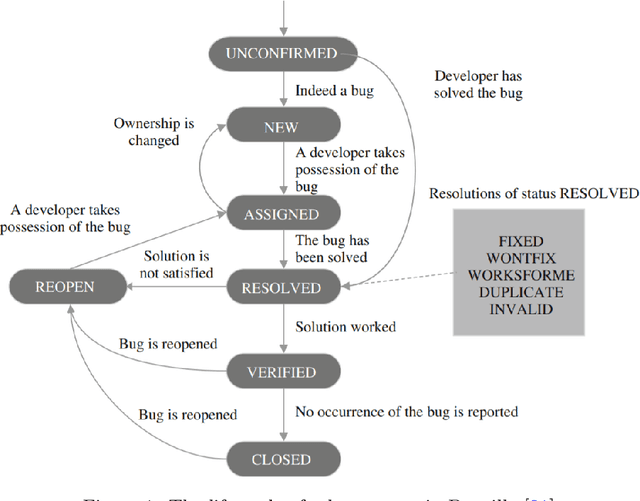
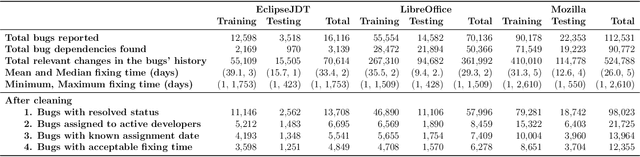
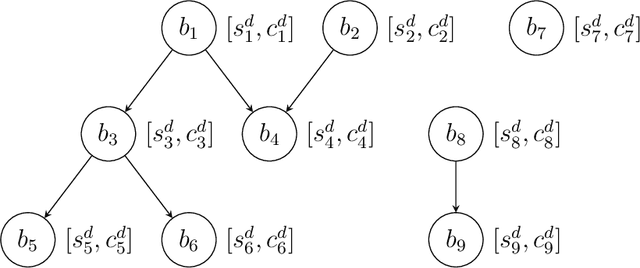
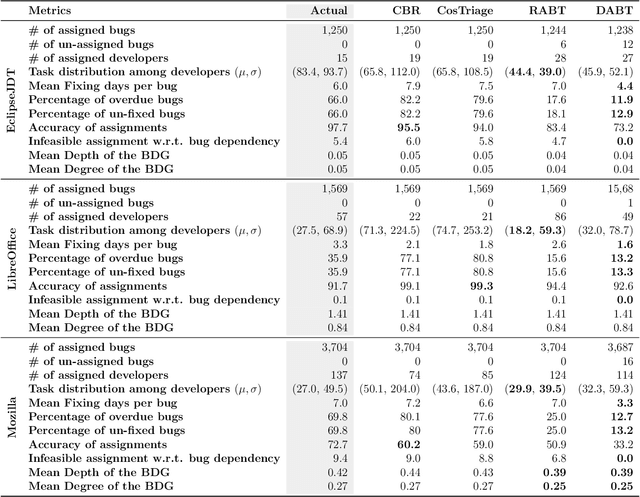
In software engineering practice, fixing a bug promptly reduces the associated costs. On the other hand, the manual bug fixing process can be time-consuming, cumbersome, and error-prone. In this work, we introduce a bug triaging method, called Dependency-aware Bug Triaging (DABT), which leverages natural language processing and integer programming to assign bugs to appropriate developers. Unlike previous works that mainly focus on one aspect of the bug reports, DABT considers the textual information, cost associated with each bug, and dependency among them. Therefore, this comprehensive formulation covers the most important aspect of the previous works while considering the blocking effect of the bugs. We report the performance of the algorithm on three open-source software systems, i.e., EclipseJDT, LibreOffice, and Mozilla. Our result shows that DABT is able to reduce the number of overdue bugs up to 12\%. It also decreases the average fixing time of the bugs by half. Moreover, it reduces the complexity of the bug dependency graph by prioritizing blocking bugs.
Predicting the Number of Reported Bugs in a Software Repository
Apr 24, 2021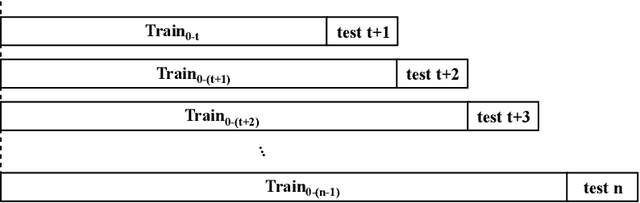
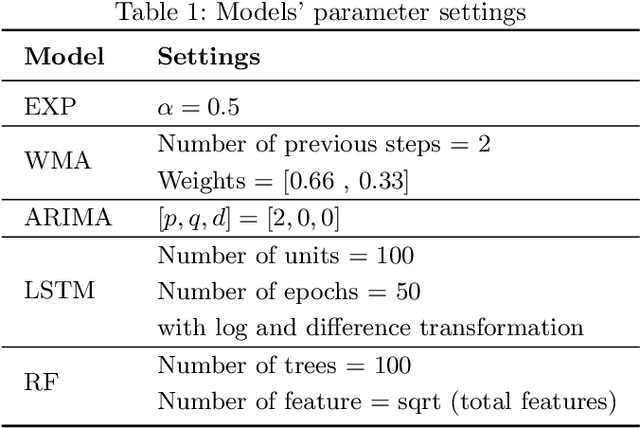
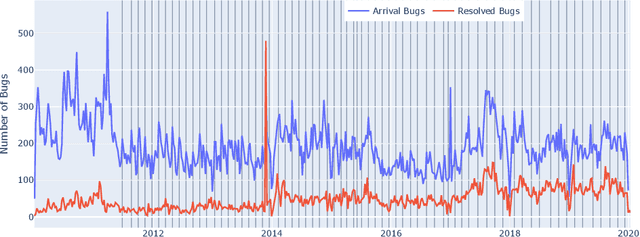
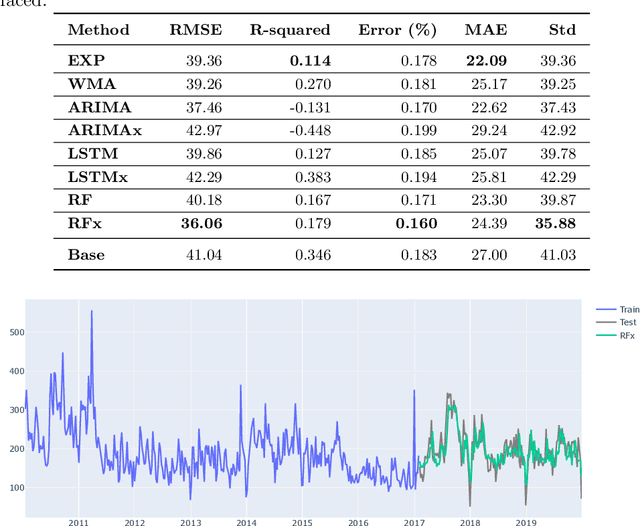
The bug growth pattern prediction is a complicated, unrelieved task, which needs considerable attention. Advance knowledge of the likely number of bugs discovered in the software system helps software developers in designating sufficient resources at a convenient time. The developers may also use such information to take necessary actions to increase the quality of the system and in turn customer satisfaction. In this study, we examine eight different time series forecasting models, including Long Short Term Memory Neural Networks (LSTM), auto-regressive integrated moving average (ARIMA), and Random Forest Regressor. Further, we assess the impact of exogenous variables such as software release dates by incorporating those into the prediction models. We analyze the quality of long-term prediction for each model based on different performance metrics. The assessment is conducted on Mozilla, which is a large open-source software application. The dataset is originally mined from Bugzilla and contains the number of bugs for the project between Jan 2010 and Dec 2019. Our numerical analysis provides insights on evaluating the trends in a bug repository. We observe that LSTM is effective when considering long-run predictions whereas Random Forest Regressor enriched by exogenous variables performs better for predicting the number of bugs in the short term.
A Deep Reinforcement Learning Approach for the Meal Delivery Problem
Apr 24, 2021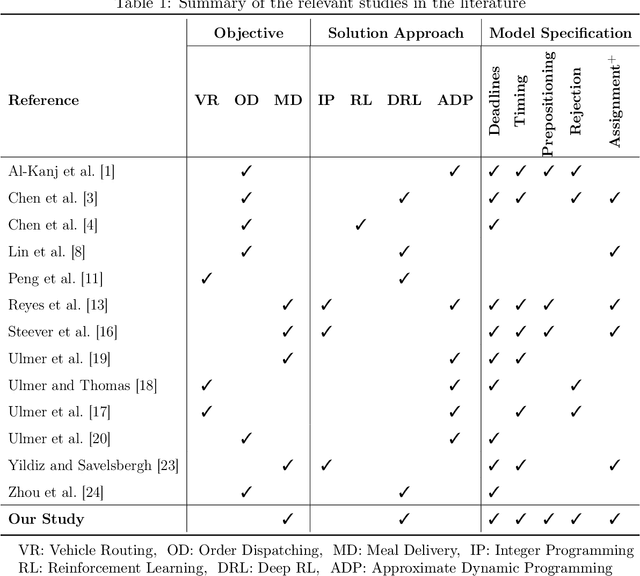
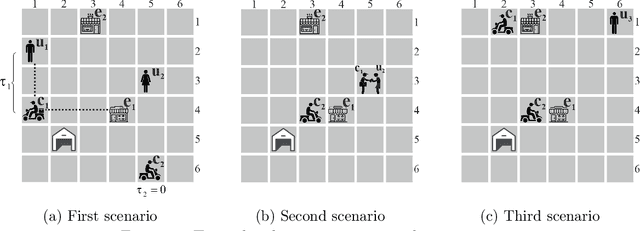
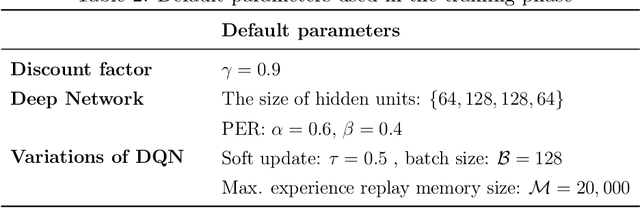
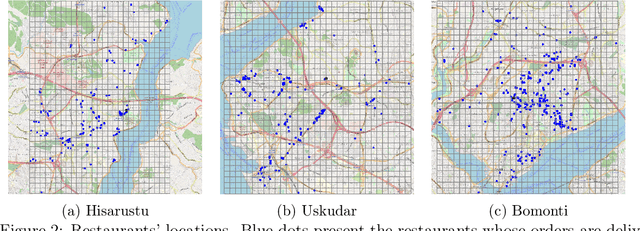
We consider a meal delivery service fulfilling dynamic customer requests given a set of couriers over the course of a day. A courier's duty is to pick-up an order from a restaurant and deliver it to a customer. We model this service as a Markov decision process and use deep reinforcement learning as the solution approach. We experiment with the resulting policies on synthetic and real-world datasets and compare those with the baseline policies. We also examine the courier utilization for different numbers of couriers. In our analysis, we specifically focus on the impact of the limited available resources in the meal delivery problem. Furthermore, we investigate the effect of intelligent order rejection and re-positioning of the couriers. Our numerical experiments show that, by incorporating the geographical locations of the restaurants, customers, and the depot, our model significantly improves the overall service quality as characterized by the expected total reward and the delivery times. Our results present valuable insights on both the courier assignment process and the optimal number of couriers for different order frequencies on a given day. The proposed model also shows a robust performance under a variety of scenarios for real-world implementation.
Does chronology matter in JIT defect prediction? A Partial Replication Study
Mar 05, 2021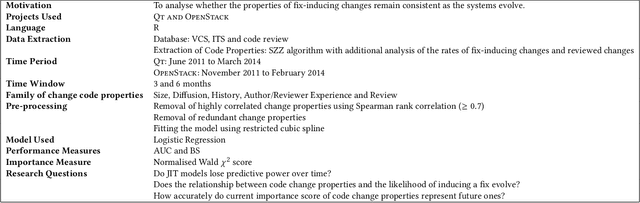
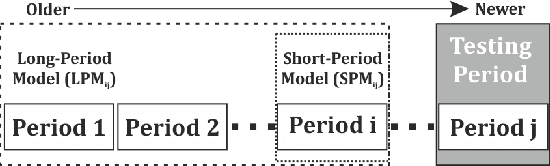
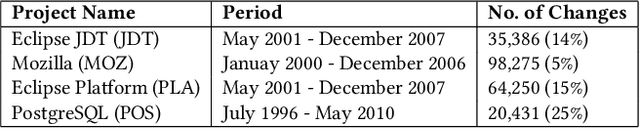
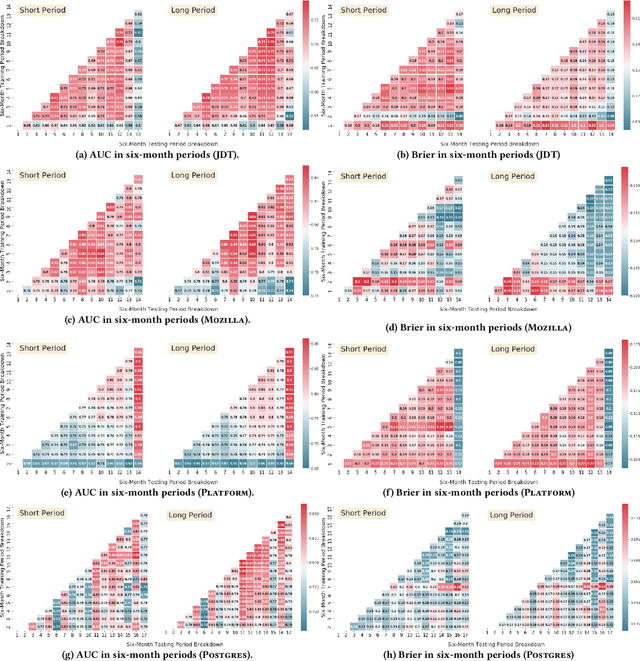
Just-In-Time (JIT) models detect the fix-inducing changes (or defect-inducing changes). These models are designed based on the assumption that past code change properties are similar to future ones. However, as the system evolves, the expertise of developers and/or the complexity of the system also changes. In this work, we aim to investigate the effect of code change properties on JIT models over time. We also study the impact of using recent data as well as all available data on the performance of JIT models. Further, we analyze the effect of weighted sampling on the performance of fix-inducing properties of JIT models. For this purpose, we used datasets from Eclipse JDT, Mozilla, Eclipse Platform, and PostgreSQL. We used five families of change-code properties such as size, diffusion, history, experience, and purpose. We used Random Forest to train and test the JIT model and Brier Score and the area under the ROC curve for performance measurement. Our paper suggests that the predictive power of JIT models does not change over time. Furthermore, we observed that the chronology of data in JIT defect prediction models can be discarded by considering all the available data. On the other hand, the importance score of families of code change properties is found to oscillate over time. To mitigate the impact of the evolution of code change properties, it is recommended to use a weighted sampling approach in which more emphasis is placed upon the changes occurring closer to the current time. Moreover, since properties such as "Expertise of the Developer" and "Size" evolve with time, the models obtained from old data may exhibit different characteristics compared to those employing the newer dataset. Hence, practitioners should constantly retrain JIT models to include fresh data.
Moving from Cross-Project Defect Prediction to Heterogeneous Defect Prediction: A Partial Replication Study
Mar 05, 2021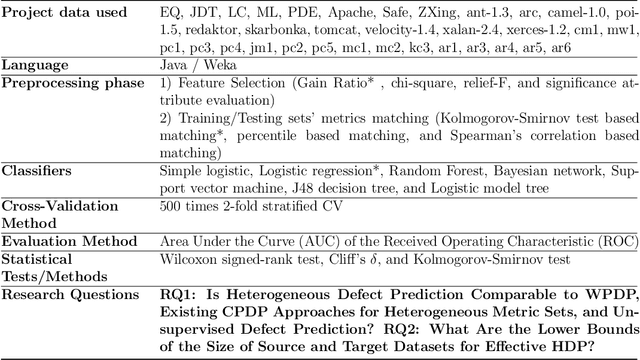
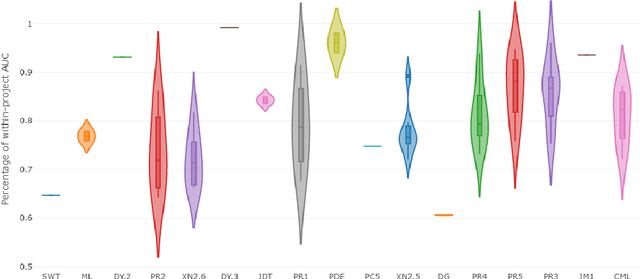
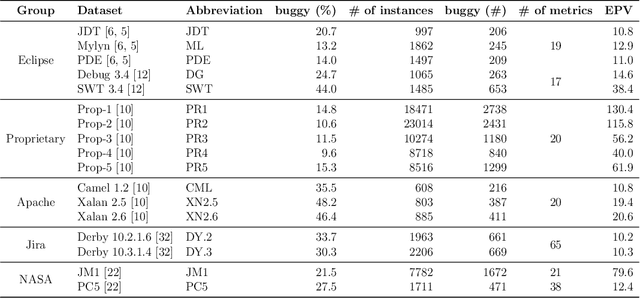
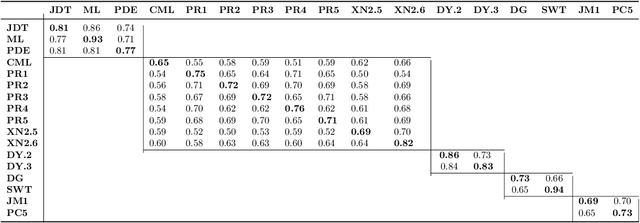
Software defect prediction heavily relies on the metrics collected from software projects. Earlier studies often used machine learning techniques to build, validate, and improve bug prediction models using either a set of metrics collected within a project or across different projects. However, techniques applied and conclusions derived by those models are restricted by how identical those metrics are. Knowledge coming from those models will not be extensible to a target project if no sufficient overlapping metrics have been collected in the source projects. To explore the feasibility of transferring knowledge across projects without common labeled metrics, we systematically integrated Heterogeneous Defect Prediction (HDP) by replicating and validating the obtained results. Our main goal is to extend prior research and explore the feasibility of HDP and finally to compare its performance with that of its predecessor, Cross-Project Defect Prediction. We construct an HDP model on different publicly available datasets. Moreover, we propose a new ensemble voting approach in the HDP context to utilize the predictive power of multiple available datasets. The result of our experiment is comparable to that of the original study. However, we also explored the feasibility of HDP in real cases. Our results shed light on the infeasibility of many cases for the HDP algorithm due to its sensitivity to the parameter selection. In general, our analysis gives a deep insight into why and how to perform transfer learning from one domain to another, and in particular, provides a set of guidelines to help researchers and practitioners to disseminate knowledge to the defect prediction domain.