 Add to Chrome
 Add to Firefox
 Add to Edge
Uncertainty-Aware Deepfake Detection via Multi-View Structural Learning
Jul 30, 2026
Security-critical biometric and forensic applications require accurate predictions and reliable confidence estimates, particularly under distribution shift. This challenge is especially acute for deepfake detection, where foundation-model-based detectors often exhibit overconfident predictions on out-of-distribution manipulations, which limits their suitability for operational deployment. We propose an uncertainty-aware deepfake detection framework that identifies manipulations through inconsistencies across complementary evidence sources. The framework integrates three streams: a visual stream based on an adapted CLIP encoder, a semantic stream that models consistency among facial attributes through differentiable constraints, and a structural stream that captures class-dependent dependency patterns between semantic and forensic features. To effectively combine these signals, we introduce Inter-Branch Disagreement Calibration (IBDC), a disagreement-aware uncertainty modeling mechanism that links predictive uncertainty to conflicts among evidence streams. Extensive cross-dataset experiments using FaceForensics++ as the training source demonstrate that the proposed framework achieves state-of-the-art generalization across multiple out-of-distribution benchmarks while consistently improving calibration and selective prediction performance. These results show that combining complementary evidence with disagreement-aware uncertainty provides a robust foundation for trustworthy and well-calibrated deepfake detection under distribution shift.

Do Transformations Reveal the Truth? Generative Residual Learning for Generalized AI-Generated Image Detection
Jul 09, 2026The rapid advancement of generative AI has enabled the creation of highly realistic deepfake media, posing significant threats, including misinformation, digital identity theft, fraud, and manipulation of public opinion. AI-generated image (AIGI) detection is reliably challenging due to the diversity of generative methods and the subtle artifacts they leave behind. In this work, we propose GenRes, a novel framework for generative residual learning via a neural tensor network, which models fine-grained relational features between original and transformed samples to enhance generalization. To address scenarios involving multiple generative transformations, we introduce GenRes++, which employs a learnable attention mechanism to aggregate relational features across multiple transformed samples and enables the model to focus on the most informative cues. Both models leverage PE-Core as a feature extractor, providing generalized and semantically rich embeddings that improve cross-domain performance and enable the detection of AIGI generated by unseen methods. Comprehensive experiments on multiple benchmark datasets demonstrate that the proposed GenRes++ approach outperforms existing methods.
Dual-Branch Gated Fusion for Open-Set Audio Deepfake Source Tracing
Jun 08, 2026Attributing a synthetic utterance to its originating system remains an open challenge: closed-set models fail to reject unseen synthesizers and produce overconfident predictions. To address this, we propose a dual-branch gated fusion framework that pairs XLSR-53 with CORES, a 66-dimensional descriptor that, unlike prior Linear Filter Bank (LFB)-only work, spans cepstral, oscillatory, rhythmic, energy, and spectral dimensions to capture complementary synthesis artifacts. Our analysis shows XLSR-53 remains discriminative in-domain (ID) while CORES generalizes stably under distribution shift (OOD), yet their naive concatenation fails due to SSL representational imbalance. To resolve this, an input-conditioned gate adaptively weights each branch under joint training with cross-entropy, an energy margin loss for ID/OOD separation, and a gate diversity term. On the MLAAD benchmark, our system achieves 97.6\% ID accuracy, 4.9\% EERc, and an 83.5\% relative FPR95 reduction over the Interspeech 2025 baseline.
Instruction-Tuned LLMs for Parsing and Mining Unstructured Logs on Leadership HPC Systems
Apr 06, 2026Leadership-class HPC systems generate massive volumes of heterogeneous, largely unstructured system logs. Because these logs originate from diverse software, hardware, and runtime layers, they exhibit inconsistent formats, making structure extraction and pattern discovery extremely challenging. Therefore, robust log parsing and mining is critical to transform this raw telemetry into actionable insights that reveal operational patterns, diagnose anomalies, and enable reliable, efficient, and scalable system analysis. Recent advances in large language models (LLMs) offer a promising new direction for automated log understanding in leadership-class HPC environments. To capitalize on this opportunity, we present a domain-adapted, instruction-following, LLM-driven framework that leverages chain-of-thought (CoT) reasoning to parse and structure HPC logs with high fidelity. Our approach combines domain-specific log-template data with instruction-tuned examples to fine-tune an 8B-parameter LLaMA model tailored for HPC log analysis. We develop a hybrid fine-tuning methodology that adapts a general-purpose LLM to domain-specific log data, enabling privacy-preserving, locally deployable, fast, and energy-efficient log-mining approach. We conduct experiments on a diverse set of log datasets from the LogHub repository. The evaluation confirms that our approach achieves parsing accuracy on par with significantly larger models, such as LLaMA 70B and Anthropic's Claude. We further validate the practical utility of our fine-tuned LLM model by parsing over 600 million production logs from the Frontier supercomputer over a four-week window, uncovering critical patterns in temporal dynamics, node-level anomalies, and workload-error log correlations.
TRACE: Training-Free Partial Audio Deepfake Detection via Embedding Trajectory Analysis of Speech Foundation Models
Apr 01, 2026Partial audio deepfakes, where synthesized segments are spliced into genuine recordings, are particularly deceptive because most of the audio remains authentic. Existing detectors are supervised: they require frame-level annotations, overfit to specific synthesis pipelines, and must be retrained as new generative models emerge. We argue that this supervision is unnecessary. We hypothesize that speech foundation models implicitly encode a forensic signal: genuine speech forms smooth, slowly varying embedding trajectories, while splice boundaries introduce abrupt disruptions in frame-level transitions. Building on this, we propose TRACE (Training-free Representation-based Audio Countermeasure via Embedding dynamics), a training-free framework that detects partial audio deepfakes by analyzing the first-order dynamics of frozen speech foundation model representations without any training, labeled data, or architectural modification. We evaluate TRACE on four benchmarks that span two languages using six speech foundation models. In PartialSpoof, TRACE achieves 8.08% EER, competitive with fine-tuned supervised baselines. In LlamaPartialSpoof, the most challenging benchmark featuring LLM-driven commercial synthesis, TRACE surpasses a supervised baseline outright (24.12% vs. 24.49% EER) without any target-domain data. These results show that temporal dynamics in speech foundation models provide an effective, generalize signal for training-free audio forensics.
Adversarial Attacks on Audio Deepfake Detection: A Benchmark and Comparative Study
Sep 08, 2025The widespread use of generative AI has shown remarkable success in producing highly realistic deepfakes, posing a serious threat to various voice biometric applications, including speaker verification, voice biometrics, audio conferencing, and criminal investigations. To counteract this, several state-of-the-art (SoTA) audio deepfake detection (ADD) methods have been proposed to identify generative AI signatures to distinguish between real and deepfake audio. However, the effectiveness of these methods is severely undermined by anti-forensic (AF) attacks that conceal generative signatures. These AF attacks span a wide range of techniques, including statistical modifications (e.g., pitch shifting, filtering, noise addition, and quantization) and optimization-based attacks (e.g., FGSM, PGD, C \& W, and DeepFool). In this paper, we investigate the SoTA ADD methods and provide a comparative analysis to highlight their effectiveness in exposing deepfake signatures, as well as their vulnerabilities under adversarial conditions. We conducted an extensive evaluation of ADD methods on five deepfake benchmark datasets using two categories: raw and spectrogram-based approaches. This comparative analysis enables a deeper understanding of the strengths and limitations of SoTA ADD methods against diverse AF attacks. It does not only highlight vulnerabilities of ADD methods, but also informs the design of more robust and generalized detectors for real-world voice biometrics. It will further guide future research in developing adaptive defense strategies that can effectively counter evolving AF techniques.
SHIELD: A Secure and Highly Enhanced Integrated Learning for Robust Deepfake Detection against Adversarial Attacks
Jul 17, 2025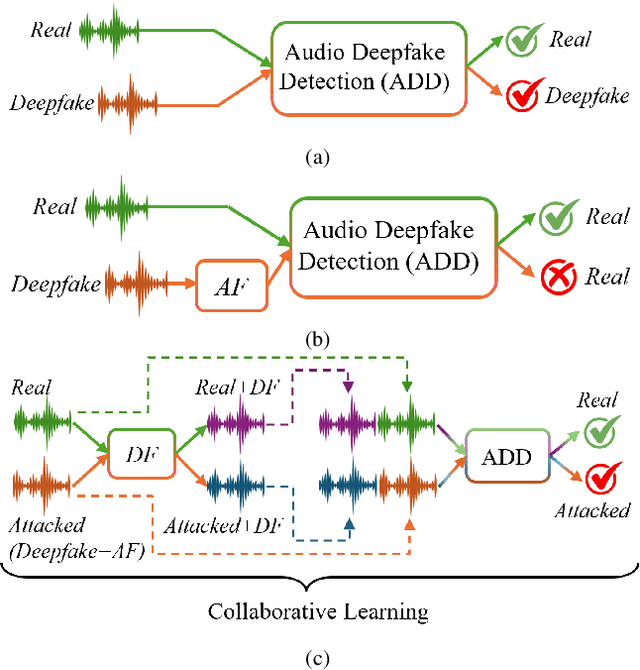
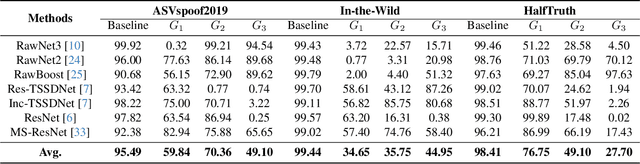
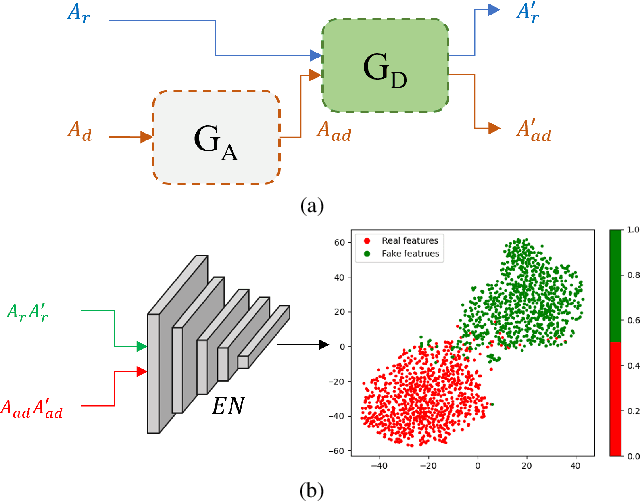
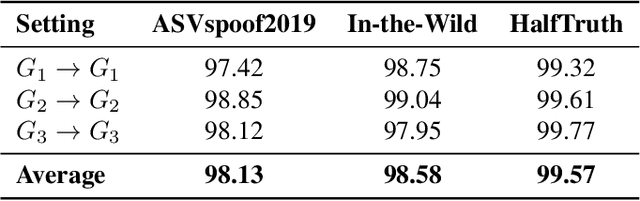
Audio plays a crucial role in applications like speaker verification, voice-enabled smart devices, and audio conferencing. However, audio manipulations, such as deepfakes, pose significant risks by enabling the spread of misinformation. Our empirical analysis reveals that existing methods for detecting deepfake audio are often vulnerable to anti-forensic (AF) attacks, particularly those attacked using generative adversarial networks. In this article, we propose a novel collaborative learning method called SHIELD to defend against generative AF attacks. To expose AF signatures, we integrate an auxiliary generative model, called the defense (DF) generative model, which facilitates collaborative learning by combining input and output. Furthermore, we design a triplet model to capture correlations for real and AF attacked audios with real-generated and attacked-generated audios using auxiliary generative models. The proposed SHIELD strengthens the defense against generative AF attacks and achieves robust performance across various generative models. The proposed AF significantly reduces the average detection accuracy from 95.49% to 59.77% for ASVspoof2019, from 99.44% to 38.45% for In-the-Wild, and from 98.41% to 51.18% for HalfTruth for three different generative models. The proposed SHIELD mechanism is robust against AF attacks and achieves an average accuracy of 98.13%, 98.58%, and 99.57% in match, and 98.78%, 98.62%, and 98.85% in mismatch settings for the ASVspoof2019, In-the-Wild, and HalfTruth datasets, respectively.
Transferable Adversarial Attacks on Audio Deepfake Detection
Jan 21, 2025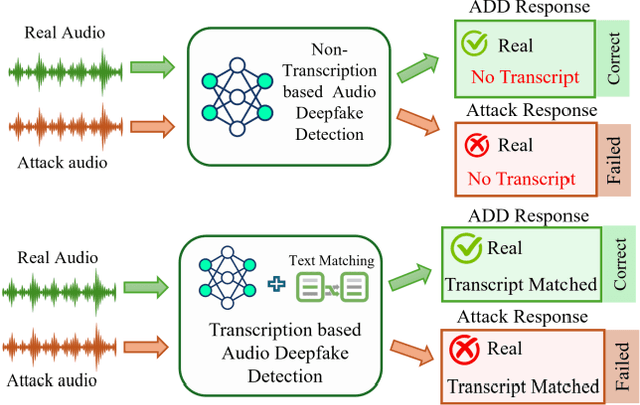
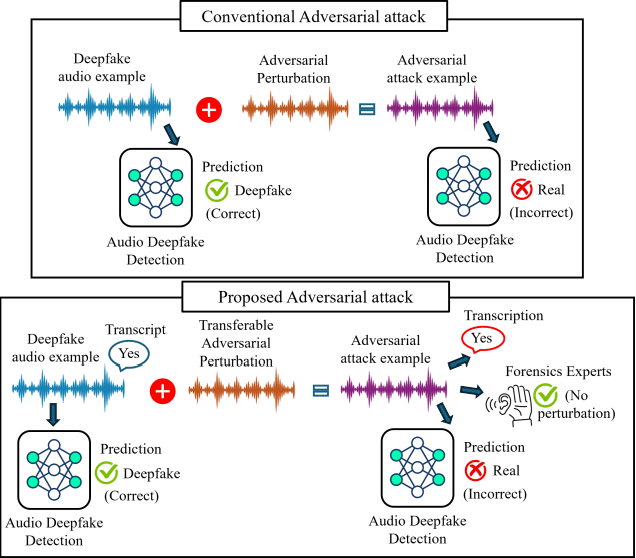
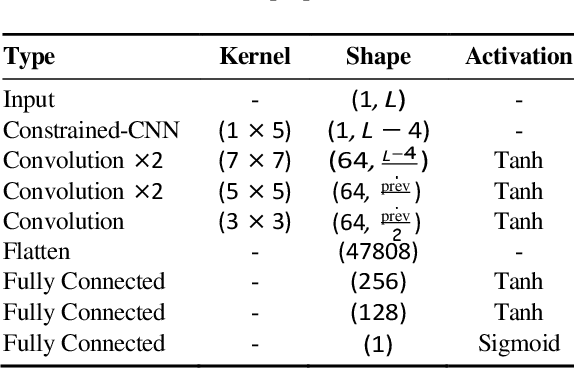
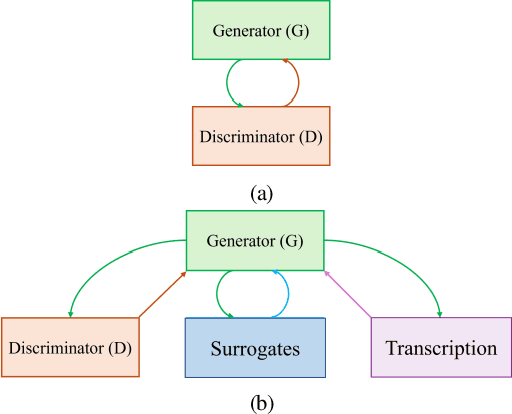
Audio deepfakes pose significant threats, including impersonation, fraud, and reputation damage. To address these risks, audio deepfake detection (ADD) techniques have been developed, demonstrating success on benchmarks like ASVspoof2019. However, their resilience against transferable adversarial attacks remains largely unexplored. In this paper, we introduce a transferable GAN-based adversarial attack framework to evaluate the effectiveness of state-of-the-art (SOTA) ADD systems. By leveraging an ensemble of surrogate ADD models and a discriminator, the proposed approach generates transferable adversarial attacks that better reflect real-world scenarios. Unlike previous methods, the proposed framework incorporates a self-supervised audio model to ensure transcription and perceptual integrity, resulting in high-quality adversarial attacks. Experimental results on benchmark dataset reveal that SOTA ADD systems exhibit significant vulnerabilities, with accuracies dropping from 98% to 26%, 92% to 54%, and 94% to 84% in white-box, gray-box, and black-box scenarios, respectively. When tested in other data sets, performance drops of 91% to 46%, and 94% to 67% were observed against the In-the-Wild and WaveFake data sets, respectively. These results highlight the significant vulnerabilities of existing ADD systems and emphasize the need to enhance their robustness against advanced adversarial threats to ensure security and reliability.
Securing Social Media Against Deepfakes using Identity, Behavioral, and Geometric Signatures
Dec 07, 2024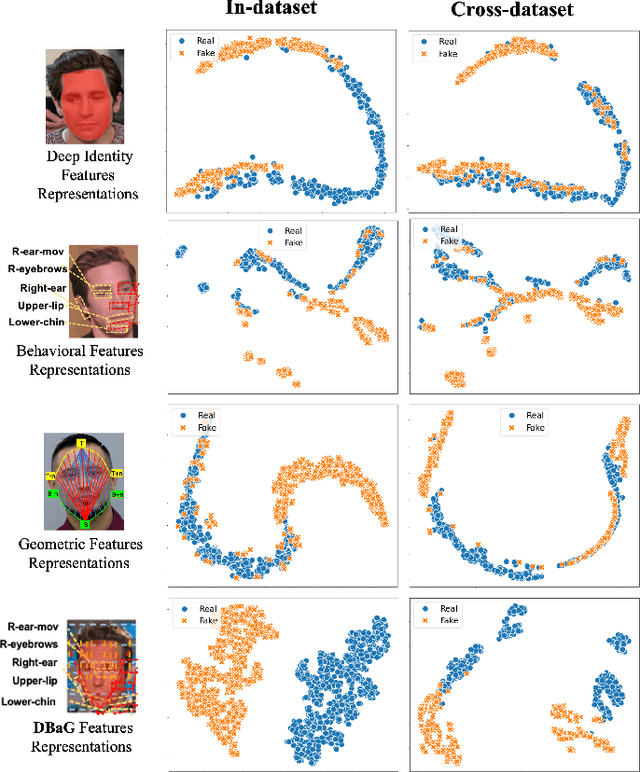

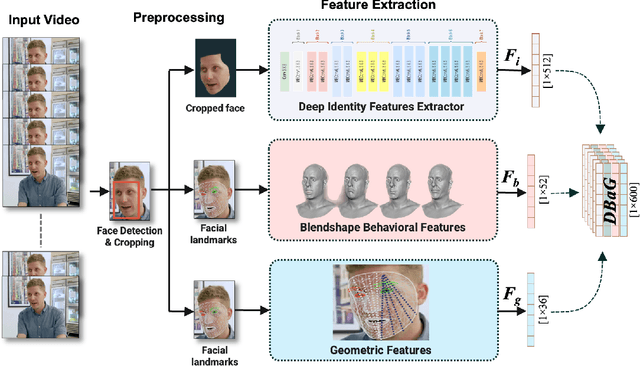

Trust in social media is a growing concern due to its ability to influence significant societal changes. However, this space is increasingly compromised by various types of deepfake multimedia, which undermine the authenticity of shared content. Although substantial efforts have been made to address the challenge of deepfake content, existing detection techniques face a major limitation in generalization: they tend to perform well only on specific types of deepfakes they were trained on.This dependency on recognizing specific deepfake artifacts makes current methods vulnerable when applied to unseen or varied deepfakes, thereby compromising their performance in real-world applications such as social media platforms. To address the generalizability of deepfake detection, there is a need for a holistic approach that can capture a broader range of facial attributes and manipulations beyond isolated artifacts. To address this, we propose a novel deepfake detection framework featuring an effective feature descriptor that integrates Deep identity, Behavioral, and Geometric (DBaG) signatures, along with a classifier named DBaGNet. Specifically, the DBaGNet classifier utilizes the extracted DBaG signatures, leveraging a triplet loss objective to enhance generalized representation learning for improved classification. Specifically, the DBaGNet classifier utilizes the extracted DBaG signatures and applies a triplet loss objective to enhance generalized representation learning for improved classification. To test the effectiveness and generalizability of our proposed approach, we conduct extensive experiments using six benchmark deepfake datasets: WLDR, CelebDF, DFDC, FaceForensics++, DFD, and NVFAIR. Specifically, to ensure the effectiveness of our approach, we perform cross-dataset evaluations, and the results demonstrate significant performance gains over several state-of-the-art methods.
Parallel Stacked Aggregated Network for Voice Authentication in IoT-Enabled Smart Devices
Nov 29, 2024
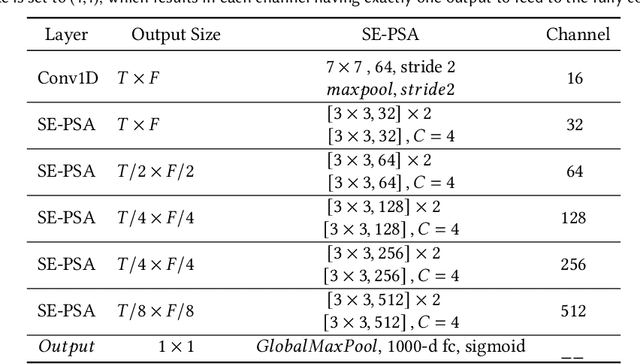

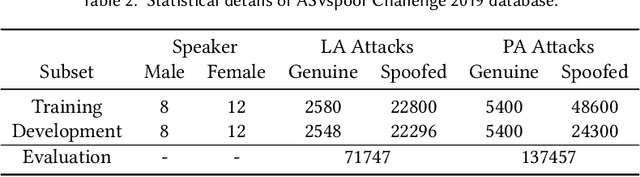
Voice authentication on IoT-enabled smart devices has gained prominence in recent years due to increasing concerns over user privacy and security. The current authentication systems are vulnerable to different voice-spoofing attacks (e.g., replay, voice cloning, and audio deepfakes) that mimic legitimate voices to deceive authentication systems and enable fraudulent activities (e.g., impersonation, unauthorized access, financial fraud, etc.). Existing solutions are often designed to tackle a single type of attack, leading to compromised performance against unseen attacks. On the other hand, existing unified voice anti-spoofing solutions, not designed specifically for IoT, possess complex architectures and thus cannot be deployed on IoT-enabled smart devices. Additionally, most of these unified solutions exhibit significant performance issues, including higher equal error rates or lower accuracy for specific attacks. To overcome these issues, we present the parallel stacked aggregation network (PSA-Net), a lightweight framework designed as an anti-spoofing defense system for voice-controlled smart IoT devices. The PSA-Net processes raw audios directly and eliminates the need for dataset-dependent handcrafted features or pre-computed spectrograms. Furthermore, PSA-Net employs a split-transform-aggregate approach, which involves the segmentation of utterances, the extraction of intrinsic differentiable embeddings through convolutions, and the aggregation of them to distinguish legitimate from spoofed audios. In contrast to existing deep Resnet-oriented solutions, we incorporate cardinality as an additional dimension in our network, which enhances the PSA-Net ability to generalize across diverse attacks. The results show that the PSA-Net achieves more consistent performance for different attacks that exist in current anti-spoofing solutions.