 Add to Chrome
 Add to Firefox
 Add to Edge
Abstractive Red-Teaming of Language Model Character
Feb 12, 2026
We want language model assistants to conform to a character specification, which asserts how the model should act across diverse user interactions. While models typically follow these character specifications, they can occasionally violate them in large-scale deployments. In this work, we aim to identify types of queries that are likely to produce such character violations at deployment, using much less than deployment-level compute. To do this, we introduce abstractive red-teaming, where we search for natural-language query categories, e.g. "The query is in Chinese. The query asks about family roles," that routinely elicit violations. These categories abstract over the many possible variants of a query which could appear in the wild. We introduce two algorithms for efficient category search against a character-trait-specific reward model: one based on reinforcement learning on a category generator LLM, and another which leverages a strong LLM to iteratively synthesize categories from high-scoring queries. Across a 12-principle character specification and 7 target models, we find that our algorithms consistently outperform baselines, and generate qualitatively interesting categories; for example, queries which ask Llama-3.1-8B-Instruct to predict the future lead to responses saying that AI will dominate humanity, and queries that ask GPT-4.1-Mini for essential prison survival items lead to enthusiastic recommendation of illegal weapons. Overall, we believe our results represent an important step towards realistic pre-deployment auditing of language model character.

Eliciting Harmful Capabilities by Fine-Tuning On Safeguarded Outputs
Jan 20, 2026Model developers implement safeguards in frontier models to prevent misuse, for example, by employing classifiers to filter dangerous outputs. In this work, we demonstrate that even robustly safeguarded models can be used to elicit harmful capabilities in open-source models through elicitation attacks. Our elicitation attacks consist of three stages: (i) constructing prompts in adjacent domains to a target harmful task that do not request dangerous information; (ii) obtaining responses to these prompts from safeguarded frontier models; (iii) fine-tuning open-source models on these prompt-output pairs. Since the requested prompts cannot be used to directly cause harm, they are not refused by frontier model safeguards. We evaluate these elicitation attacks within the domain of hazardous chemical synthesis and processing, and demonstrate that our attacks recover approximately 40% of the capability gap between the base open-source model and an unrestricted frontier model. We then show that the efficacy of elicitation attacks scales with the capability of the frontier model and the amount of generated fine-tuning data. Our work demonstrates the challenge of mitigating ecosystem level risks with output-level safeguards.
The Local Interaction Basis: Identifying Computationally-Relevant and Sparsely Interacting Features in Neural Networks
May 17, 2024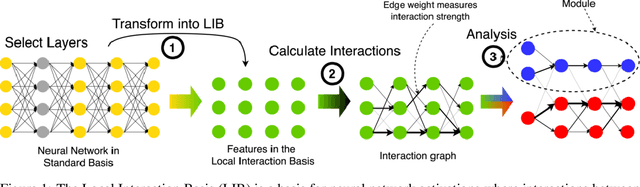
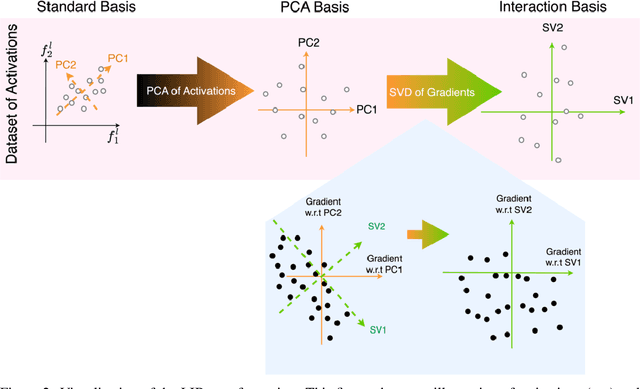
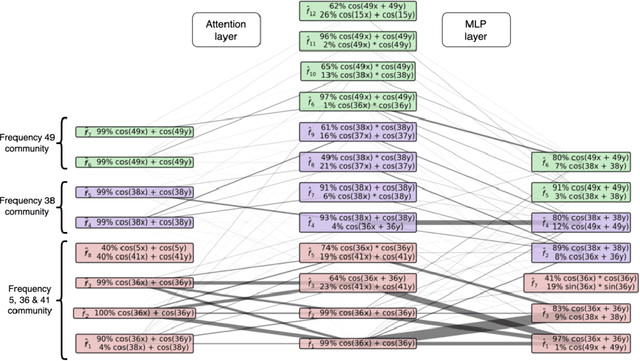
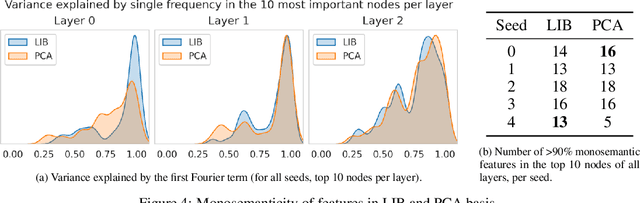
Mechanistic interpretability aims to understand the behavior of neural networks by reverse-engineering their internal computations. However, current methods struggle to find clear interpretations of neural network activations because a decomposition of activations into computational features is missing. Individual neurons or model components do not cleanly correspond to distinct features or functions. We present a novel interpretability method that aims to overcome this limitation by transforming the activations of the network into a new basis - the Local Interaction Basis (LIB). LIB aims to identify computational features by removing irrelevant activations and interactions. Our method drops irrelevant activation directions and aligns the basis with the singular vectors of the Jacobian matrix between adjacent layers. It also scales features based on their importance for downstream computation, producing an interaction graph that shows all computationally-relevant features and interactions in a model. We evaluate the effectiveness of LIB on modular addition and CIFAR-10 models, finding that it identifies more computationally-relevant features that interact more sparsely, compared to principal component analysis. However, LIB does not yield substantial improvements in interpretability or interaction sparsity when applied to language models. We conclude that LIB is a promising theory-driven approach for analyzing neural networks, but in its current form is not applicable to large language models.