 Add to Chrome
 Add to Firefox
 Add to Edge
Compliant Sphere Lattice Contact: Distributed Contact Modeling for Sphere-Based Robot Representations
Jul 31, 2026
Contact planning in robotics requires models that are both computationally efficient and physically accurate. Sphere-based robot representations satisfy the first requirement by enabling fast collision checking and differentiable geometry, but sacrifice physical accuracy by relying on point contact which cannot capture contact patch area, pressure distributions, rotational stiffness, or frictional moments. We introduce Compliant Sphere Lattice Contact (CSLC), a distributed contact model that operates natively on sphere representations by modeling the robot interface as a compliant lattice of surface spheres connected through anchor and lateral springs. When pressed against an object, the lattice deforms to produce a spatially distributed contact patch that improves the physical accuracy of sphere-based contact. We validate CSLC across two independent solvers and show preliminary results demonstrating contact patch formation and improved grasp stability.

Physically Accurate Rigid-Body Dynamics in Particle-Based Simulation
Mar 15, 2026Robotics demands simulation that can reason about the diversity of real-world physical interactions, from rigid to deformable objects and fluids. Current simulators address this by stitching together multiple subsolvers for different material types, resulting in a compositional architecture that complicates physical reasoning. Particle-based simulators offer a compelling alternative, representing all materials through a single unified formulation that enables seamless cross-material interactions. Among particle-based simulators, position-based dynamics (PBD) is a popular solver known for its computational efficiency and visual plausibility. However, its lack of physical accuracy has limited its adoption in robotics. To leverage the benefits of particle-based solvers while meeting the physical fidelity demands of robotics, we introduce PBD-R, a revised PBD formulation that enforces physically accurate rigid-body dynamics through a novel momentum-conservation constraint and a modified velocity update. Additionally, we introduce a solver-agnostic benchmark with analytical solutions to evaluate physical accuracy. Using this benchmark, we show that PBD-R significantly outperforms PBD and achieves competitive accuracy with MuJoCo while requiring less computation.
Exploring How Non-Prehensile Manipulation Expands Capability in Robots Experiencing Multi-Joint Failure
Oct 01, 2024


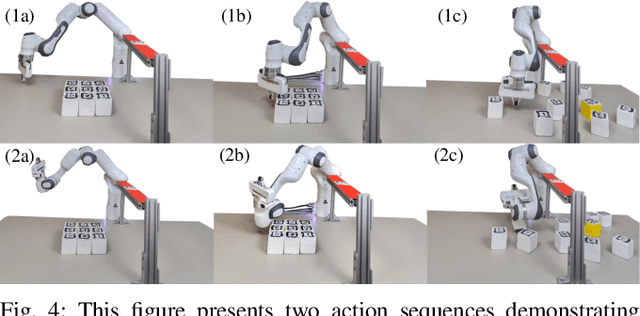
This work explores non-prehensile manipulation (NPM) and whole-body interaction as strategies for enabling robotic manipulators to conduct manipulation tasks despite experiencing locked multi-joint (LMJ) failures. LMJs are critical system faults where two or more joints become inoperable; they impose constraints on the robot's configuration and control spaces, consequently limiting the capability and reach of a prehensile-only approach. This approach involves three components: i) modeling the failure-constrained workspace of the robot, ii) generating a kinodynamic map of NPM actions within this workspace, and iii) a manipulation action planner that uses a sim-in-the-loop approach to select the best actions to take from the kinodynamic map. The experimental evaluation shows that our approach can increase the failure-constrained reachable area in LMJ cases by 79%. Further, it demonstrates the ability to complete real-world manipulation with up to 88.9% success when the end-effector is unusable and up to 100% success when it is usable.
Clutter-Aware Spill-Free Liquid Transport via Learned Dynamics
Aug 01, 2024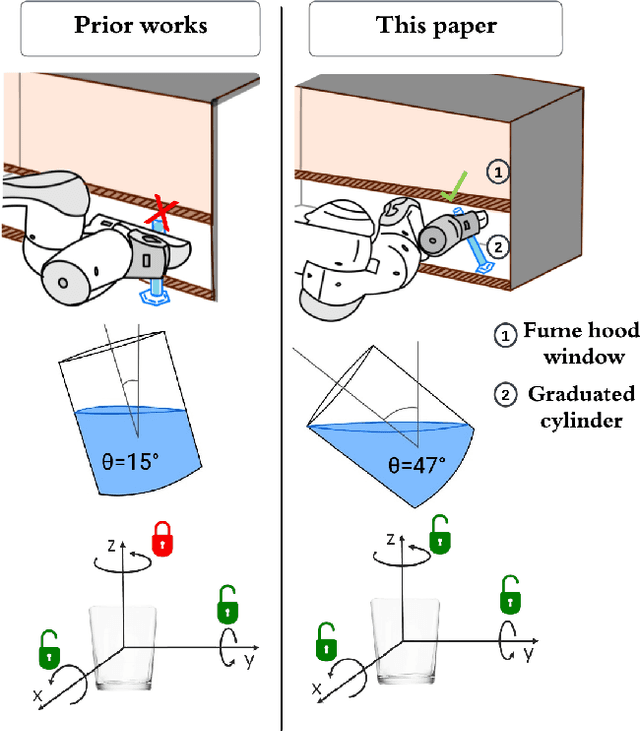
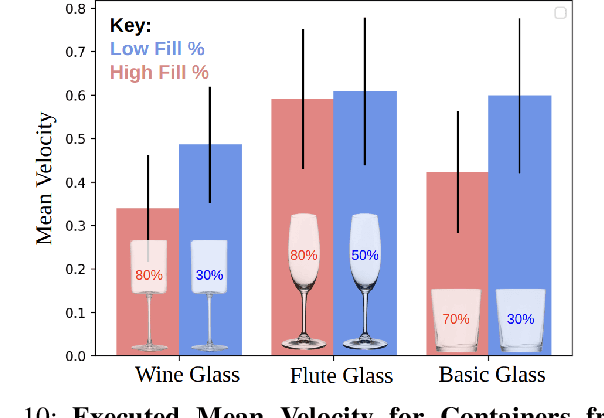

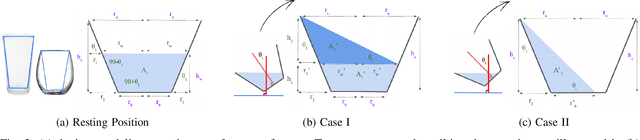
In this work, we present a novel algorithm to perform spill-free handling of open-top liquid-filled containers that operates in cluttered environments. By allowing liquid-filled containers to be tilted at higher angles and enabling motion along all axes of end-effector orientation, our work extends the reachable space and enhances maneuverability around obstacles, broadening the range of feasible scenarios. Our key contributions include: i) generating spill-free paths through the use of RRT* with an informed sampler that leverages container properties to avoid spill-inducing states (such as an upside-down container), ii) parameterizing the resulting path to generate spill-free trajectories through the implementation of a time parameterization algorithm, coupled with a transformer-based machine-learning model capable of classifying trajectories as spill-free or not. We validate our approach in real-world, obstacle-rich task settings using containers of various shapes and fill levels and demonstrate an extended solution space that is at least 3x larger than an existing approach.