 Add to Chrome
 Add to Firefox
 Add to Edge
ConRTF: Edge-Constrained Boundary Distribution Refinement for Realtime TransFormer Table Structure Recognition
Jul 01, 2026
Table Structure Recognition (TSR) aims to recover the row and column layout of tables from document images, a key step in document understanding pipelines. Accurate TSR depends on precise boundary localization: small errors in row or column boundaries can propagate into incorrect cell assignments and structural inconsistencies. Yet detection-based approaches treat table elements as generic objects, ignoring a fundamental property of table layout: rows and columns play structurally distinct roles and their boundaries carry unequal importance. We propose an Edge-constrained Fine-grained Localization loss (EFL) that formalizes this structural asymmetry by encoding table-specific geometric priors into the training objective: row-like elements are supervised with emphasis on their horizontal boundaries, while column-like elements prioritize vertical boundaries. Implemented within a real-time detector with distribution-based boundary refinement (D-FINE), EFL operates during training only and guides boundary refinement toward structurally meaningful adjustments with no change to the inference pipeline. The proposed approach, ConRTF, is also data-efficient, maintaining robust accuracy with as few as 2k--3k annotated tables. Experiments on PubTables-1M and two private datasets show consistent improvements over the optimized baseline and several real-time detectors including RT-DETRv2 and YOLOv10-11, with gains of up to +1.6 GriTS points at equal inference speed.

Active Learning for Cascaded Object Detection: Balancing Coverage and Uncertainty in Table Extraction Pipelines
Jul 01, 2026Table extraction from business documents relies on a cascaded pipeline where Table Detection (TD) first localizes tables and Table Structure Recognition (TSR) then recovers their internal layout. Building task-specific training sets for this pipeline is costly, particularly for TSR which requires fine-grained structural annotations. Active learning (AL) can reduce this annotation burden, yet most AL strategies are designed for single-model tasks and do not account for inter-stage dependencies in cascaded architectures. In this work, we present the first adaptation of Uncertainty Herding (UHerding), a hybrid coverage-uncertainty sampling method originally proposed for image classification, to cascaded object detection pipelines. We propose two pipeline-aware extensions that exploit the TD-to-TSR dependency: RankFusion adds dual-manifold coverage over both detection and structure representation spaces, while CAPA further incorporates stage-dependent gating and per-task uncertainty calibration. Extensive experiments across two public (PubTables-1M and FinTabNet) and two private table extraction datasets, with various annotation budgets (from 71 to 500 documents) show that UHerding generalizes well to table extraction, outperforming each baseline. Among pipeline-aware variants, RankFusion achieves higher expected gains but at the cost of greater variance, while CAPA emerges as the most consistent strategy, outperforming standard UHerding on three out of four datasets.
QUEST: Quality-aware Semi-supervised Table Extraction for Business Documents
Jun 17, 2025Automating table extraction (TE) from business documents is critical for industrial workflows but remains challenging due to sparse annotations and error-prone multi-stage pipelines. While semi-supervised learning (SSL) can leverage unlabeled data, existing methods rely on confidence scores that poorly reflect extraction quality. We propose QUEST, a Quality-aware Semi-supervised Table extraction framework designed for business documents. QUEST introduces a novel quality assessment model that evaluates structural and contextual features of extracted tables, trained to predict F1 scores instead of relying on confidence metrics. This quality-aware approach guides pseudo-label selection during iterative SSL training, while diversity measures (DPP, Vendi score, IntDiv) mitigate confirmation bias. Experiments on a proprietary business dataset (1000 annotated + 10000 unannotated documents) show QUEST improves F1 from 64% to 74% and reduces empty predictions by 45% (from 12% to 6.5%). On the DocILE benchmark (600 annotated + 20000 unannotated documents), QUEST achieves a 50% F1 score (up from 42%) and reduces empty predictions by 19% (from 27% to 22%). The framework's interpretable quality assessments and robustness to annotation scarcity make it particularly suited for business documents, where structural consistency and data completeness are paramount.
RAPTOR: Refined Approach for Product Table Object Recognition
Feb 24, 2025Extracting tables from documents is a critical task across various industries, especially on business documents like invoices and reports. Existing systems based on DEtection TRansformer (DETR) such as TAble TRansformer (TATR), offer solutions for Table Detection (TD) and Table Structure Recognition (TSR) but face challenges with diverse table formats and common errors like incorrect area detection and overlapping columns. This research introduces RAPTOR, a modular post-processing system designed to enhance state-of-the-art models for improved table extraction, particularly for product tables. RAPTOR addresses recurrent TD and TSR issues, improving both precision and structural predictions. For TD, we use DETR (trained on ICDAR 2019) and TATR (trained on PubTables-1M and FinTabNet), while TSR only relies on TATR. A Genetic Algorithm is incorporated to optimize RAPTOR's module parameters, using a private dataset of product tables to align with industrial needs. We evaluate our method on two private datasets of product tables, the public DOCILE dataset (which contains tables similar to our target product tables), and the ICDAR 2013 and ICDAR 2019 datasets. The results demonstrate that while our approach excels at product tables, it also maintains reasonable performance across diverse table formats. An ablation study further validates the contribution of each module in our system.
CHIC: Corporate Document for Visual question Answering
May 01, 2023The massive use of digital documents due to the substantial trend of paperless initiatives confronted some companies to find ways to process thousands of documents per day automatically. To achieve this, they use automatic information retrieval (IR) allowing them to extract useful information from large datasets quickly. In order to have effective IR methods, it is first necessary to have an adequate dataset. Although companies have enough data to take into account their needs, there is also a need for a public database to compare contributions between state-of-the-art methods. Public data on the document exists as DocVQA[2] and XFUND [10], but these do not fully satisfy the needs of companies. XFUND contains only form documents while the company uses several types of documents (i.e. structured documents like forms but also semi-structured as invoices, and unstructured as emails). Compared to XFUND, DocVQA has several types of documents but only 4.5% of them are corporate documents (i.e. invoice, purchase order, etc). All of this 4.5% of documents do not meet the diversity of documents required by the company. We propose CHIC a visual question-answering public dataset. This dataset contains different types of corporate documents and the information extracted from these documents meet the right expectations of companies.
Evaluation of Neural Network Classification Systems on Document Stream
Jul 15, 2020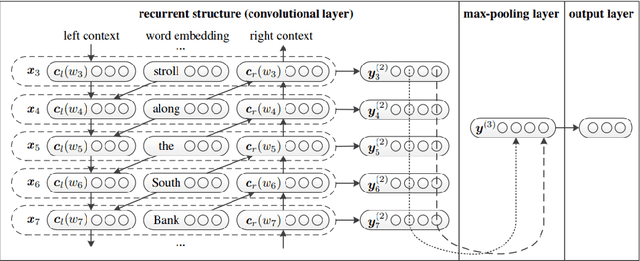
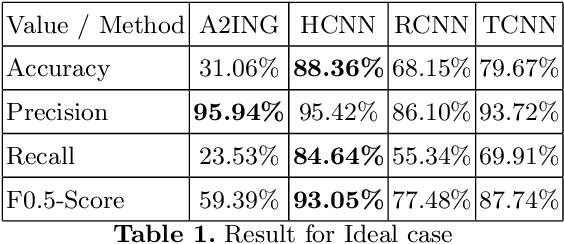
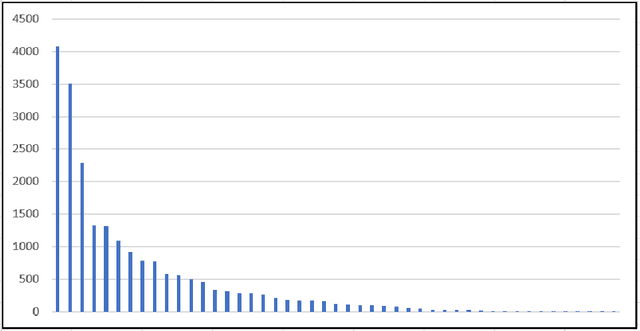
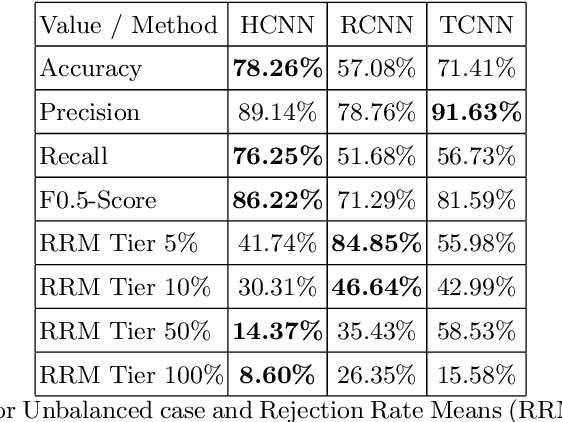
One major drawback of state of the art Neural Networks (NN)-based approaches for document classification purposes is the large number of training samples required to obtain an efficient classification. The minimum required number is around one thousand annotated documents for each class. In many cases it is very difficult, if not impossible, to gather this number of samples in real industrial processes. In this paper, we analyse the efficiency of NN-based document classification systems in a sub-optimal training case, based on the situation of a company document stream. We evaluated three different approaches, one based on image content and two on textual content. The evaluation was divided into four parts: a reference case, to assess the performance of the system in the lab; two cases that each simulate a specific difficulty linked to document stream processing; and a realistic case that combined all of these difficulties. The realistic case highlighted the fact that there is a significant drop in the efficiency of NN-Based document classification systems. Although they remain efficient for well represented classes (with an over-fitting of the system for those classes), it is impossible for them to handle appropriately less well represented classes. NN-Based document classification systems need to be adapted to resolve these two problems before they can be considered for use in a company document stream.