 Add to Chrome
 Add to Firefox
 Add to Edge
Iterative Deployment Improves Planning Skills in LLMs
Dec 31, 2025
We show that iterative deployment of large language models (LLMs), each fine-tuned on data carefully curated by users from the previous models' deployment, can significantly change the properties of the resultant models. By testing this mechanism on various planning domains, we observe substantial improvements in planning skills, with later models displaying emergent generalization by discovering much longer plans than the initial models. We then provide theoretical analysis showing that iterative deployment effectively implements reinforcement learning (RL) training in the outer-loop (i.e. not as part of intentional model training), with an implicit reward function. The connection to RL has two important implications: first, for the field of AI safety, as the reward function entailed by repeated deployment is not defined explicitly, and could have unexpected implications to the properties of future model deployments. Second, the mechanism highlighted here can be viewed as an alternative training regime to explicit RL, relying on data curation rather than explicit rewards.

The 2025 Planning Performance of Frontier Large Language Models
Nov 12, 2025The capacity of Large Language Models (LLMs) for reasoning remains an active area of research, with the capabilities of frontier models continually advancing. We provide an updated evaluation of the end-to-end planning performance of three frontier LLMs as of 2025, where models are prompted to generate a plan from PDDL domain and task descriptions. We evaluate DeepSeek R1, Gemini 2.5 Pro, GPT-5 and as reference the planner LAMA on a subset of domains from the most recent Learning Track of the International Planning Competition. Our results show that on standard PDDL domains, the performance of GPT-5 in terms of solved tasks is competitive with LAMA. When the PDDL domains and tasks are obfuscated to test for pure reasoning, the performance of all LLMs degrades, though less severely than previously reported for other models. These results show substantial improvements over prior generations of LLMs, reducing the performance gap to planners on a challenging benchmark.
Classical Planning with LLM-Generated Heuristics: Challenging the State of the Art with Python Code
Mar 24, 2025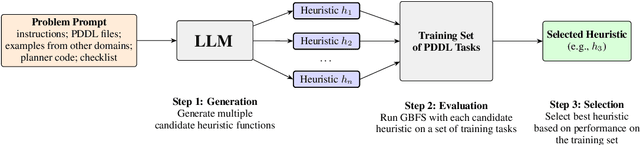
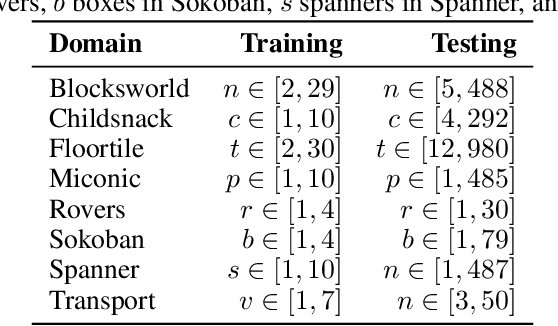
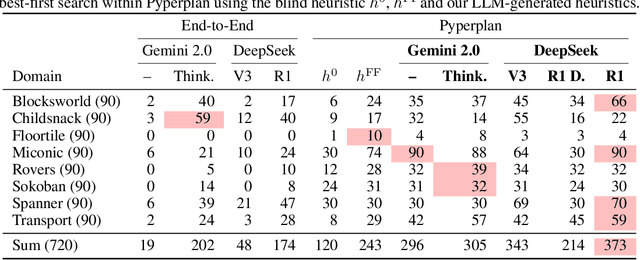
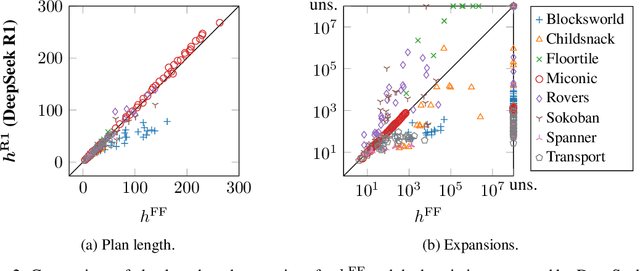
In recent years, large language models (LLMs) have shown remarkable capabilities in various artificial intelligence problems. However, they fail to plan reliably, even when prompted with a detailed definition of the planning task. Attempts to improve their planning capabilities, such as chain-of-thought prompting, fine-tuning, and explicit "reasoning" still yield incorrect plans and usually fail to generalize to larger tasks. In this paper, we show how to use LLMs to generate correct plans, even for out-of-distribution tasks of increasing size. For a given planning domain, we ask an LLM to generate several domain-dependent heuristic functions in the form of Python code, evaluate them on a set of training tasks within a greedy best-first search, and choose the strongest one. The resulting LLM-generated heuristics solve many more unseen test tasks than state-of-the-art domain-independent heuristics for classical planning. They are even competitive with the strongest learning algorithm for domain-dependent planning. These findings are especially remarkable given that our proof-of-concept implementation is based on an unoptimized Python planner and the baselines all build upon highly optimized C++ code. In some domains, the LLM-generated heuristics expand fewer states than the baselines, revealing that they are not only efficiently computable, but sometimes even more informative than the state-of-the-art heuristics. Overall, our results show that sampling a set of planning heuristic function programs can significantly improve the planning capabilities of LLMs.
Consolidating LAMA with Best-First Width Search
Apr 26, 2024One key decision for heuristic search algorithms is how to balance exploration and exploitation. In classical planning, novelty search has come out as the most successful approach in this respect. The idea is to favor states that contain previously unseen facts when searching for a plan. This is done by maintaining a record of the tuples of facts observed in previous states. Then the novelty of a state is the size of the smallest previously unseen tuple. The most successful version of novelty search is best-first width search (BFWS), which combines novelty measures with heuristic estimates. An orthogonal approach to balance exploration-exploitation is to use several open-lists. These open-lists are ordered using different heuristic estimates, which diversify the information used in the search. The search algorithm then alternates between these open-lists, trying to exploit these different estimates. This is the approach used by LAMA, a classical planner that, a decade after its release, is still considered state-of-the-art in agile planning. In this paper, we study how to combine LAMA and BFWS. We show that simply adding the strongest open-list used in BFWS to LAMA harms performance. However, we show that combining only parts of each planner leads to a new state-of-the-art agile planner.