 Add to Chrome
 Add to Firefox
 Add to Edge
A Reference-Free Score for Detecting Silent Reasoning Failures in Large Language Models
Jul 28, 2026
Mathematical chain of thought (CoT) evaluation is commonly reduced to whether the final answer matches a reference. This conflates producing a correct conclusion with producing a valid derivation an invalid chain can accidentally reach the right answer, while a valid calculation can be followed by a transcription error. We call this mismatch the reasoning answer consistency gap. This framework paper introduces the Reasoning Answer Faithfulness Score (RAFS), a reference free, instance level diagnostic of whether an emitted mathematical trace is locally credible, supports its answer, and is stable under resampling and targeted counterfactual interventions. RAFS combines step validity, reasoning to answer entailment and counterfactual sensitivity, answer consensus, and conditional reasoning stability. It evaluates transcript level agreement, not a models private computation and not factual correctness outside the tested mathematical setting. We retain a preregistered, results blind confirmatory study on GSM8K and MATH, with hypotheses, admissibility rules, calibration, and tests fixed before confirmatory outcomes are inspected. A separate feasibility pilot is specified to verify end to end execution and estimate interven tion coverage before that freeze numerical pilot claims are re ported only when trace level artifacts are available. We formalize four reasoning answer outcomes, justify the non compensatory aggregator, instantiate semantic trace distance, quantify compute and abstention tradeoffs, and define verifier independence and power analyses. RAFS is intended to complement mathematical answer accuracy with an auditable warning signal for silent reasoning failures and answer extraction errors

Learning Disentangled Representation in Object-Centric Models for Visual Dynamics Prediction via Transformers
Jul 03, 2024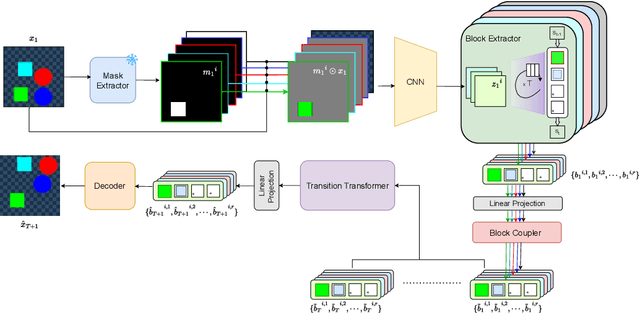
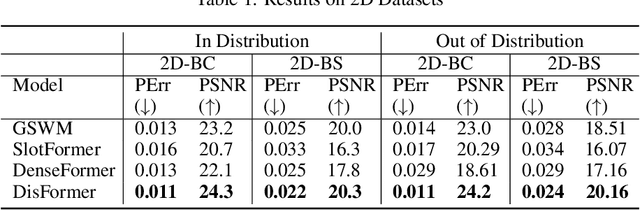
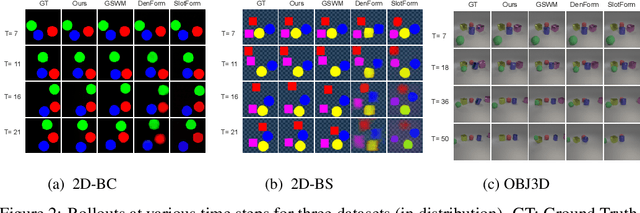
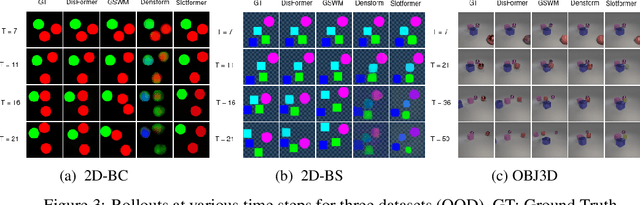
Recent work has shown that object-centric representations can greatly help improve the accuracy of learning dynamics while also bringing interpretability. In this work, we take this idea one step further, ask the following question: "can learning disentangled representation further improve the accuracy of visual dynamics prediction in object-centric models?" While there has been some attempt to learn such disentangled representations for the case of static images \citep{nsb}, to the best of our knowledge, ours is the first work which tries to do this in a general setting for video, without making any specific assumptions about the kind of attributes that an object might have. The key building block of our architecture is the notion of a {\em block}, where several blocks together constitute an object. Each block is represented as a linear combination of a given number of learnable concept vectors, which is iteratively refined during the learning process. The blocks in our model are discovered in an unsupervised manner, by attending over object masks, in a style similar to discovery of slots \citep{slot_attention}, for learning a dense object-centric representation. We employ self-attention via transformers over the discovered blocks to predict the next state resulting in discovery of visual dynamics. We perform a series of experiments on several benchmark 2-D, and 3-D datasets demonstrating that our architecture (1) can discover semantically meaningful blocks (2) help improve accuracy of dynamics prediction compared to SOTA object-centric models (3) perform significantly better in OOD setting where the specific attribute combinations are not seen earlier during training. Our experiments highlight the importance discovery of disentangled representation for visual dynamics prediction.