 Add to Chrome
 Add to Firefox
 Add to Edge
RCAP: Robust, Class-Aware, Probabilistic Dynamic Dataset Pruning
Jun 10, 2026
Dynamic data pruning techniques aim to reduce computational cost while minimizing information loss by periodically selecting representative subsets of input data during model training. However, existing methods often struggle to maintain strong worst-group accuracy, particularly at high pruning rates, across balanced and imbalanced datasets. To address this challenge, we propose RCAP, a Robust, Class-Aware, Probabilistic dynamic dataset pruning algorithm for classification tasks. RCAP applies a closed-form solution to estimate the fraction of samples to be included in the training subset for each individual class. This fraction is adaptively adjusted in every epoch using class-wise aggregated loss. Thereafter, it employs an adaptive sampling strategy that prioritizes samples having high loss for populating the class-wise subsets. We evaluate RCAP on six diverse datasets ranging from class-balanced to highly imbalanced using five distinct models across three training paradigms: training from scratch, transfer learning, and fine-tuning. Our approach consistently outperforms state-of-the-art dataset pruning methods, achieving superior worst-group accuracy at all pruning rates. Remarkably, with only $10\%$ data, RCAP delivers $>1\%$ improvement in performance on class-imbalanced datasets compared to full data training while providing an average $8.69\times$ speedup. The code can be accessed at https://github.com/atif-hassan/RCAP-dynamic-dataset-pruning
* Proceedings of the Forty-first Conference on Uncertainty in Artificial Intelligence (UAI 2025)

PPFS: Predictive Permutation Feature Selection
Oct 20, 2021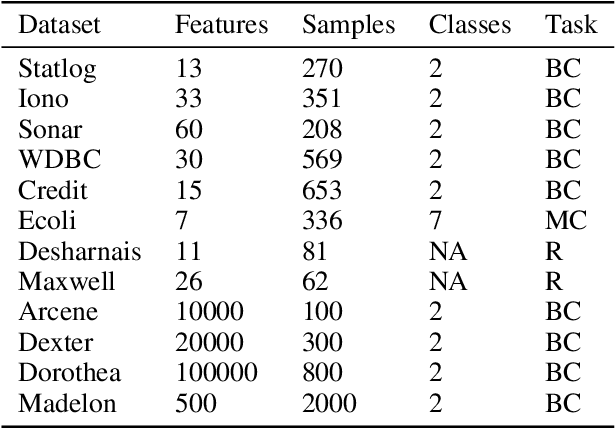
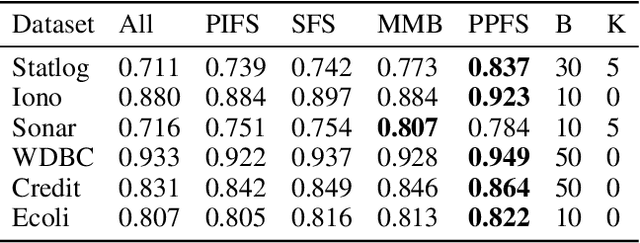
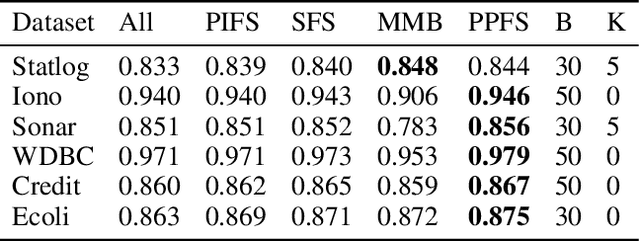
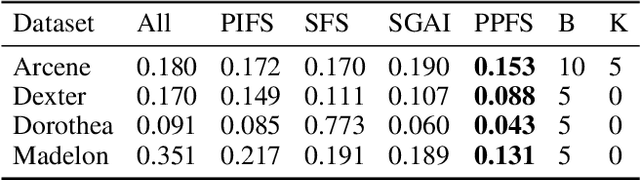
We propose Predictive Permutation Feature Selection (PPFS), a novel wrapper-based feature selection method based on the concept of Markov Blanket (MB). Unlike previous MB methods, PPFS is a universal feature selection technique as it can work for both classification as well as regression tasks on datasets containing categorical and/or continuous features. We propose Predictive Permutation Independence (PPI), a new Conditional Independence (CI) test, which enables PPFS to be categorised as a wrapper feature selection method. This is in contrast to current filter based MB feature selection techniques that are unable to harness the advancements in supervised algorithms such as Gradient Boosting Machines (GBM). The PPI test is based on the knockoff framework and utilizes supervised algorithms to measure the association between an individual or a set of features and the target variable. We also propose a novel MB aggregation step that addresses the issue of sample inefficiency. Empirical evaluations and comparisons on a large number of datasets demonstrate that PPFS outperforms state-of-the-art Markov blanket discovery algorithms as well as, well-known wrapper methods. We also provide a sketch of the proof of correctness of our method. Implementation of this work is available at \url{https://github.com/atif-hassan/PyImpetus}