 Add to Chrome
 Add to Firefox
 Add to Edge
ArcMark: Multi-bit LLM Watermark via Optimal Transport
Feb 06, 2026
Watermarking is an important tool for promoting the responsible use of language models (LMs). Existing watermarks insert a signal into generated tokens that either flags LM-generated text (zero-bit watermarking) or encodes more complex messages (multi-bit watermarking). Though a number of recent multi-bit watermarks insert several bits into text without perturbing average next-token predictions, they largely extend design principles from the zero-bit setting, such as encoding a single bit per token. Notably, the information-theoretic capacity of multi-bit watermarking -- the maximum number of bits per token that can be inserted and detected without changing average next-token predictions -- has remained unknown. We address this gap by deriving the first capacity characterization of multi-bit watermarks. Our results inform the design of ArcMark: a new watermark construction based on coding-theoretic principles that, under certain assumptions, achieves the capacity of the multi-bit watermark channel. In practice, ArcMark outperforms competing multi-bit watermarks in terms of bit rate per token and detection accuracy. Our work demonstrates that LM watermarking is fundamentally a channel coding problem, paving the way for principled coding-theoretic approaches to watermark design.

GeoClip: Geometry-Aware Clipping for Differentially Private SGD
Jun 06, 2025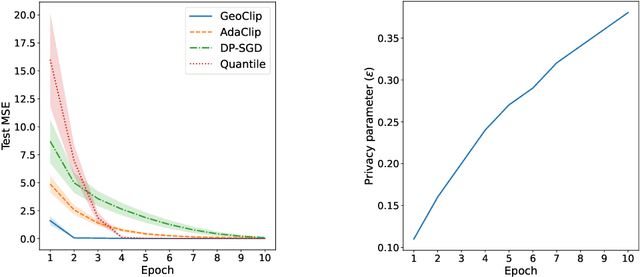
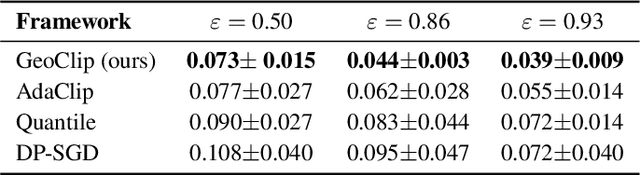
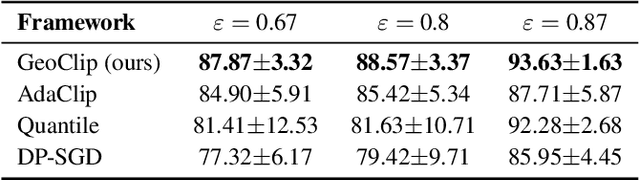
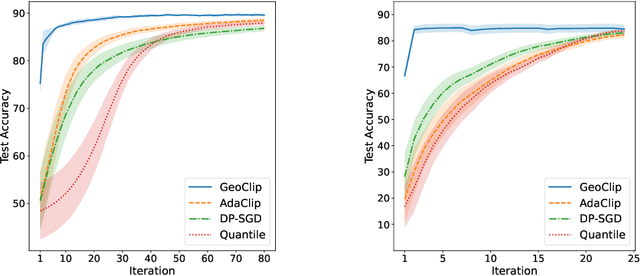
Differentially private stochastic gradient descent (DP-SGD) is the most widely used method for training machine learning models with provable privacy guarantees. A key challenge in DP-SGD is setting the per-sample gradient clipping threshold, which significantly affects the trade-off between privacy and utility. While recent adaptive methods improve performance by adjusting this threshold during training, they operate in the standard coordinate system and fail to account for correlations across the coordinates of the gradient. We propose GeoClip, a geometry-aware framework that clips and perturbs gradients in a transformed basis aligned with the geometry of the gradient distribution. GeoClip adaptively estimates this transformation using only previously released noisy gradients, incurring no additional privacy cost. We provide convergence guarantees for GeoClip and derive a closed-form solution for the optimal transformation that minimizes the amount of noise added while keeping the probability of gradient clipping under control. Experiments on both tabular and image datasets demonstrate that GeoClip consistently outperforms existing adaptive clipping methods under the same privacy budget.
Reveal-or-Obscure: A Differentially Private Sampling Algorithm for Discrete Distributions
Apr 20, 2025We introduce a differentially private (DP) algorithm called reveal-or-obscure (ROO) to generate a single representative sample from a dataset of $n$ observations drawn i.i.d. from an unknown discrete distribution $P$. Unlike methods that add explicit noise to the estimated empirical distribution, ROO achieves $\epsilon$-differential privacy by randomly choosing whether to "reveal" or "obscure" the empirical distribution. While ROO is structurally identical to Algorithm 1 proposed by Cheu and Nayak (arXiv:2412.10512), we prove a strictly better bound on the sampling complexity than that established in Theorem 12 of (arXiv:2412.10512). To further improve the privacy-utility trade-off, we propose a novel generalized sampling algorithm called Data-Specific ROO (DS-ROO), where the probability of obscuring the empirical distribution of the dataset is chosen adaptively. We prove that DS-ROO satisfies $\epsilon$-DP, and provide empirical evidence that DS-ROO can achieve better utility under the same privacy budget of vanilla ROO.