 Add to Chrome
 Add to Firefox
 Add to Edge
Epileptic Seizure Prediction Using Patient-Adaptive Transformer Networks
Mar 26, 2026
Epileptic seizure prediction from electroencephalographic (EEG) recordings remains challenging due to strong inter-patient variability and the complex temporal structure of neural signals. This paper presents a patient-adaptive transformer framework for short-horizon seizure forecasting. The proposed approach employs a two-stage training strategy: self-supervised pretraining is first used to learn general EEG temporal representations through autoregressive sequence modeling, followed by patient-specific fine-tuning for binary prediction of seizure onset within a 30-second horizon. To enable transformer-based sequence learning, multichannel EEG signals are processed using noise-aware preprocessing and discretized into tokenized temporal sequences. Experiments conducted on subjects from the TUH EEG dataset demonstrate that the proposed method achieves validation accuracies above 90% and F1 scores exceeding 0.80 across evaluated patients, supporting the effectiveness of combining self-supervised representation learning with patient-specific adaptation for individualized seizure prediction.

DASPS: A Database for Anxious States based on a Psychological Stimulation
Jan 09, 2019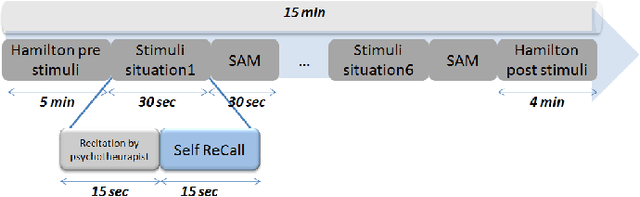
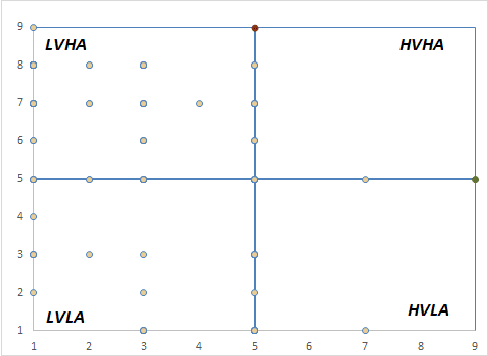
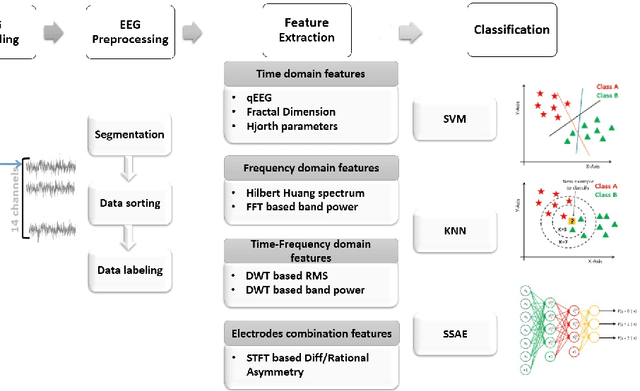
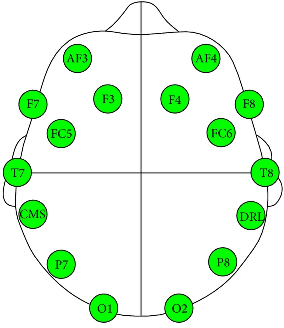
Anxiety affects human capabilities and behavior as much as it affects productivity and quality of life. It can be considered as the main cause of depression and suicide. Anxious states are easily detectable by humans due to their acquired cognition, humans interpret the interlocutor's tone of speech, gesture, facial expressions and recognize their mental state. There is a need for non-invasive reliable techniques that performs the complex task of anxiety detection. In this paper, we present DASPS database containing recorded Electroencephalogram (EEG) signals of 23 participants during anxiety elicitation by means of face-to-face psychological stimuli. EEG signals were captured with Emotiv Epoc headset as it's a wireless wearable low-cost equipment. In our study, we investigate the impact of different parameters, notably: trial duration, feature type, feature combination and anxiety levels number. Our findings showed that anxiety is well elicited in 1 second. For instance, stacked sparse autoencoder with different type of features achieves 83.50% and 74.60% for 2 and 4 anxiety levels detection, respectively. The presented results prove the benefits of the use of a low-cost EEG headset instead of medical non-wireless devices and create a starting point for new researches in the field of anxiety detection.