 Add to Chrome
 Add to Firefox
 Add to Edge
Aligned but Not Partner-Specific: Distinguishing How Multimodal LLM Agents Succeed in Reference Games Without Human-Like Conventions
Jun 06, 2026
Repeated reference games test whether interlocutors replace their initially long descriptions with shorter, partner-specific conventions grounded in shared interaction history. Prior work shows that multimodal LLMs fail to become more efficient across rounds, although they align on the labels they use. How can we determine whether this alignment reflects partner-specific grounding rather than a shared task vocabulary? We address this question by comparing capable multimodal agent dyads with human dyads from the KTH Tangrams corpus. Our novel methodological contribution is a constrained pseudo-dyad baseline that matches the original referential task structure, but breaks partner history. This baseline enables us to test whether the observed label alignment depends on interaction with a specific partner. Across three analytic layers (task competence, description strategy, alignment dynamics), we find clear differences. Humans reduce effort through entrainment, compressing descriptions and increasing label alignment with partners. Agents instead maintain fixed effort levels, producing verbose descriptions from round one, with near-ceiling label overlap that is statistically indistinguishable between real and pseudo dyads. MLLMs thus achieve coordination without convention, succeeding by verbose description rather than by forming the compact, history-dependent referring expressions characteristic of human dialogue.

DuoGesture: Neuro-Inspired and Biomechanically Informed Dual-Stream Co-Speech Gesture Generation
May 25, 2026Co-speech gesture generation requires both semantic expressivity and biomechanically plausible rhythmic motion. Existing holistic gesture models mix lexically grounded semantic gestures with frequent prosody-aligned beat gestures. This limits semantic grounding, speech-motion alignment, and kinematic smoothness. We propose \emph{DuoGesture}, a neuro-inspired and biomechanically informed dual-stream approach that decomposes co-speech gesture synthesis into coupled semantic and beat streams. The two streams are coordinated by a \emph{Semantic Variational Information Bottleneck}, a stochastic frame-level gate that learns when semantic gestures should override rhythmic beat motion. The semantic stream is controlled by \emph{Motion-Grounded Semantic Conditioning}, which replaces purely linguistic word embeddings with motion-language representations to provide motion-aligned semantic priors for long-tailed lexical triggers of gestures. The beat stream is further regularised by an \emph{Inertial Beat Prior}, an anthropometry-weighted arm-chain module that reduces jitter and improves rhythmic consistency without constraining semantic frames. Objective evaluations and subjective experiments show that DuoGesture outperforms strong holistic baselines, while component ablations confirm the complementary roles of semantic grounding, stochastic stream selection, and biomechanical regularisation.
HolisticSemGes: Semantic Grounding of Holistic Co-Speech Gesture Generation with Contrastive Flow-Matching
Mar 27, 2026While the field of co-speech gesture generation has seen significant advances, producing holistic, semantically grounded gestures remains a challenge. Existing approaches rely on external semantic retrieval methods, which limit their generalisation capability due to dependency on predefined linguistic rules. Flow-matching-based methods produce promising results; however, the network is optimised using only semantically congruent samples without exposure to negative examples, leading to learning rhythmic gestures rather than sparse motion, such as iconic and metaphoric gestures. Furthermore, by modelling body parts in isolation, the majority of methods fail to maintain crossmodal consistency. We introduce a Contrastive Flow Matching-based co-speech gesture generation model that uses mismatched audio-text conditions as negatives, training the velocity field to follow the correct motion trajectory while repelling semantically incongruent trajectories. Our model ensures cross-modal coherence by embedding text, audio, and holistic motion into a composite latent space via cosine and contrastive objectives. Extensive experiments and a user study demonstrate that our proposed approach outperforms state-of-the-art methods on two datasets, BEAT2 and SHOW.
Analysing Cross-Speaker Convergence in Face-to-Face Dialogue through the Lens of Automatically Detected Shared Linguistic Constructions
May 14, 2024Conversation requires a substantial amount of coordination between dialogue participants, from managing turn taking to negotiating mutual understanding. Part of this coordination effort surfaces as the reuse of linguistic behaviour across speakers, a process often referred to as alignment. While the presence of linguistic alignment is well documented in the literature, several questions remain open, including the extent to which patterns of reuse across speakers have an impact on the emergence of labelling conventions for novel referents. In this study, we put forward a methodology for automatically detecting shared lemmatised constructions -- expressions with a common lexical core used by both speakers within a dialogue -- and apply it to a referential communication corpus where participants aim to identify novel objects for which no established labels exist. Our analyses uncover the usage patterns of shared constructions in interaction and reveal that features such as their frequency and the amount of different constructions used for a referent are associated with the degree of object labelling convergence the participants exhibit after social interaction. More generally, the present study shows that automatically detected shared constructions offer a useful level of analysis to investigate the dynamics of reference negotiation in dialogue.
Leveraging Speech for Gesture Detection in Multimodal Communication
Apr 23, 2024
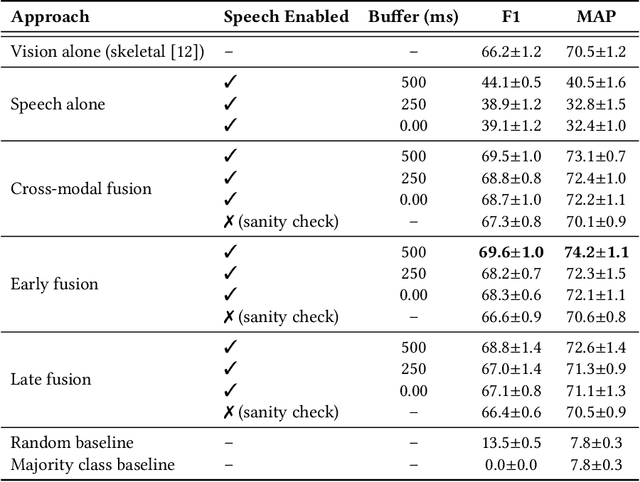


Gestures are inherent to human interaction and often complement speech in face-to-face communication, forming a multimodal communication system. An important task in gesture analysis is detecting a gesture's beginning and end. Research on automatic gesture detection has primarily focused on visual and kinematic information to detect a limited set of isolated or silent gestures with low variability, neglecting the integration of speech and vision signals to detect gestures that co-occur with speech. This work addresses this gap by focusing on co-speech gesture detection, emphasising the synchrony between speech and co-speech hand gestures. We address three main challenges: the variability of gesture forms, the temporal misalignment between gesture and speech onsets, and differences in sampling rate between modalities. We investigate extended speech time windows and employ separate backbone models for each modality to address the temporal misalignment and sampling rate differences. We utilize Transformer encoders in cross-modal and early fusion techniques to effectively align and integrate speech and skeletal sequences. The study results show that combining visual and speech information significantly enhances gesture detection performance. Our findings indicate that expanding the speech buffer beyond visual time segments improves performance and that multimodal integration using cross-modal and early fusion techniques outperforms baseline methods using unimodal and late fusion methods. Additionally, we find a correlation between the models' gesture prediction confidence and low-level speech frequency features potentially associated with gestures. Overall, the study provides a better understanding and detection methods for co-speech gestures, facilitating the analysis of multimodal communication.
Co-Speech Gesture Detection through Multi-phase Sequence Labeling
Aug 21, 2023
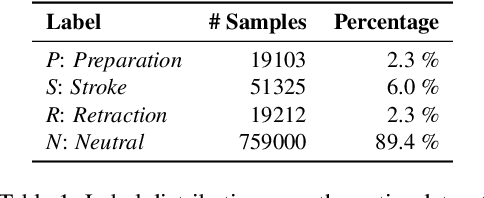

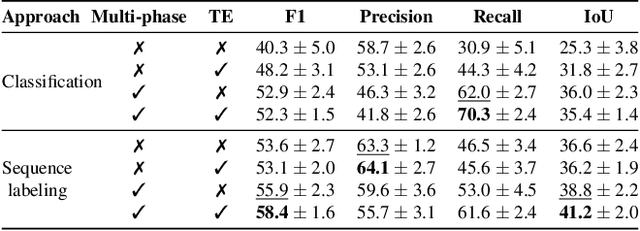
Gestures are integral components of face-to-face communication. They unfold over time, often following predictable movement phases of preparation, stroke, and retraction. Yet, the prevalent approach to automatic gesture detection treats the problem as binary classification, classifying a segment as either containing a gesture or not, thus failing to capture its inherently sequential and contextual nature. To address this, we introduce a novel framework that reframes the task as a multi-phase sequence labeling problem rather than binary classification. Our model processes sequences of skeletal movements over time windows, uses Transformer encoders to learn contextual embeddings, and leverages Conditional Random Fields to perform sequence labeling. We evaluate our proposal on a large dataset of diverse co-speech gestures in task-oriented face-to-face dialogues. The results consistently demonstrate that our method significantly outperforms strong baseline models in detecting gesture strokes. Furthermore, applying Transformer encoders to learn contextual embeddings from movement sequences substantially improves gesture unit detection. These results highlight our framework's capacity to capture the fine-grained dynamics of co-speech gesture phases, paving the way for more nuanced and accurate gesture detection and analysis.