 Add to Chrome
 Add to Firefox
 Add to Edge
A Step Towards Robust Unsupervised Domain Adaptation via Fine-Tuning and Reinforcement Learning
Jul 03, 2026
Adversarial robustness in Unsupervised Domain Adaptation (UDA) remains a significant challenge due to noisy pseudo labels and inherent distributional shifts between the clean source and adversarially perturbed target domains. Existing approaches often fail to achieve an optimal trade-off between robustness and accuracy, as pseudo-labels generated by domain-adapted models tend to introduce classification errors under adversarial attacks. In this work, we propose \textbf{SFT+RL}, a two-stage robust UDA framework that integrates Supervised Fine Tuning (SFT) and Reinforcement Learning (RL) on top of CLIP's pre-trained visual encoder. In the SFT stage, we adversarially fine-tune a linear classifier using PGD-based perturbations over the labelled source domain while partially unfreezing CLIP's projection layer. It allows adaptation to adversarial noise while preserving CLIP's rich semantic priors. We introduce a confidence-guided pseudo-labeling strategy in the RL stage to annotate unlabeled target samples progressively. Pseudo labels are filtered using a decaying confidence threshold to balance quality and coverage, and the model is trained on a composite dataset formed by combining clean source samples with high-confidence target samples. Adversarial training is applied to mixed batches of clean and adversarial examples to enhance cross-domain robustness. Comprehensive evaluations on three benchmark datasets OfficeHome~\cite{tomm-ude}, PACS~\cite{pacs}, and VisDA~\cite{visda} demonstrate the effectiveness of our approach. Notably, \textbf{SFT+RL} achieves average improvements of \textbf{10.2\%} in clean accuracy and \textbf{15.8\%} in adversarial robustness across all three datasets, outperforming existing state-of-the-art methods.
* Accepted and presented at the 28th European Conference on Artificial Intelligence (ECAI 2025), Bologna, Italy

i-Mask: An Intelligent Mask for Breath-Driven Activity Recognition
Sep 04, 2025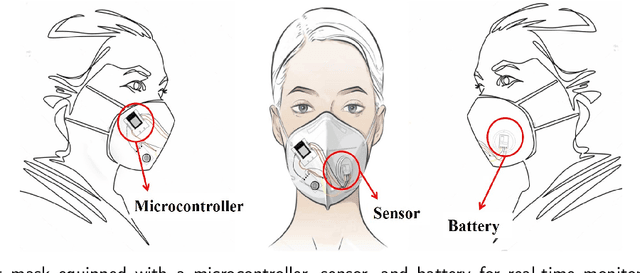
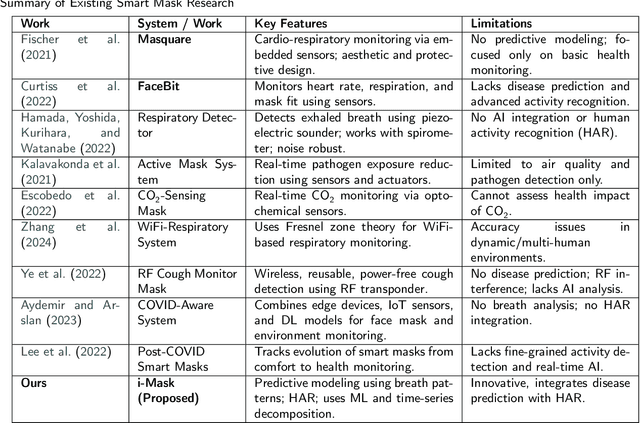
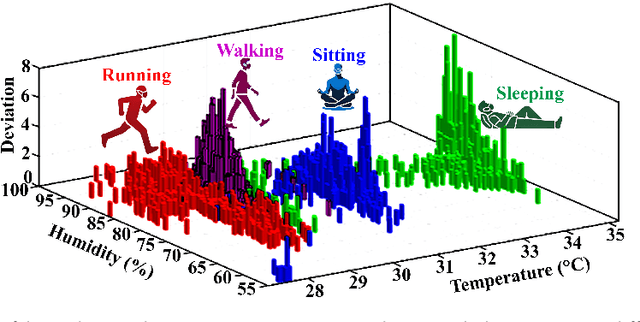
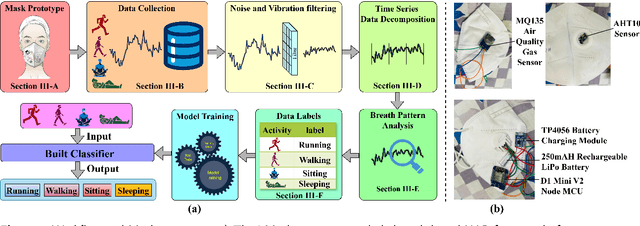
The patterns of inhalation and exhalation contain important physiological signals that can be used to anticipate human behavior, health trends, and vital parameters. Human activity recognition (HAR) is fundamentally connected to these vital signs, providing deeper insights into well-being and enabling real-time health monitoring. This work presents i-Mask, a novel HAR approach that leverages exhaled breath patterns captured using a custom-developed mask equipped with integrated sensors. Data collected from volunteers wearing the mask undergoes noise filtering, time-series decomposition, and labeling to train predictive models. Our experimental results validate the effectiveness of the approach, achieving over 95\% accuracy and highlighting its potential in healthcare and fitness applications.