 Add to Chrome
 Add to Firefox
 Add to Edge
How Non-Linguistic Is the Indus Sign System? A Synthetic-Baseline Scorecard
Apr 20, 2026
Whether the Indus Valley sign system (c. 2600-1900 BCE) encodes spoken language has been debated for decades. This paper introduces a multi-metric discrimination framework that tests the observed Indus corpus against two kinds of computer-generated non-linguistic baseline -- one mimicking a heraldic emblem system, the other an administrative coding system -- each calibrated with Zipfian frequency distributions, positional constraints, and bigram dependencies derived from six attested non-linguistic corpora. The scorecard evaluates four properties central to the Farmer-Sproat-Witzel (2004) critique: text brevity, repeated formulaic phrases, hapax legomenon rate, and positional rigidity. Applying this framework to 1,916 deduplicated inscriptions (584 unique signs, 11,110 tokens) from the ICIT/Yajnadevam digitization, we find that the Indus corpus does not match either baseline cleanly. Across the four metrics examined, the Indus corpus occupies an intermediate position relative to the two baseline families, matching neither cleanly. Neither a heraldic nor an administrative generator can reproduce all four properties at once. We also compare against seven real-world non-linguistic corpora including Sproat's (2014) datasets, finding that no attested non-linguistic system reproduces the full Indus statistical profile either. We replicate key prior results including a Zipf slope of -1.49 and conditional entropy of 3.23 bits. All code and data are publicly available.

Gigs with Guarantees: Achieving Fair Wage for Food Delivery Workers
May 07, 2022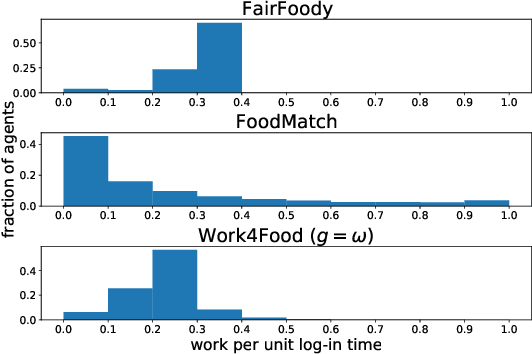
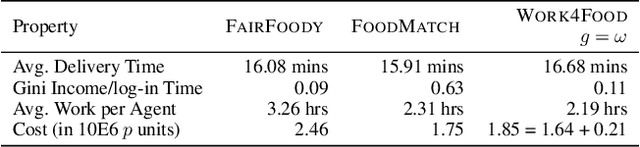
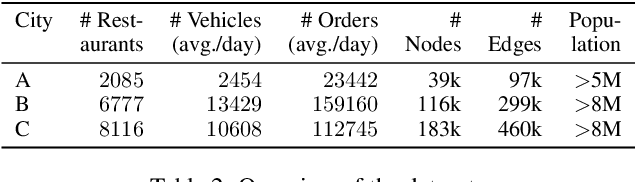
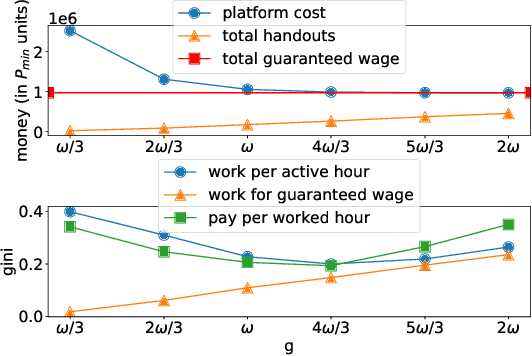
With the increasing popularity of food delivery platforms, it has become pertinent to look into the working conditions of the 'gig' workers in these platforms, especially providing them fair wages, reasonable working hours, and transparency on work availability. However, any solution to these problems must not degrade customer experience and be cost-effective to ensure that platforms are willing to adopt them. We propose WORK4FOOD, which provides income guarantees to delivery agents, while minimizing platform costs and ensuring customer satisfaction. WORK4FOOD ensures that the income guarantees are met in such a way that it does not lead to increased working hours or degrade environmental impact. To incorporate these objectives, WORK4FOOD balances supply and demand by controlling the number of agents in the system and providing dynamic payment guarantees to agents based on factors such as agent location, ratings, etc. We evaluate WORK4FOOD on a real-world dataset from a leading food delivery platform and establish its advantages over the state of the art in terms of the multi-dimensional objectives at hand.