 Add to Chrome
 Add to Firefox
 Add to Edge
Shape-Based Inductive Bias for Glioma Grading from Tumor Contours
Jul 27, 2026
Glioma grading from tumor contours is often treated as a pixel problem even when the signal of interest is shape. We align closed contours with a functional shape-alignment framework, separate global deformation from residual Fourier shape, and organize these quantities as frequency-ordered tokens. In five-fold patient-disjoint cross-validation on BraTS~2020 tumor contours, with model selection performed using grouped inner validation, a compact multilayer perceptron (MLP) achieves the highest mean balanced accuracy at 71.5\%, compared with 65.9\% for ResNet-18 and 63.3\% for ViT-Tiny. It also gives the highest mean low-grade glioma F1 at 54.9\%. Its pooled out-of-fold balanced accuracy is 72.4\% (patient-bootstrap 95\% CI: 66.4--77.8\%). The selected MLPs use 2.9k--117.3k parameters across folds, at least 46 times fewer than the pixel baselines. In a controlled noise-free simulation, shape-based models reach 56.3--71.5\% balanced accuracy while the pixel models remain at 50.0--52.5\%. This work demonstrates how incorporating a shape-based inductive bias at the representation level can improve interpretability and scalability while enabling substantial dimensionality reduction.

Efficient Neural Architectures for Real-Time ECG Interpretation on Limited Hardware
May 11, 2026Electrocardiogram (ECG) interpretation is essential for diagnosing a wide range of cardiac abnormalities. While deep learning has shown strong potential for automating ECG classification, many existing models rely on large, computationally intensive architectures that hinder practical deployment. In this paper, we present an empirical study of convolutional neural network (CNN) architectures, exploring tradeoffs between diagnostic accuracy and computational efficiency. We benchmark two established baselines: AttiaNet, a compact model composed of sequential temporal and spatial blocks, and DeepResidualCNN, the winning architecture of the 2021 PhysioNet/Computing in Cardiology Challenge. Building on these, we propose three lightweight models: (i) ParallelCNN, which employs dual temporal and spatial branches for parallel pattern extraction; (ii) ParallelCNNew, a variant with symmetric weight initialization for balanced feature learning; and (iii) SimpleNet, a streamlined architecture that jointly processes temporal and spatial dimensions. Our experiments span three publicly available 12-lead ECG datasets from Germany, China, and the United States, covering binary, multiclass, and multilabel classification tasks across diverse patient populations. We further evaluate the impact of integrating low-cost demographic metadata (age and sex) to improve performance with minimal overhead. To ensure fair comparison, we introduce a unified Efficiency Score that integrates model size, inference speed, memory usage, and AUC performance. By balancing diagnostic performance and efficiency, our models offer a scalable and viable foundation for next-generation AI systems in cardiovascular care.
* 9 pages, 6 figures, 3 tables. Published in: 2025 IEEE International Conference on Big Data (BigData), pp. 3275-3284. DOI: 10.1109/BIGDATA66926.2025.11402097
A Survey on African Computer Vision Datasets, Topics and Researchers
Feb 04, 2024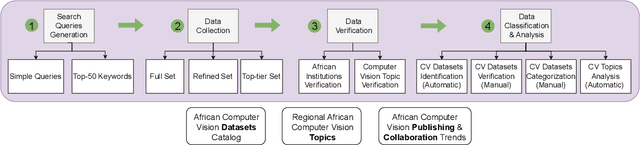
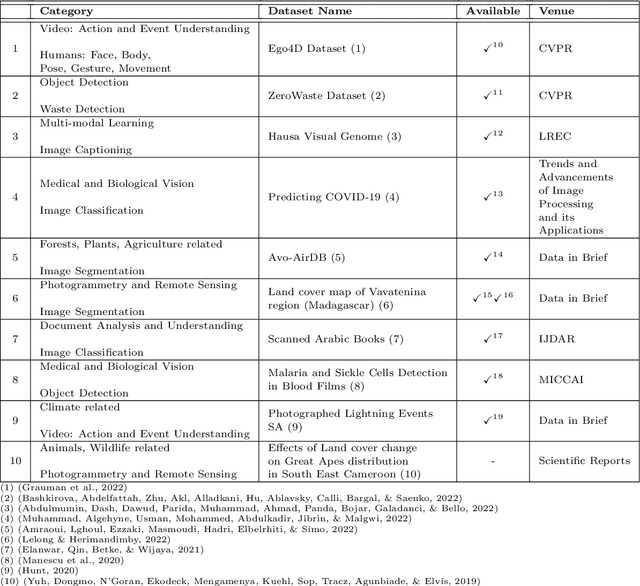
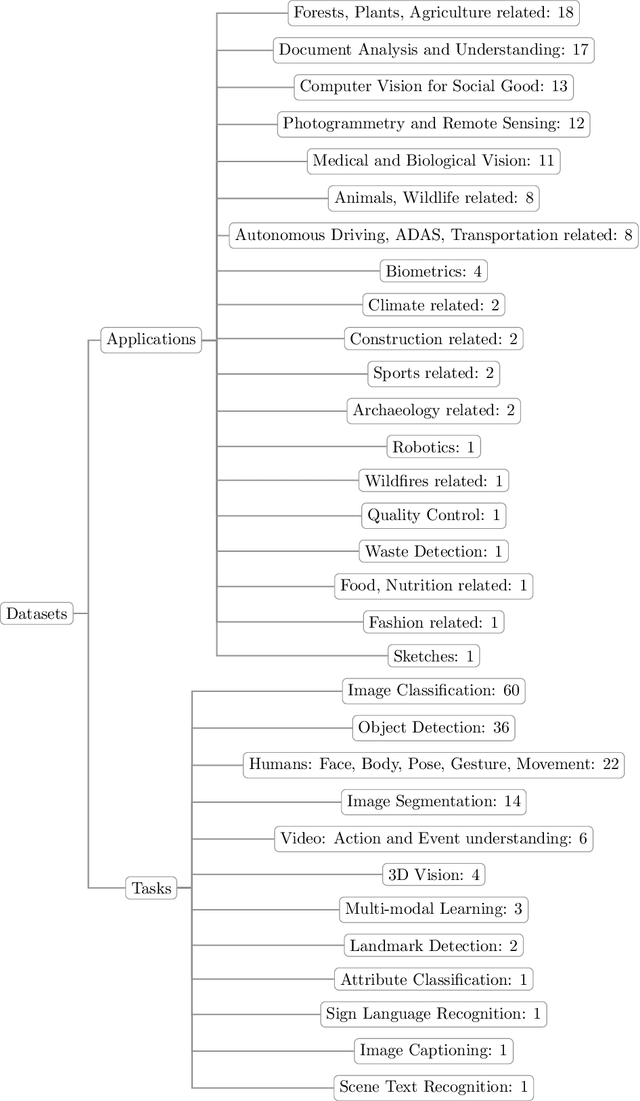

Computer vision encompasses a range of tasks such as object detection, semantic segmentation, and 3D reconstruction. Despite its relevance to African communities, research in this field within Africa represents only 0.06% of top-tier publications over the past decade. This study undertakes a thorough analysis of 63,000 Scopus-indexed computer vision publications from Africa, spanning from 2012 to 2022. The aim is to provide a survey of African computer vision topics, datasets and researchers. A key aspect of our study is the identification and categorization of African Computer Vision datasets using large language models that automatically parse abstracts of these publications. We also provide a compilation of unofficial African Computer Vision datasets distributed through challenges or data hosting platforms, and provide a full taxonomy of dataset categories. Our survey also pinpoints computer vision topics trends specific to different African regions, indicating their unique focus areas. Additionally, we carried out an extensive survey to capture the views of African researchers on the current state of computer vision research in the continent and the structural barriers they believe need urgent attention. In conclusion, this study catalogs and categorizes Computer Vision datasets and topics contributed or initiated by African institutions and identifies barriers to publishing in top-tier Computer Vision venues. This survey underscores the importance of encouraging African researchers and institutions in advancing computer vision research in the continent. It also stresses on the need for research topics to be more aligned with the needs of African communities.