 Add to Chrome
 Add to Firefox
 Add to Edge
Does Explainability Transfer? A Controlled Benchmark of Attribution Methods on Vision Transformers and CNNs
Aug 03, 2026
Most evidence on the effectiveness of explainable artificial intelligence (XAI) attribution methods has been established on convolutional neural networks (CNNs), with limited investigation into whether these conclusions generalize to the diverse Vision Transformer (ViT) architectures that now dominate computer vision. This paper presents a controlled benchmark that evaluates attribution quality across five dimensions: faithfulness, localization, robustness, complexity, and computational cost. A standardized framework assesses 13 attribution methods from four algorithmic families on eight representative backbones spanning CNNs, isotropic ViTs, hierarchical transformers, hybrid architectures, and linear-attention transformers. The results show that attribution performance is strongly architecture-dependent and that rankings established on CNNs do not reliably transfer to transformer-based models. CAM-based methods achieve the highest scores under the conventional bounding-box localization metric on CNNs and most ViTs but perform poorly on linear-attention architectures. Pixel-level dense-mask evaluation further reveals that these gains largely reflect metric saturation rather than accurate localization. CAM-based methods also exhibit limited robustness on global-attention transformers, whereas attention rollout provides consistently stable explanations with poor localization. Furthermore, faithfulness correlation offers limited discrimination between attribution methods, highlighting the limitations of single-metric evaluation. These findings challenge prevailing conclusions on attribution performance and demonstrate the need for architecture-aware, multi-dimensional evaluation. The open-source code for the evaluation framework and benchmark results is available at https://github.com/Nishan-Charlie/VIT_XAI_Bench.

Radio Source Localization using Sparse Signal Measurements from Uncrewed Ground Vehicles
Dec 06, 2023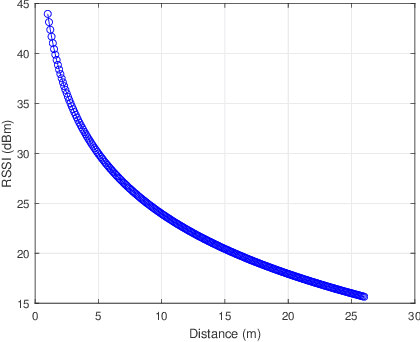
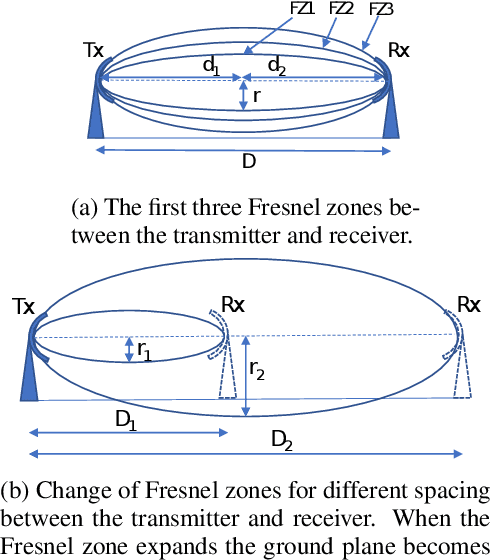
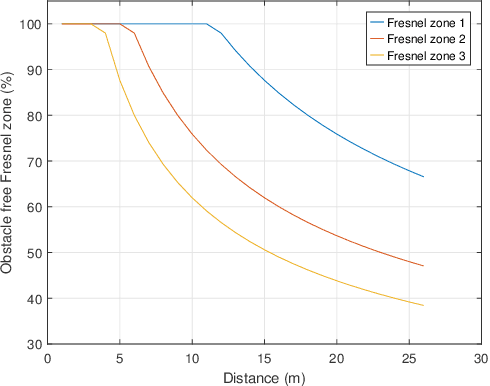
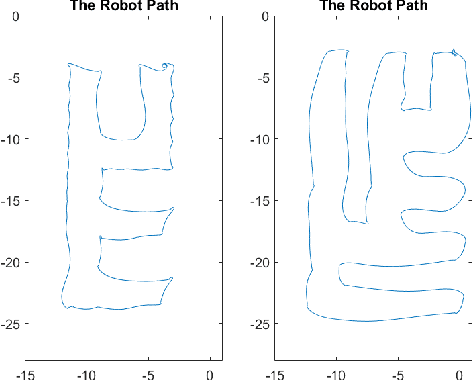
Radio source localization can benefit many fields, including wireless communications, radar, radio astronomy, wireless sensor networks, positioning systems, and surveillance systems. However, accurately estimating the position of a radio transmitter using a remote sensor is not an easy task, as many factors contribute to the highly dynamic behavior of radio signals. In this study, we investigate techniques to use a mobile robot to explore an outdoor area and localize the radio source using sparse Received Signal Strength Indicator (RSSI) measurements. We propose a novel radio source localization method with fast turnaround times and reduced complexity compared to the state-of-the-art. Our technique uses RSSI measurements collected while the robot completed a sparse trajectory using a coverage path planning map. The mean RSSI within each grid cell was used to find the most likely cell containing the source. Three techniques were analyzed with the data from eight field tests using a mobile robot. The proposed method can localize a gas source in a basketball field with a 1.2 m accuracy and within three minutes of convergence time, whereas the state-of-the-art active sensing technique took more than 30 minutes to reach a source estimation accuracy below 1 m.
Coverage Path Planning with Budget Constraints for Multiple Unmanned Ground Vehicles
Jun 07, 2023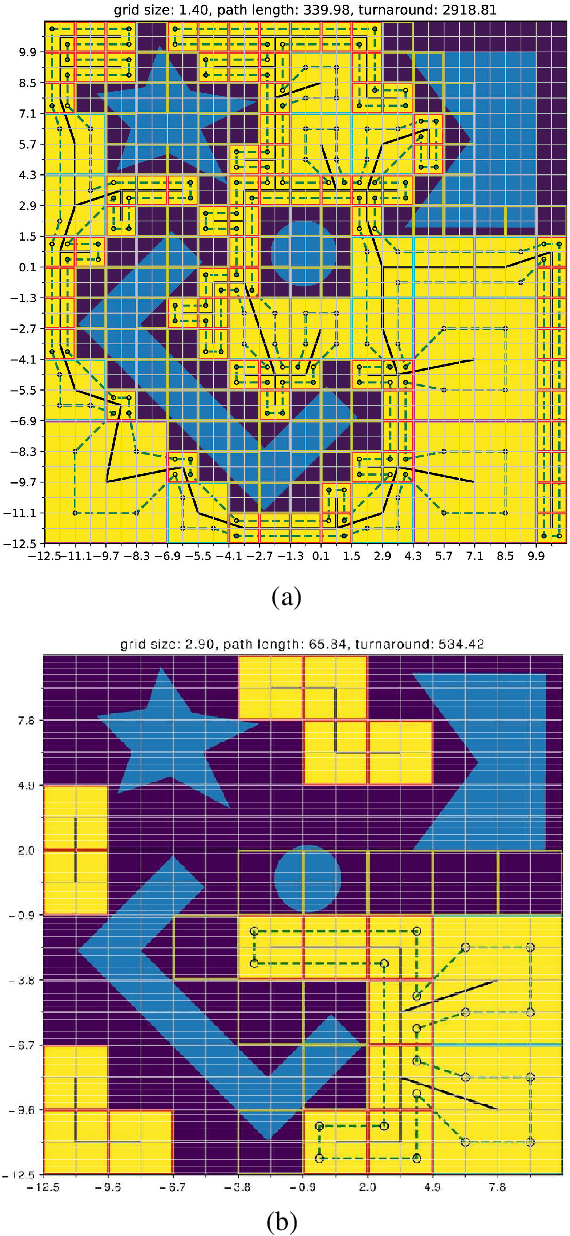

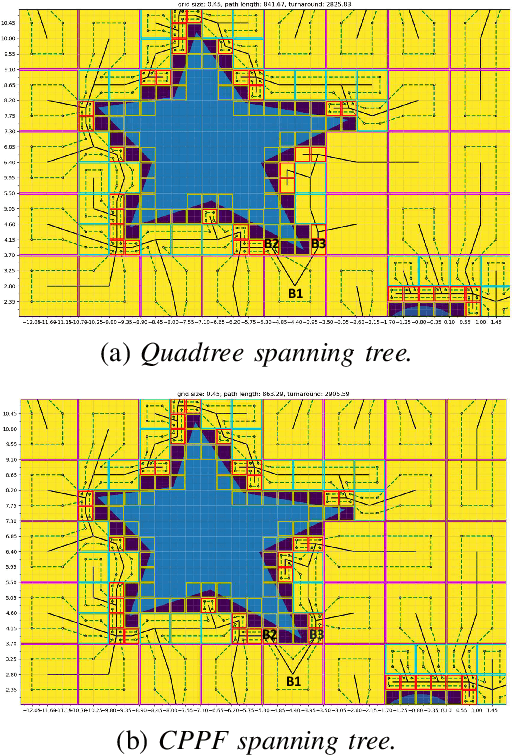
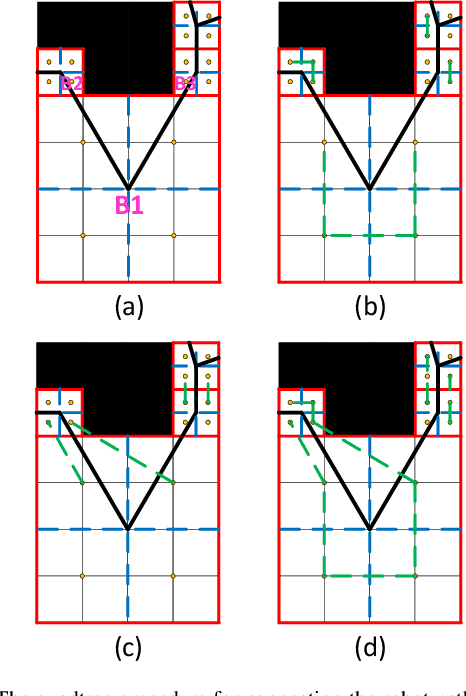
This paper proposes a state-machine model for a multi-modal, multi-robot environmental sensing algorithm. This multi-modal algorithm integrates two different exploration algorithms: (1) coverage path planning using variable formations and (2) collaborative active sensing using multi-robot swarms. The state machine provides the logic for when to switch between these different sensing algorithms. We evaluate the performance of the proposed approach on a gas source localisation and mapping task. We use hardware-in-the-loop experiments and real-time experiments with a radio source simulating a real gas field. We compare the proposed approach with a single-mode, state-of-the-art collaborative active sensing approach. Our results indicate that our multi-modal switching approach can converge more rapidly than single-mode active sensing.