 Add to Chrome
 Add to Firefox
 Add to Edge
The Regularization Parameter: Sparse Precision Matrix Estimation
Jul 07, 2026
Sparse precision matrix estimation provides an interpretable and computationally efficient framework for modeling conditional dependencies in high-dimensional, low-sample-size data. A recurring challenge is appropriately selecting the regularization parameter that controls estimator sparsity and strikes a balance between underfitting and overfitting. We propose a closed-form, matrix-valued regularization parameter derived from the sampling distribution of the first-order optimality conditions of the $\ell_1$-regularized Gaussian maximum-likelihood estimator. By prescribing the probability that each nonzero entry of the estimator satisfies its optimality condition under resampling, we eliminate the need for cross-validation. The resulting regularization parameter is shown to attain asymptotic scaling properties that, under standard conditions, provide consistency and sparsistency of the estimator. On synthetic Gaussian and non-Gaussian datasets, as well as real-world gene microarray and neuroimaging applications, the proposed approach achieves estimation accuracy comparable to cross-validation, delivers superior support recovery, and reduces runtime by several orders of magnitude.

Building Interpretable Climate Emulators for Economics
Nov 16, 2024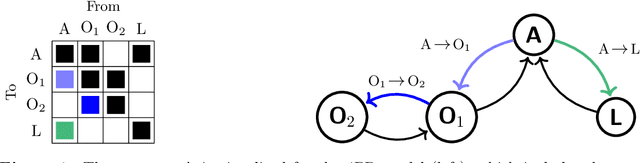
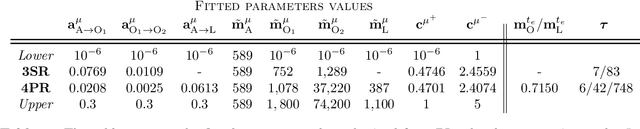
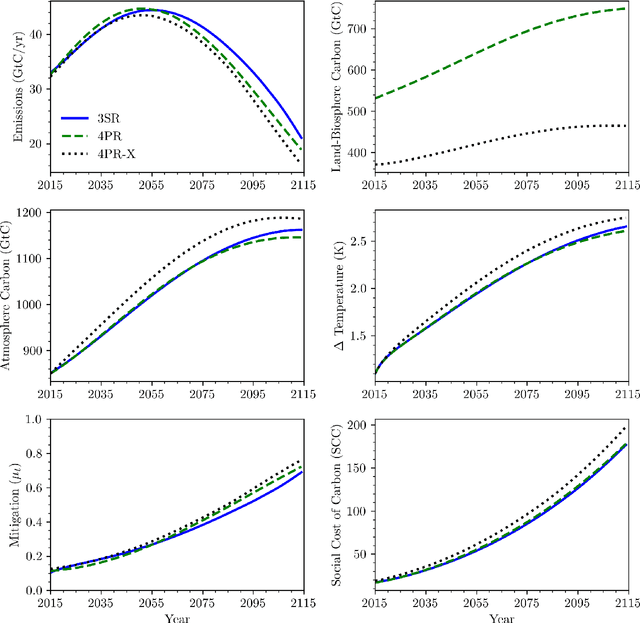
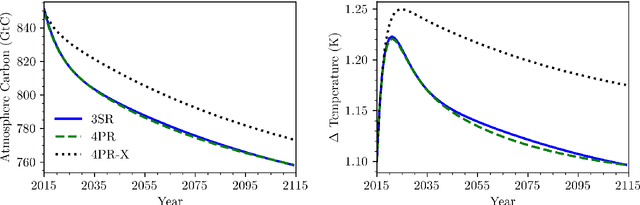
This paper presents a framework for developing efficient and interpretable carbon-cycle emulators (CCEs) as part of climate emulators in Integrated Assessment Models, enabling economists to custom-build CCEs accurately calibrated to advanced climate science. We propose a generalized multi-reservoir linear box-model CCE that preserves key physical quantities and can be use-case tailored for specific use cases. Three CCEs are presented for illustration: the 3SR model (replicating DICE-2016), the 4PR model (including the land biosphere), and the 4PR-X model (accounting for dynamic land-use changes like deforestation that impact the reservoir's storage capacity). Evaluation of these models within the DICE framework shows that land-use changes in the 4PR-X model significantly impact atmospheric carbon and temperatures -- emphasizing the importance of using tailored climate emulators. By providing a transparent and flexible tool for policy analysis, our framework allows economists to assess the economic impacts of climate policies more accurately.