 Add to Chrome
 Add to Firefox
 Add to Edge
Clustering with Non-adaptive Subset Queries
Sep 17, 2024
Recovering the underlying clustering of a set $U$ of $n$ points by asking pair-wise same-cluster queries has garnered significant interest in the last decade. Given a query $S \subset U$, $|S|=2$, the oracle returns yes if the points are in the same cluster and no otherwise. For adaptive algorithms with pair-wise queries, the number of required queries is known to be $\Theta(nk)$, where $k$ is the number of clusters. However, non-adaptive schemes require $\Omega(n^2)$ queries, which matches the trivial $O(n^2)$ upper bound attained by querying every pair of points. To break the quadratic barrier for non-adaptive queries, we study a generalization of this problem to subset queries for $|S|>2$, where the oracle returns the number of clusters intersecting $S$. Allowing for subset queries of unbounded size, $O(n)$ queries is possible with an adaptive scheme (Chakrabarty-Liao, 2024). However, the realm of non-adaptive algorithms is completely unknown. In this paper, we give the first non-adaptive algorithms for clustering with subset queries. Our main result is a non-adaptive algorithm making $O(n \log k \cdot (\log k + \log\log n)^2)$ queries, which improves to $O(n \log \log n)$ when $k$ is a constant. We also consider algorithms with a restricted query size of at most $s$. In this setting we prove that $\Omega(\max(n^2/s^2,n))$ queries are necessary and obtain algorithms making $\tilde{O}(n^2k/s^2)$ queries for any $s \leq \sqrt{n}$ and $\tilde{O}(n^2/s)$ queries for any $s \leq n$. We also consider the natural special case when the clusters are balanced, obtaining non-adaptive algorithms which make $O(n \log k) + \tilde{O}(k)$ and $O(n\log^2 k)$ queries. Finally, allowing two rounds of adaptivity, we give an algorithm making $O(n \log k)$ queries in the general case and $O(n \log \log k)$ queries when the clusters are balanced.

Transfer Learning for Latent Variable Network Models
Jun 06, 2024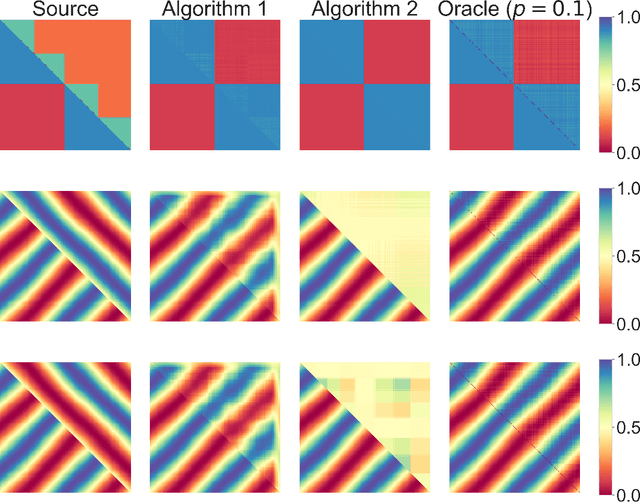
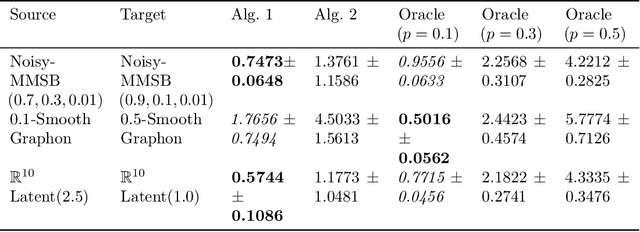
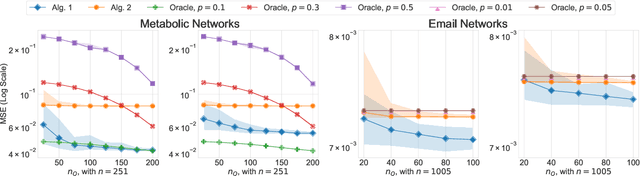
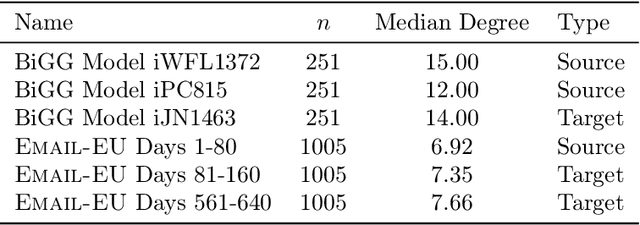
We study transfer learning for estimation in latent variable network models. In our setting, the conditional edge probability matrices given the latent variables are represented by $P$ for the source and $Q$ for the target. We wish to estimate $Q$ given two kinds of data: (1) edge data from a subgraph induced by an $o(1)$ fraction of the nodes of $Q$, and (2) edge data from all of $P$. If the source $P$ has no relation to the target $Q$, the estimation error must be $\Omega(1)$. However, we show that if the latent variables are shared, then vanishing error is possible. We give an efficient algorithm that utilizes the ordering of a suitably defined graph distance. Our algorithm achieves $o(1)$ error and does not assume a parametric form on the source or target networks. Next, for the specific case of Stochastic Block Models we prove a minimax lower bound and show that a simple algorithm achieves this rate. Finally, we empirically demonstrate our algorithm's use on real-world and simulated graph transfer problems.
Agnostic Learning of Mixed Linear Regressions with EM and AM Algorithms
Jun 03, 2024Mixed linear regression is a well-studied problem in parametric statistics and machine learning. Given a set of samples, tuples of covariates and labels, the task of mixed linear regression is to find a small list of linear relationships that best fit the samples. Usually it is assumed that the label is generated stochastically by randomly selecting one of two or more linear functions, applying this chosen function to the covariates, and potentially introducing noise to the result. In that situation, the objective is to estimate the ground-truth linear functions up to some parameter error. The popular expectation maximization (EM) and alternating minimization (AM) algorithms have been previously analyzed for this. In this paper, we consider the more general problem of agnostic learning of mixed linear regression from samples, without such generative models. In particular, we show that the AM and EM algorithms, under standard conditions of separability and good initialization, lead to agnostic learning in mixed linear regression by converging to the population loss minimizers, for suitably defined loss functions. In some sense, this shows the strength of AM and EM algorithms that converges to ``optimal solutions'' even in the absence of realizable generative models.
Robust 1-bit Compressed Sensing with Iterative Hard Thresholding
Oct 12, 2023In 1-bit compressed sensing, the aim is to estimate a $k$-sparse unit vector $x\in S^{n-1}$ within an $\epsilon$ error (in $\ell_2$) from minimal number of linear measurements that are quantized to just their signs, i.e., from measurements of the form $y = \mathrm{Sign}(\langle a, x\rangle).$ In this paper, we study a noisy version where a fraction of the measurements can be flipped, potentially by an adversary. In particular, we analyze the Binary Iterative Hard Thresholding (BIHT) algorithm, a proximal gradient descent on a properly defined loss function used for 1-bit compressed sensing, in this noisy setting. It is known from recent results that, with $\tilde{O}(\frac{k}{\epsilon})$ noiseless measurements, BIHT provides an estimate within $\epsilon$ error. This result is optimal and universal, meaning one set of measurements work for all sparse vectors. In this paper, we show that BIHT also provides better results than all known methods for the noisy setting. We show that when up to $\tau$-fraction of the sign measurements are incorrect (adversarial error), with the same number of measurements as before, BIHT agnostically provides an estimate of $x$ within an $\tilde{O}(\epsilon+\tau)$ error, maintaining the universality of measurements. This establishes stability of iterative hard thresholding in the presence of measurement error. To obtain the result, we use the restricted approximate invertibility of Gaussian matrices, as well as a tight analysis of the high-dimensional geometry of the adversarially corrupted measurements.
Optimal Compression of Unit Norm Vectors in the High Distortion Regime
Jul 16, 2023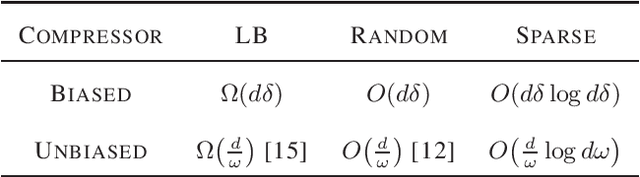
Motivated by the need for communication-efficient distributed learning, we investigate the method for compressing a unit norm vector into the minimum number of bits, while still allowing for some acceptable level of distortion in recovery. This problem has been explored in the rate-distortion/covering code literature, but our focus is exclusively on the "high-distortion" regime. We approach this problem in a worst-case scenario, without any prior information on the vector, but allowing for the use of randomized compression maps. Our study considers both biased and unbiased compression methods and determines the optimal compression rates. It turns out that simple compression schemes are nearly optimal in this scenario. While the results are a mix of new and known, they are compiled in this paper for completeness.
On the sample complexity of estimation in logistic regression
Jul 09, 2023The logistic regression model is one of the most popular data generation model in noisy binary classification problems. In this work, we study the sample complexity of estimating the parameters of the logistic regression model up to a given $\ell_2$ error, in terms of the dimension and the inverse temperature, with standard normal covariates. The inverse temperature controls the signal-to-noise ratio of the data generation process. While both generalization bounds and asymptotic performance of the maximum-likelihood estimator for logistic regression are well-studied, the non-asymptotic sample complexity that shows the dependence on error and the inverse temperature for parameter estimation is absent from previous analyses. We show that the sample complexity curve has two change-points (or critical points) in terms of the inverse temperature, clearly separating the low, moderate, and high temperature regimes.
Optimization using Parallel Gradient Evaluations on Multiple Parameters
Feb 06, 2023We propose a first-order method for convex optimization, where instead of being restricted to the gradient from a single parameter, gradients from multiple parameters can be used during each step of gradient descent. This setup is particularly useful when a few processors are available that can be used in parallel for optimization. Our method uses gradients from multiple parameters in synergy to update these parameters together towards the optima. While doing so, it is ensured that the computational and memory complexity is of the same order as that of gradient descent. Empirical results demonstrate that even using gradients from as low as \textit{two} parameters, our method can often obtain significant acceleration and provide robustness to hyper-parameter settings. We remark that the primary goal of this work is less theoretical, and is instead aimed at exploring the understudied case of using multiple gradients during each step of optimization.
Async-HFL: Efficient and Robust Asynchronous Federated Learning in Hierarchical IoT Networks
Jan 17, 2023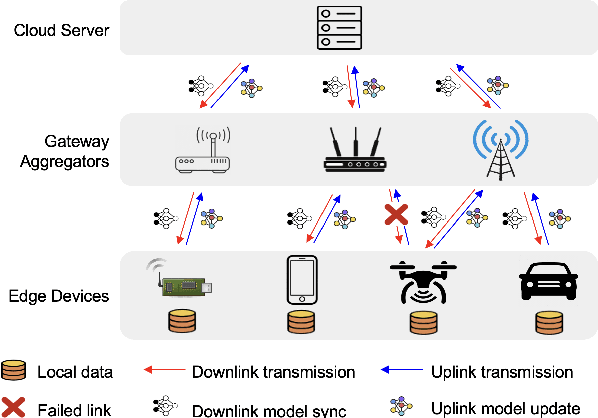
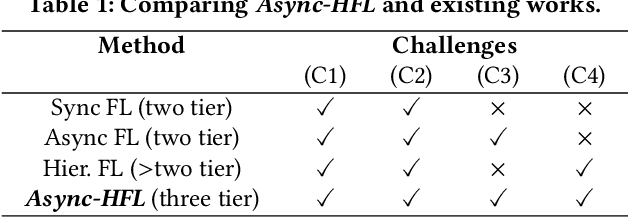
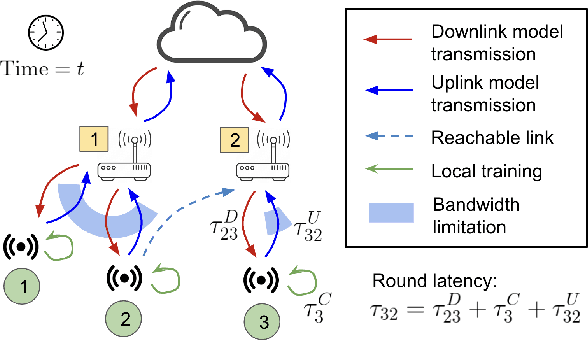
Federated Learning (FL) has gained increasing interest in recent years as a distributed on-device learning paradigm. However, multiple challenges remain to be addressed for deploying FL in real-world Internet-of-Things (IoT) networks with hierarchies. Although existing works have proposed various approaches to account data heterogeneity, system heterogeneity, unexpected stragglers and scalibility, none of them provides a systematic solution to address all of the challenges in a hierarchical and unreliable IoT network. In this paper, we propose an asynchronous and hierarchical framework (Async-HFL) for performing FL in a common three-tier IoT network architecture. In response to the largely varied delays, Async-HFL employs asynchronous aggregations at both the gateway and the cloud levels thus avoids long waiting time. To fully unleash the potential of Async-HFL in converging speed under system heterogeneities and stragglers, we design device selection at the gateway level and device-gateway association at the cloud level. Device selection chooses edge devices to trigger local training in real-time while device-gateway association determines the network topology periodically after several cloud epochs, both satisfying bandwidth limitation. We evaluate Async-HFL's convergence speedup using large-scale simulations based on ns-3 and a network topology from NYCMesh. Our results show that Async-HFL converges 1.08-1.31x faster in wall-clock time and saves up to 21.6% total communication cost compared to state-of-the-art asynchronous FL algorithms (with client selection). We further validate Async-HFL on a physical deployment and observe robust convergence under unexpected stragglers.
Improved Support Recovery in Universal One-bit Compressed Sensing
Oct 29, 2022
One-bit compressed sensing (1bCS) is an extremely quantized signal acquisition method that has been proposed and studied rigorously in the past decade. In 1bCS, linear samples of a high dimensional signal are quantized to only one bit per sample (sign of the measurement). Assuming the original signal vector to be sparse, existing results in 1bCS either aim to find the support of the vector, or approximate the signal allowing a small error. The focus of this paper is support recovery, which often also computationally facilitate approximate signal recovery. A {\em universal} measurement matrix for 1bCS refers to one set of measurements that work for all sparse signals. With universality, it is known that $\tilde{\Theta}(k^2)$ 1bCS measurements are necessary and sufficient for support recovery (where $k$ denotes the sparsity). To improve the dependence on sparsity from quadratic to linear, in this work we propose approximate support recovery (allowing $\epsilon>0$ proportion of errors), and superset recovery (allowing $\epsilon$ proportion of false positives). We show that the first type of recovery is possible with $\tilde{O}(k/\epsilon)$ measurements, while the later type of recovery, more challenging, is possible with $\tilde{O}(\max\{k/\epsilon,k^{3/2}\})$ measurements. We also show that in both cases $\Omega(k/\epsilon)$ measurements would be necessary for universal recovery. Improved results are possible if we consider universal recovery within a restricted class of signals, such as rational signals, or signals with bounded dynamic range. In both cases superset recovery is possible with only $\tilde{O}(k/\epsilon)$ measurements. Other results on universal but approximate support recovery are also provided in this paper. All of our main recovery algorithms are simple and polynomial-time.
Binary Iterative Hard Thresholding Converges with Optimal Number of Measurements for 1-Bit Compressed Sensing
Jul 07, 2022Compressed sensing has been a very successful high-dimensional signal acquisition and recovery technique that relies on linear operations. However, the actual measurements of signals have to be quantized before storing or processing. 1(One)-bit compressed sensing is a heavily quantized version of compressed sensing, where each linear measurement of a signal is reduced to just one bit: the sign of the measurement. Once enough of such measurements are collected, the recovery problem in 1-bit compressed sensing aims to find the original signal with as much accuracy as possible. The recovery problem is related to the traditional "halfspace-learning" problem in learning theory. For recovery of sparse vectors, a popular reconstruction method from 1-bit measurements is the binary iterative hard thresholding (BIHT) algorithm. The algorithm is a simple projected sub-gradient descent method, and is known to converge well empirically, despite the nonconvexity of the problem. The convergence property of BIHT was not theoretically justified, except with an exorbitantly large number of measurements (i.e., a number of measurement greater than $\max\{k^{10}, 24^{48}, k^{3.5}/\epsilon\}$, where $k$ is the sparsity, $\epsilon$ denotes the approximation error, and even this expression hides other factors). In this paper we show that the BIHT algorithm converges with only $\tilde{O}(\frac{k}{\epsilon})$ measurements. Note that, this dependence on $k$ and $\epsilon$ is optimal for any recovery method in 1-bit compressed sensing. With this result, to the best of our knowledge, BIHT is the only practical and efficient (polynomial time) algorithm that requires the optimal number of measurements in all parameters (both $k$ and $\epsilon$). This is also an example of a gradient descent algorithm converging to the correct solution for a nonconvex problem, under suitable structural conditions.