 Add to Chrome
 Add to Firefox
 Add to Edge
Learning Consistent Temporal Grounding between Related Tasks in Sports Coaching
Mar 19, 2026
Video-LLMs often attend to irrelevant frames, which is especially detrimental for sports coaching tasks requiring precise temporal grounding. Yet obtaining frame-level supervision is challenging: expensive to collect from humans and unreliable from other models. We improve temporal grounding without additional annotations by exploiting the observation that related tasks, such as generation and verification, must attend to the same frames. We enforce this via a self-consistency objective over select visual attention maps of tightly-related tasks. Using VidDiffBench, which provides ground-truth keyframe annotations, we first validate that attention misallocation is a significant bottleneck. We then show that training with our objective yields gains of +3.0%, +14.1% accuracy and +0.9 BERTScore over supervised finetuning across three sports coaching tasks: Exact, FitnessQA, and ExpertAF, even surpassing closed-source models.

TARo: Token-level Adaptive Routing for LLM Test-time Alignment
Mar 19, 2026Large language models (LLMs) exhibit strong reasoning capabilities but typically require expensive post-training to reach high performance. Recent test-time alignment methods offer a lightweight alternative, but have been explored mainly for preference alignment rather than reasoning. To bridge this gap, we propose, Token-level Adaptive Routing (TARo), which steers frozen LLMs toward structured reasoning entirely at inference time. Specifically, we first train reward models on step-wise mathematical traces to capture fine-grained logical consistency signals, then introduce a learnable token-level router that automatically controls the guidance of the reward model to the base model. Extensive experiments show that TARo significantly improves reasoning performance by up to +22.4% over base model and +8.4% over existing token-level test-time alignment methods, while also boosting out-of-distribution clinical reasoning (MedXpertQA) and instruction following (AlpacaEval). Furthermore, TARo also generalizes from small to large backbones without retraining, extending test-time alignment from preference optimization to robust, cross-domain reasoning.
Generalizing Sports Feedback Generation by Watching Competitions and Reading Books: A Rock Climbing Case Study
Feb 09, 2026While there is rapid progress in video-LLMs with advanced reasoning capabilities, prior work shows that these models struggle on the challenging task of sports feedback generation and require expensive and difficult-to-collect finetuning feedback data for each sport. This limitation is evident from the poor generalization to sports unseen during finetuning. Furthermore, traditional text generation evaluation metrics (e.g., BLEU-4, METEOR, ROUGE-L, BERTScore), originally developed for machine translation and summarization, fail to capture the unique aspects of sports feedback quality. To address the first problem, using rock climbing as our case study, we propose using auxiliary freely-available web data from the target domain, such as competition videos and coaching manuals, in addition to existing sports feedback from a disjoint, source domain to improve sports feedback generation performance on the target domain. To improve evaluation, we propose two evaluation metrics: (1) specificity and (2) actionability. Together, our approach enables more meaningful and practical generation of sports feedback under limited annotations.
VEIL: Vetting Extracted Image Labels from In-the-Wild Captions for Weakly-Supervised Object Detection
Mar 16, 2023

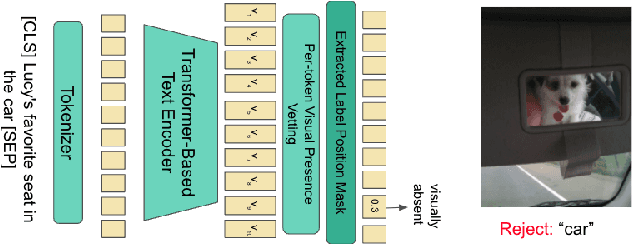
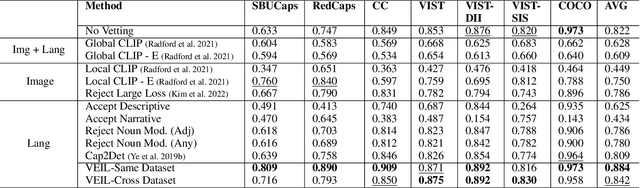
The use of large-scale vision-language datasets is limited for object detection due to the negative impact of label noise on localization. Prior methods have shown how such large-scale datasets can be used for pretraining, which can provide initial signal for localization, but is insufficient without clean bounding-box data for at least some categories. We propose a technique to "vet" labels extracted from noisy captions. Our method trains a classifier that predicts if an extracted label is actually present in the image or not. Our classifier generalizes across dataset boundaries and shows promise for generalizing across categories as well. We compare the classifier to eleven baselines on five datasets, and demonstrate that it can improve weakly-supervised detection without label vetting by 80% (16.0 to 29.1 mAP when evaluated on PASCAL VOC).