 Add to Chrome
 Add to Firefox
 Add to Edge
Certified Feedforward Tracking for Unknown Nonlinear Systems via Invertible Neural Networks
Aug 05, 2026
In this paper, we address the certification of datadriven feedforward control for periodic tracking of unknown nonlinear systems under partial state measurements. To this end, we adopt an invertible neural network (INN) as a surrogate for the unknown system. This choice allows us to bypass solving a nonconvex inversion problem, eliminating the associated inversion errors and reducing tracking error certification to a surrogate modeling problem. We then apply conformal prediction to provide finite-sample probabilistic guarantees on the surrogate modeling error which, through the derived tracking error bound, yield marginal certificates on feedforward tracking error. Finally, we demonstrate the approach on a DC-motor-driven mechanical load with nonlinear friction.

Learning-Based Decision Making for Combustion Phasing Control in Multi-Fuel CI Engines with Latent Fuel Reactivity Estimation
Jun 16, 2026Multi-fuel compression-ignition engines offer fuel flexibility but introduce uncertain, time-varying fuel reactivity, represented by cetane number (CN), which complicates cycle-to-cycle combustion-phasing control. This work formulates CA50 regulation under latent CN variation as a partially observable sequential decision problem and systematically evaluates controllers with increasing temporal and representational capacity, including LinUCB, history-augmented contextual bandits, observation-only DDPG, recurrent DDPG, and a proposed GRU-guided RL framework. A Gaussian-process surrogate trained on experimental multi-fuel engine data provides a controlled and reproducible evaluation environment. Results show that myopic and fixed-history bandit methods degrade under CN variation, observation-only RL suffers from latent-state aliasing, and generic recurrence is insufficient when CN evolves rapidly. The proposed framework learns a compact GRU-based representation of fuel reactivity from combustion history and conditions both actor and critic on this estimated signal rather than oracle CN. By training the policy on the same imperfect fuel-reactivity information available at deployment, the controller avoids train-deploy inconsistency in conventional online estimate-then-control pipelines. Across unseen CN trajectories, the policy achieves stable CA50 regulation with mean absolute tracking error below 0.25° CA at the training setpoint, while producing smooth, physically consistent SOI and glow-plug-power actuation. These results show that combustion control under latent, continuously evolving fuel dynamics requires more than standalone estimation or generic recurrence. By aligning fuel-reactivity inference with control policy learning, the proposed framework enables reactivity-aware decision-making using the same estimated state available during deployment.
Data-driven Control with Real-time Uncertainty Compensation for Multi-Fuel Engines
Jun 15, 2026Multi-fuel compression ignition (CI) engines offer superior power density and fuel flexibility. However, achieving consistent and optimal combustion phasing across a wide range of operating conditions remains a major challenge, particularly in the presence of modeling uncertainties. This paper presents a novel, data-driven real-time uncertainty compensation framework for combustion control in multi-fuel CI engines. The proposed approach introduces a pseudo-engine speed that enables dynamic adaptation of control inputs in response to uncertainty affecting the engine. To model the underlying combustion process, a Gaussian Process Regression (GPR) model is first trained on available input-output data, capturing the nonlinear and fuel-dependent behavior across varying operating conditions. Control inputs are then synthesized through model inversion of the learned GPR surrogate and augmented with an uncertainty compensator designed to mitigate deviations caused by dynamic variations in operating conditions and model inaccuracies. This integrated control strategy allows for real-time input corrections within a finite number of combustion cycles. Theoretical analysis establishes finite-time convergence guarantees for the proposed controller. Simulation results demonstrate that the proposed method steers the combustion phasing to the desired value in real-time, providing a scalable and adaptive control solution for multi-fuel CI engine operation.
Robust online reconstruction of continuous-time signals from a lean spike train ensemble code
Aug 14, 2024Sensory stimuli in animals are encoded into spike trains by neurons, offering advantages such as sparsity, energy efficiency, and high temporal resolution. This paper presents a signal processing framework that deterministically encodes continuous-time signals into biologically feasible spike trains, and addresses the questions about representable signal classes and reconstruction bounds. The framework considers encoding of a signal through spike trains generated by an ensemble of neurons using a convolve-then-threshold mechanism with various convolution kernels. A closed-form solution to the inverse problem, from spike trains to signal reconstruction, is derived in the Hilbert space of shifted kernel functions, ensuring sparse representation of a generalized Finite Rate of Innovation (FRI) class of signals. Additionally, inspired by real-time processing in biological systems, an efficient iterative version of the optimal reconstruction is formulated that considers only a finite window of past spikes, ensuring robustness of the technique to ill-conditioned encoding; convergence guarantees of the windowed reconstruction to the optimal solution are then provided. Experiments on a large audio dataset demonstrate excellent reconstruction accuracy at spike rates as low as one-fifth of the Nyquist rate, while showing clear competitive advantage in comparison to state-of-the-art sparse coding techniques in the low spike rate regime.
Spike-Triggered Descent
May 12, 2020
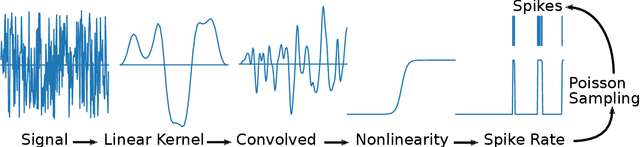
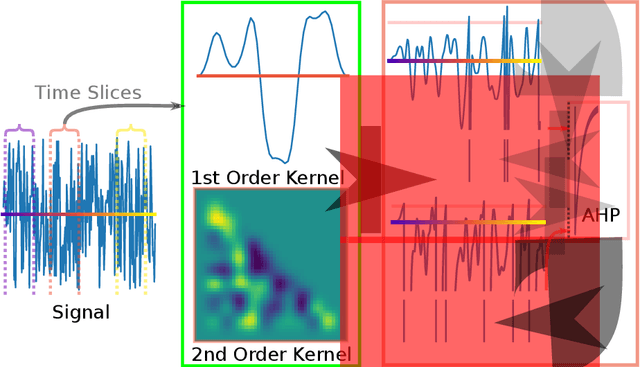
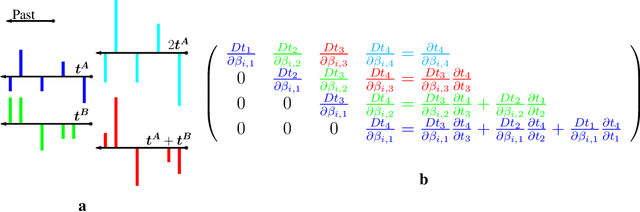
The characterization of neural responses to sensory stimuli is a central problem in neuroscience. Spike-triggered average (STA), an influential technique, has been used to extract optimal linear kernels in a variety of animal subjects. However, when the model assumptions are not met, it can lead to misleading and imprecise results. We introduce a technique, called spike-triggered descent (STD), which can be used alone or in conjunction with STA to increase precision and yield success in scenarios where STA fails. STD works by simulating a model neuron that learns to reproduce the observed spike train. Learning is achieved via parameter optimization that relies on a metric induced on the space of spike trains modeled as a novel inner product space. This technique can precisely learn higher order kernels using limited data. Kernels extracted from a Locusta migratoria tympanal nerve dataset demonstrate the strength of this approach.
Signal Coding and Perfect Reconstruction using Spike Trains
May 31, 2019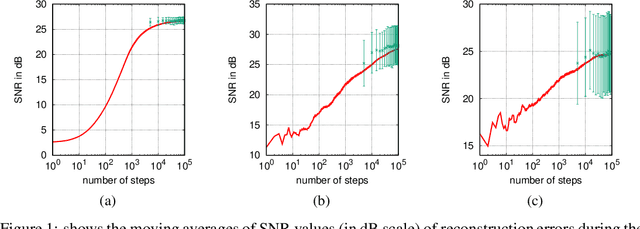
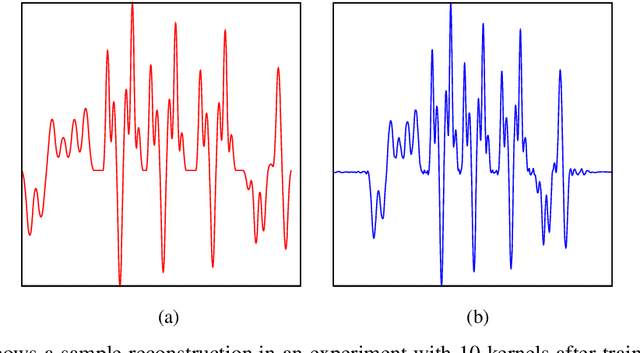
In many animal sensory pathways, the transformation from external stimuli to spike trains is essentially deterministic. In this context, a new mathematical framework for coding and reconstruction, based on a biologically plausible model of the spiking neuron, is presented. The framework considers encoding of a signal through spike trains generated by an ensemble of neurons via a standard convolve-then-threshold mechanism. Neurons are distinguished by their convolution kernels and threshold values. Reconstruction is posited as a convex optimization minimizing energy. Formal conditions under which perfect reconstruction of the signal from the spike trains is possible are then identified in this setup. Finally, a stochastic gradient descent mechanism is proposed to achieve these conditions. Simulation experiments are presented to demonstrate the strength and efficacy of the framework
Learning Feedforward and Recurrent Deterministic Spiking Neuron Network Feedback Controllers
Sep 25, 2018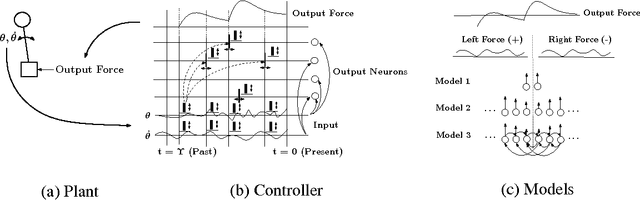

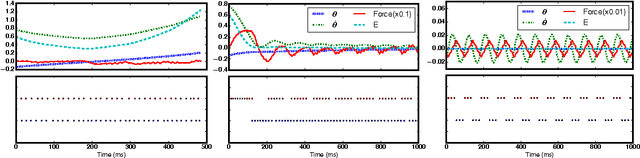
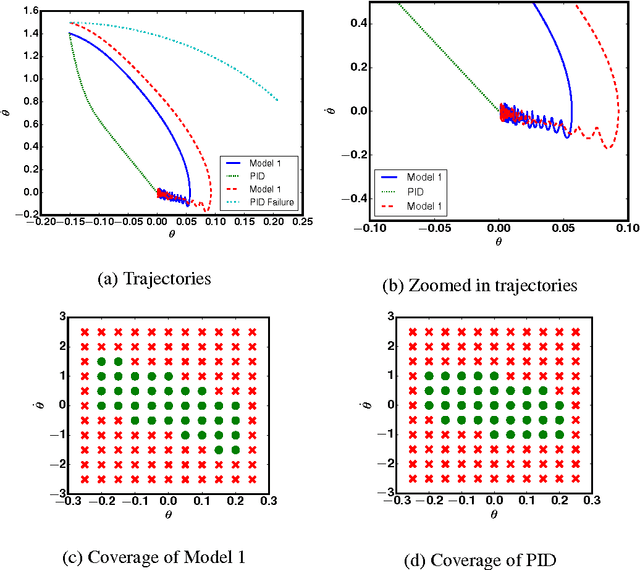
We address the problem of learning feedback control where the controller is a network constructed solely of deterministic spiking neurons. In contrast to previous investigations that were based on a spike rate model of the neuron, the control signal here is determined by the precise temporal positions of spikes generated by the output neurons of the network. We model the problem formally as a hybrid dynamical system comprised of a closed loop between a plant and a spiking neuron network. We derive a novel synaptic weight update rule via which the spiking neuron network controller learns to hold process variables at desired set points. The controller achieves its learning objective based solely on access to the plant's process variables and their derivatives with respect to changing control signals; in particular, it requires no internal model of the plant. We demonstrate the efficacy of the rule by applying it to the classical control problem of the cart-pole (inverted pendulum) and a model of fish locomotion. Experiments show that the proposed controller has a stability region comparable to a traditional PID controller, its trajectories differ qualitatively from those of a PID controller, and in many instances the controller achieves its objective using very sparse spike train outputs.
Multi-Scale Generalized Plane Match for Optical Flow
Apr 11, 2018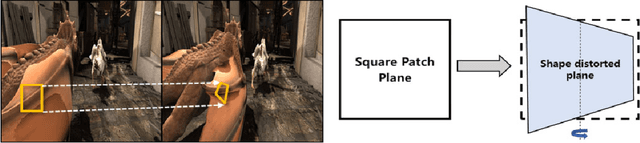
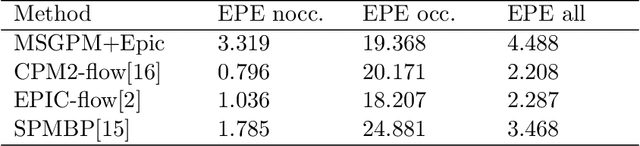

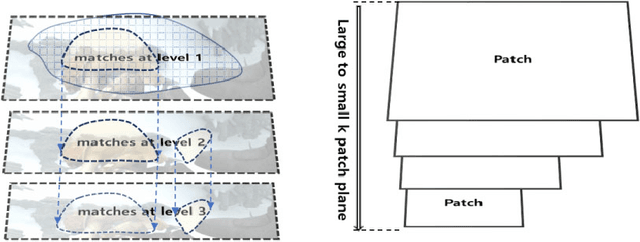
Despite recent advances, estimating optical flow remains a challenging problem in the presence of illumination change, large occlusions or fast movement. In this paper, we propose a novel optical flow estimation framework which can provide accurate dense correspondence and occlusion localization through a multi-scale generalized plane matching approach. In our method, we regard the scene as a collection of planes at multiple scales, and for each such plane, compensate motion in consensus to improve match quality. We estimate the square patch plane distortion using a robust plane model detection method and iteratively apply a plane matching scheme within a multi-scale framework. During the flow estimation process, our enhanced plane matching method also clearly localizes the occluded regions. In experiments on MPI-Sintel datasets, our method robustly estimated optical flow from given noisy correspondences, and also revealed the occluded regions accurately. Compared to other state-of-the-art optical flow methods, our method shows accurate occlusion localization, comparable optical flow quality, and better thin object detection.
Learning Precise Spike Train to Spike Train Transformations in Multilayer Feedforward Neuronal Networks
Jan 08, 2016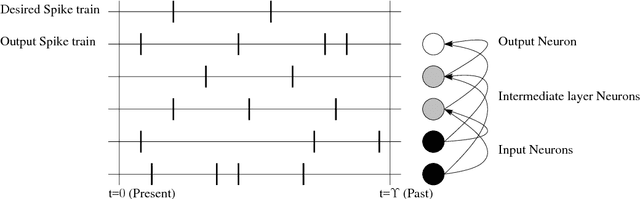
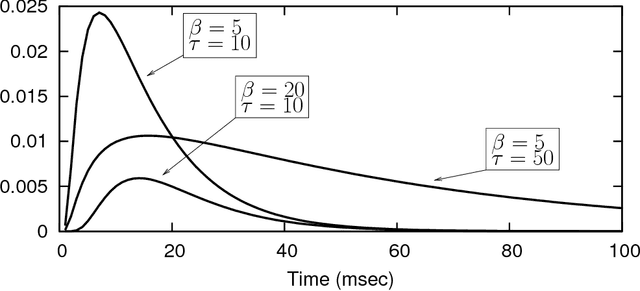
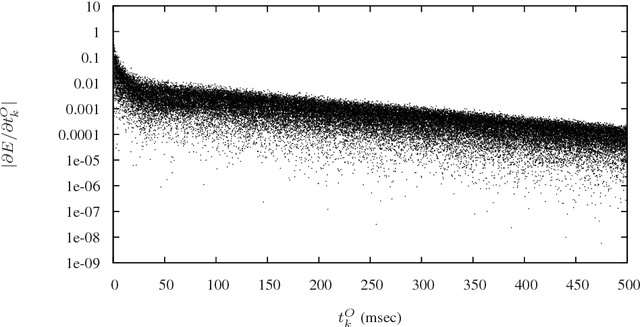
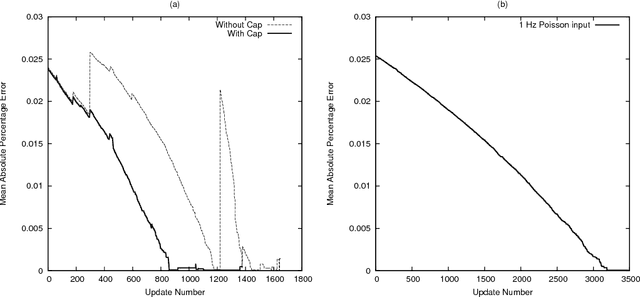
We derive a synaptic weight update rule for learning temporally precise spike train to spike train transformations in multilayer feedforward networks of spiking neurons. The framework, aimed at seamlessly generalizing error backpropagation to the deterministic spiking neuron setting, is based strictly on spike timing and avoids invoking concepts pertaining to spike rates or probabilistic models of spiking. The derivation is founded on two innovations. First, an error functional is proposed that compares the spike train emitted by the output neuron of the network to the desired spike train by way of their putative impact on a virtual postsynaptic neuron. This formulation sidesteps the need for spike alignment and leads to closed form solutions for all quantities of interest. Second, virtual assignment of weights to spikes rather than synapses enables a perturbation analysis of individual spike times and synaptic weights of the output as well as all intermediate neurons in the network, which yields the gradients of the error functional with respect to the said entities. Learning proceeds via a gradient descent mechanism that leverages these quantities. Simulation experiments demonstrate the efficacy of the proposed learning framework. The experiments also highlight asymmetries between synapses on excitatory and inhibitory neurons.
Sensitivity Analysis for additive STDP rule
Apr 13, 2015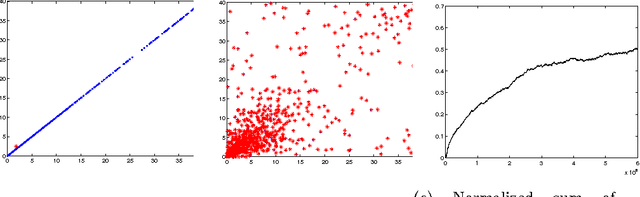

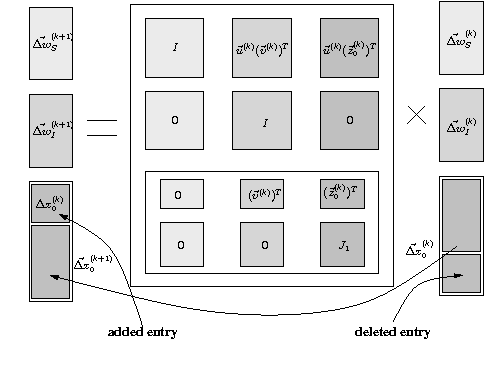
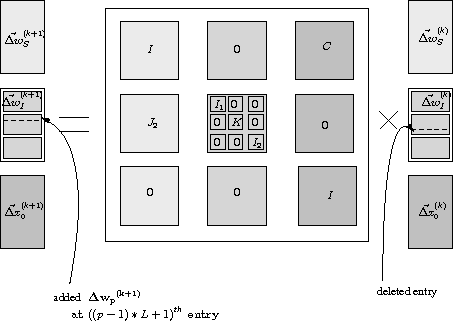
Spike Timing Dependent Plasticity (STDP) is a Hebbian like synaptic learning rule. The basis of STDP has strong experimental evidences and it depends on precise input and output spike timings. In this paper we show that under biologically plausible spiking regime, slight variability in the spike timing leads to drastically different evolution of synaptic weights when its dynamics are governed by the additive STDP rule.