 Add to Chrome
 Add to Firefox
 Add to Edge
Exploring the Effectiveness of Using LLMs for Automated Assessment of Student Self Explanations in Programming Education
May 20, 2026
Worked examples are step-by-step solutions to problems in a specific domain, offered to students to acquire domain-specific problem-solving skills. The effectiveness of worked examples could be enhanced by combining them with self-explanations, which ask students to explain rather than passively study each problem-solving step. The main challenge of this approach is assessing the correctness of the student's explanations. In the prevailing approach, student explanations are judged by their semantic similarity to an instructor's or domain expert's explanation. Given recent advances in LLM-based automated scoring, it remains unclear whether semantic similarity methods are still the most effective technique to automatically score textual student responses like essays or code explanations. Comparing these methods also requires quality datasets that offer distinctive features such as balanced class distributions and domain-specific labeled data for automated scoring tasks. In this paper, we present a rigorous comparison between LLMs and semantic similarity used for automated scoring, framed as a binary classification task.

A Pre-Trained Graph-Based Model for Adaptive Sequencing of Educational Documents
Nov 18, 2024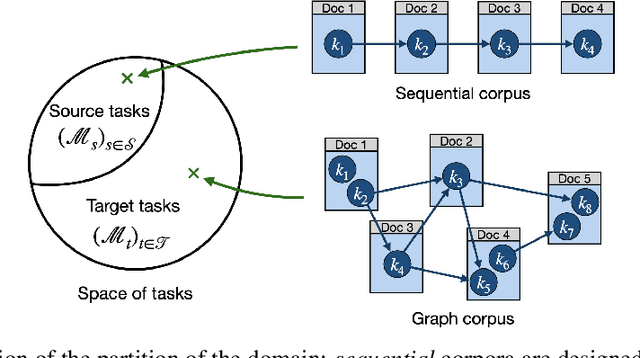
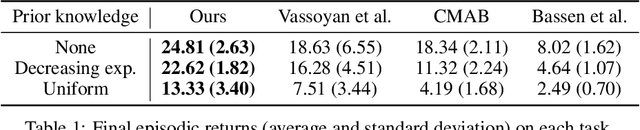
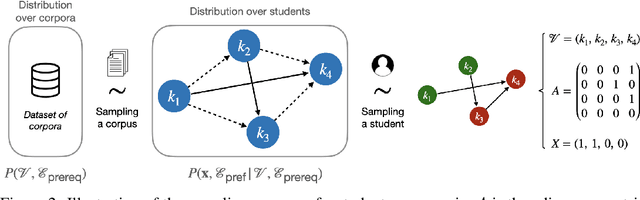
Massive Open Online Courses (MOOCs) have greatly contributed to making education more accessible. However, many MOOCs maintain a rigid, one-size-fits-all structure that fails to address the diverse needs and backgrounds of individual learners. Learning path personalization aims to address this limitation, by tailoring sequences of educational content to optimize individual student learning outcomes. Existing approaches, however, often require either massive student interaction data or extensive expert annotation, limiting their broad application. In this study, we introduce a novel data-efficient framework for learning path personalization that operates without expert annotation. Our method employs a flexible recommender system pre-trained with reinforcement learning on a dataset of raw course materials. Through experiments on semi-synthetic data, we show that this pre-training stage substantially improves data-efficiency in a range of adaptive learning scenarios featuring new educational materials. This opens up new perspectives for the design of foundation models for adaptive learning.