 Add to Chrome
 Add to Firefox
 Add to Edge
DIVO: Continuous-time DVL-Inertial-Visual Odometry for Unmanned Underwater Vehicles
Jul 06, 2026
This paper presents a novel acoustic-visual-inertial odometry solution leveraging a continuous-time trajectory estimation framework for unmanned underwater vehicles. Underwater environments present unique challenges for visual localization and mapping, such as light attenuation, illumination variance, and the presence of particulate matter. This motivates the use of additional sensing modalities and a visual tracking pipeline that is robust to diverse subsea conditions. The proposed system is the first continuous-time trajectory estimation framework based on Gaussian processes to fuse asynchronous measurements from a Doppler velocity log, a stereo camera, and an inertial measurement unit. Additionally, a novel visual frontend is proposed, incorporating learning-based feature extraction and matching that is robust to the specific challenges that subsea environments present. The proposed framework enables seamless integration of additional sensor modalities in continuous-time and is adaptable to different environments without reconfiguration. The proposed system is extensively tested on real-world underwater inspection datasets, where it outperforms state-of-the-art visual-inertial and acoustic-visual-inertial SLAM algorithms in accuracy, robustness, and trajectory coverage. Notably, the proposed system outperforms the state-of-the-art despite only forming short-term visual data associations.

Bayesian Filtering for Homography Estimation
Oct 16, 2023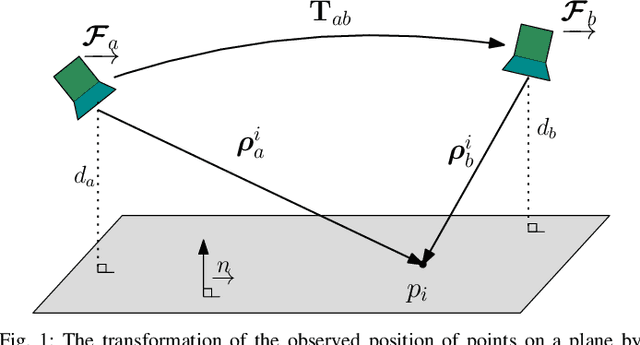
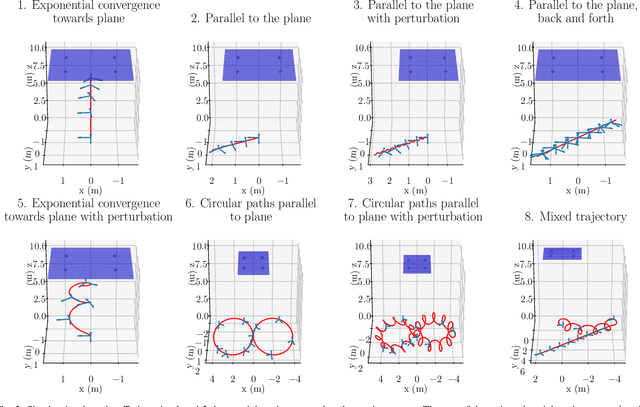
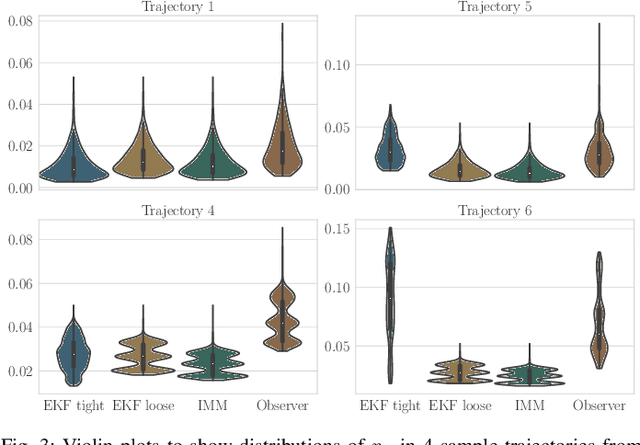
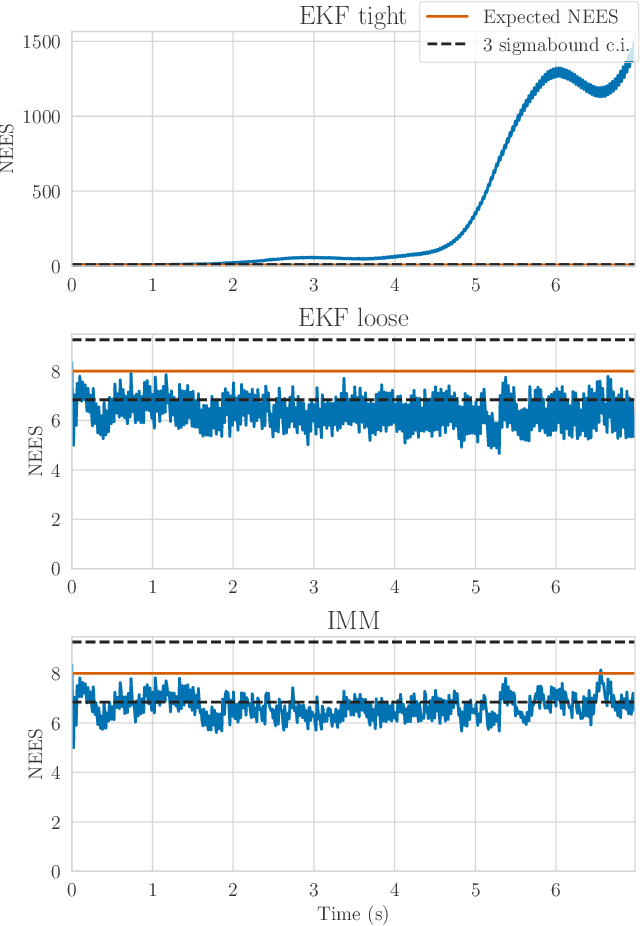
This paper considers homography estimation in a Bayesian filtering framework using rate gyro and camera measurements. The use of rate gyro measurements facilitates a more reliable estimate of homography in the presence of occlusions, while a Bayesian filtering approach generates both a homography estimate along with an uncertainty. Uncertainty information opens the door to adaptive filtering approaches, post-processing procedures, and safety protocols. In particular, herein an iterative extended Kalman filter and an interacting multiple model (IMM) filter are tested using both simulated and experimental datasets. The IMM is shown to have good consistency properties and better overall performance when compared to the state-of-the-art homography nonlinear deterministic observer in both simulations and experiments.