 Add to Chrome
 Add to Firefox
 Add to Edge
Generating synthetic computed tomography for radiotherapy: SynthRAD2025 challenge report
May 13, 2026
Radiation therapy (RT) requires precise dose delivery over multiple fractions, with CT fundamental for treatment planning due to its electron density information. Repeated CT acquisitions impose radiation exposure and logistical burdens, MRI lacks electron density, and cone-beam CT (CBCT) requires correction for dose calculation. Synthetic CT (sCT) generation addresses these by converting MRI or CBCT into CT-equivalent images with accurate Hounsfield Unit (HU) values, enabling MRI-only RT and CBCT-based adaptive workflows. Building on SynthRAD2023, SynthRAD2025 benchmarked sCT methods on 2,362 patients from five European centers across head and neck, thorax, and abdomen. Two tasks: MRI-to-CT (890 cases) and CBCT-to-CT (1,472 cases), evaluated via image similarity (MAE, PSNR, MS-SSIM), segmentation (Dice, HD95), and dosimetric metrics from photon and proton plans. With 803 participants and 12/13 valid submissions, Task 1 top performance reached MAE $64.8\pm21.3$ HU, PSNR $\sim$30 dB, MS-SSIM $\sim$0.936, Dice 0.79, photon $γ_{2\%/2\text{mm}}>98\%$, proton $γ\approx85\%$. Task 2 improved: MAE $48.3\pm13.4$ HU, PSNR 32.6 dB, MS-SSIM 0.968, Dice 0.86, photon $γ>99\%$, proton $γ\approx89\%$. Strong image--segmentation correlations ($ρ=0.78$--$0.79$) but moderate dose correlations confirmed image quality is insufficient as a dosimetric surrogate. Head-and-neck cases were most consistent; thoracic and abdominal cases showed greater variability. Residual errors at tissue interfaces propagate along beam paths, affecting proton dose more than photon. SynthRAD2025 demonstrates that deep learning yields clinically relevant sCTs, especially for CBCT-to-CT, while identifying persistent MRI-to-CT challenges and underscoring dose-based evaluation as essential for clinical validation.

Preserving Marker Specificity with Lightweight Channel-Independent Representation Learning
Dec 17, 2025Multiplexed tissue imaging measures dozens of protein markers per cell, yet most deep learning models still apply early channel fusion, assuming shared structure across markers. We investigate whether preserving marker independence, combined with deliberately shallow architectures, provides a more suitable inductive bias for self-supervised representation learning in multiplex data than increasing model scale. Using a Hodgkin lymphoma CODEX dataset with 145,000 cells and 49 markers, we compare standard early-fusion CNNs with channel-separated architectures, including a marker-aware baseline and our novel shallow Channel-Independent Model (CIM-S) with 5.5K parameters. After contrastive pretraining and linear evaluation, early-fusion models show limited ability to retain marker-specific information and struggle particularly with rare-cell discrimination. Channel-independent architectures, and CIM-S in particular, achieve substantially stronger representations despite their compact size. These findings are consistent across multiple self-supervised frameworks, remain stable across augmentation settings, and are reproducible across both the 49-marker and reduced 18-marker settings. These results show that lightweight, channel-independent architectures can match or surpass deep early-fusion CNNs and foundation models for multiplex representation learning. Code is available at https://github.com/SimonBon/CIM-S.
Deep Learning-Based Cross-Anatomy CT Synthesis Using Adapted nnResU-Net with Anatomical Feature Prioritized Loss
Sep 26, 2025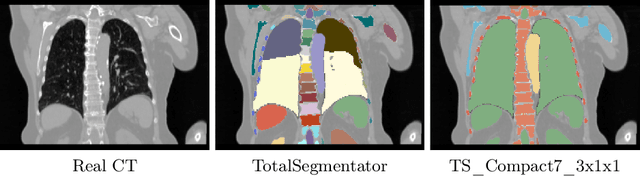
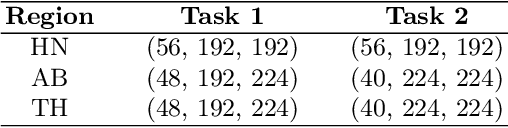

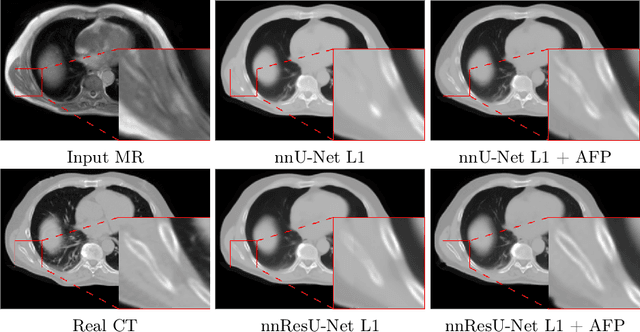
We present a patch-based 3D nnUNet adaptation for MR to CT and CBCT to CT image translation using the multicenter SynthRAD2025 dataset, covering head and neck (HN), thorax (TH), and abdomen (AB) regions. Our approach leverages two main network configurations: a standard UNet and a residual UNet, both adapted from nnUNet for image synthesis. The Anatomical Feature-Prioritized (AFP) loss was introduced, which compares multilayer features extracted from a compact segmentation network trained on TotalSegmentator labels, enhancing reconstruction of clinically relevant structures. Input volumes were normalized per-case using zscore normalization for MRIs, and clipping plus dataset level zscore normalization for CBCT and CT. Training used 3D patches tailored to each anatomical region without additional data augmentation. Models were trained for 1000 and 1500 epochs, with AFP fine-tuning performed for 500 epochs using a combined L1+AFP objective. During inference, overlapping patches were aggregated via mean averaging with step size of 0.3, and postprocessing included reverse zscore normalization. Both network configurations were applied across all regions, allowing consistent model design while capturing local adaptations through residual learning and AFP loss. Qualitative and quantitative evaluation revealed that residual networks combined with AFP yielded sharper reconstructions and improved anatomical fidelity, particularly for bone structures in MR to CT and lesions in CBCT to CT, while L1only networks achieved slightly better intensity-based metrics. This methodology provides a stable solution for cross modality medical image synthesis, demonstrating the effectiveness of combining the automatic nnUNet pipeline with residual learning and anatomically guided feature losses.
Anatomical feature-prioritized loss for enhanced MR to CT translation
Oct 14, 2024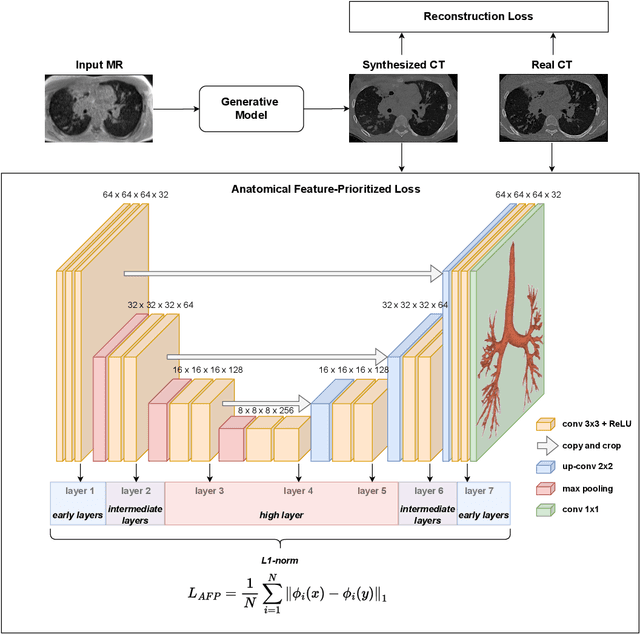


In medical image synthesis, the precision of localized structural details is crucial, particularly when addressing specific clinical requirements such as the identification and measurement of fine structures. Traditional methods for image translation and synthesis are generally optimized for global image reconstruction but often fall short in providing the finesse required for detailed local analysis. This study represents a step toward addressing this challenge by introducing a novel anatomical feature-prioritized (AFP) loss function into the synthesis process. This method enhances reconstruction by focusing on clinically significant structures, utilizing features from a pre-trained model designed for a specific downstream task, such as the segmentation of particular anatomical regions. The AFP loss function can replace or complement global reconstruction methods, ensuring a balanced emphasis on both global image fidelity and local structural details. Various implementations of this loss function are explored, including its integration into different synthesis networks such as GAN-based and CNN-based models. Our approach is applied and evaluated in two contexts: lung MR to CT translation, focusing on high-quality reconstruction of bronchial structures, using a private dataset; and pelvis MR to CT synthesis, targeting the accurate representation of organs and muscles, utilizing a public dataset from the Synthrad2023 challenge. We leverage embeddings from pre-trained segmentation models specific to these anatomical regions to demonstrate the capability of the AFP loss to prioritize and accurately reconstruct essential features. This tailored approach shows promising potential for enhancing the specificity and practicality of medical image synthesis in clinical applications.