 Add to Chrome
 Add to Firefox
 Add to Edge
Momentum Further Constrains Sharpness at the Edge of Stochastic Stability
Apr 15, 2026
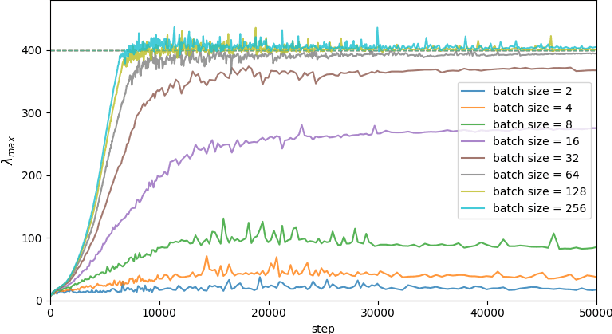
Recent work suggests that (stochastic) gradient descent self-organizes near an instability boundary, shaping both optimization and the solutions found. Momentum and mini-batch gradients are widely used in practical deep learning optimization, but it remains unclear whether they operate in a comparable regime of instability. We demonstrate that SGD with momentum exhibits an Edge of Stochastic Stability (EoSS)-like regime with batch-size-dependent behavior that cannot be explained by a single momentum-adjusted stability threshold. Batch Sharpness (the expected directional mini-batch curvature) stabilizes in two distinct regimes: at small batch sizes it converges to a lower plateau $2(1-β)/η$, reflecting amplification of stochastic fluctuations by momentum and favoring flatter regions than vanilla SGD; at large batch sizes it converges to a higher plateau $2(1+β)/η$, where momentum recovers its classical stabilizing effect and favors sharper regions consistent with full-batch dynamics. We further show that this aligns with linear stability thresholds and discuss the implications for hyperparameter tuning and coupling.

Edge of Stochastic Stability: Revisiting the Edge of Stability for SGD
Dec 29, 2024
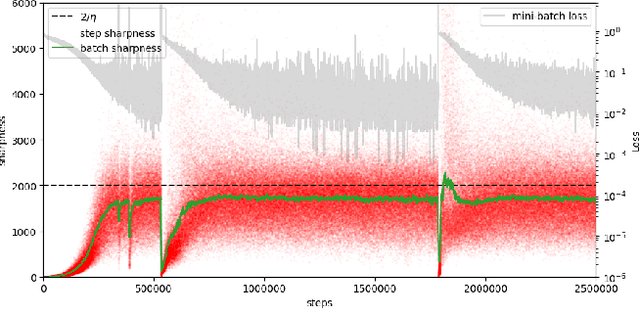
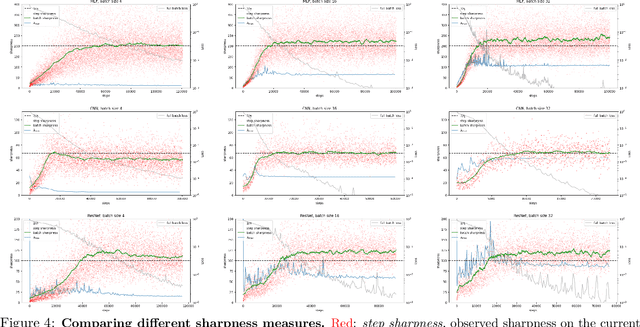
Recent findings by Cohen et al., 2021, demonstrate that when training neural networks with full-batch gradient descent at a step size of $\eta$, the sharpness--defined as the largest eigenvalue of the full batch Hessian--consistently stabilizes at $2/\eta$. These results have significant implications for convergence and generalization. Unfortunately, this was observed not to be the case for mini-batch stochastic gradient descent (SGD), thus limiting the broader applicability of these findings. We show that SGD trains in a different regime we call Edge of Stochastic Stability. In this regime, what hovers at $2/\eta$ is, instead, the average over the batches of the largest eigenvalue of the Hessian of the mini batch (MiniBS) loss--which is always bigger than the sharpness. This implies that the sharpness is generally lower when training with smaller batches or bigger learning rate, providing a basis for the observed implicit regularization effect of SGD towards flatter minima and a number of well established empirical phenomena. Additionally, we quantify the gap between the MiniBS and the sharpness, further characterizing this distinct training regime.