 Add to Chrome
 Add to Firefox
 Add to Edge
Collaborative Human-Agent Protocol (CHAP)
Jun 08, 2026
Foundation models are moving from response generation into operational roles. They plan across steps, call tools, request human input, coordinate with other agents, and increasingly carry responsibility for work that affects customers, claims, code, contracts, and clinical decisions. Production deployments are no longer one human supervising one model. They are multi-human, multi-agent collaborations that cross teams, time zones, and trust boundaries. The technical surface for this collaboration remains weakly specified. When an agent drafts a response and a human edits it before it ships, the moment of human judgement is the most valuable signal in the system. In current practice it is recorded, if at all, in application code, chat threads, ticket comments, and tribal memory. Two protocol standards address adjacent concerns: MCP standardises agent access to tools and data, and A2A standardises agent-to-agent interoperability. Neither defines the shared workspace in which humans and agents perform accountable work together. This paper presents CHAP, the Collaborative Human-Agent Protocol. Under CHAP, the override that used to vanish into a chat thread becomes a structured event carrying a diff, a rationale, and a content hash. The handoff between shifts becomes a portable envelope rather than a pinned message. The human approval of an agent's draft becomes a non-repudiable signed decision that can be replayed years later. The protocol achieves this through a small Core (workspaces, participants, tasks, artefacts, and an append-only evidence log) together with composable profiles that add review, modes, routing, deliberation, handoff, identity, signatures, and transparency-backed audit as deployments require them. Specification, reference implementation, conformance suite, and worked examples are available at: https://github.com/BrightbeamAI/chap

Using Large Language Models to Construct Virtual Top Managers: A Method for Organizational Research
Jan 26, 2026This study introduces a methodological framework that uses large language models to create virtual personas of real top managers. Drawing on real CEO communications and Moral Foundations Theory, we construct LLM-based participants that simulate the decision-making of individual leaders. Across three phases, we assess construct validity, reliability, and behavioral fidelity by benchmarking these virtual CEOs against human participants. Our results indicate that theoretically scaffolded personas approximate the moral judgements observed in human samples, suggesting that LLM-based personas can serve as credible and complementary tools for organizational research in contexts where direct access to executives is limited. We conclude by outlining implications for future research using LLM-based personas in organizational settings.
The Future of MLLM Prompting is Adaptive: A Comprehensive Experimental Evaluation of Prompt Engineering Methods for Robust Multimodal Performance
Apr 14, 2025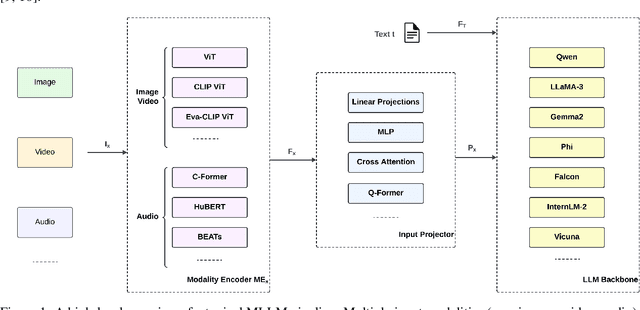
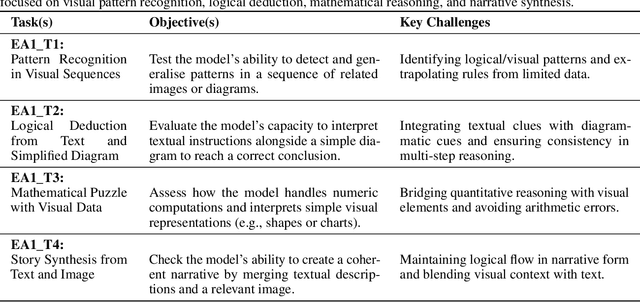
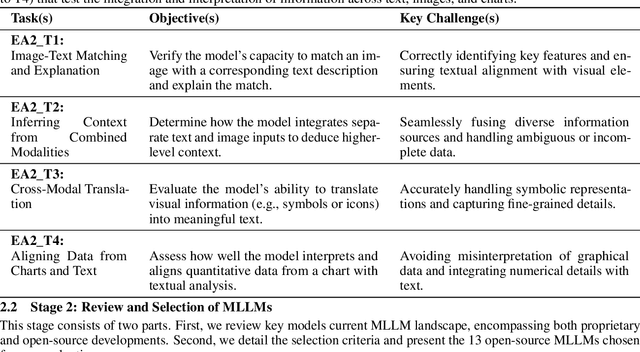
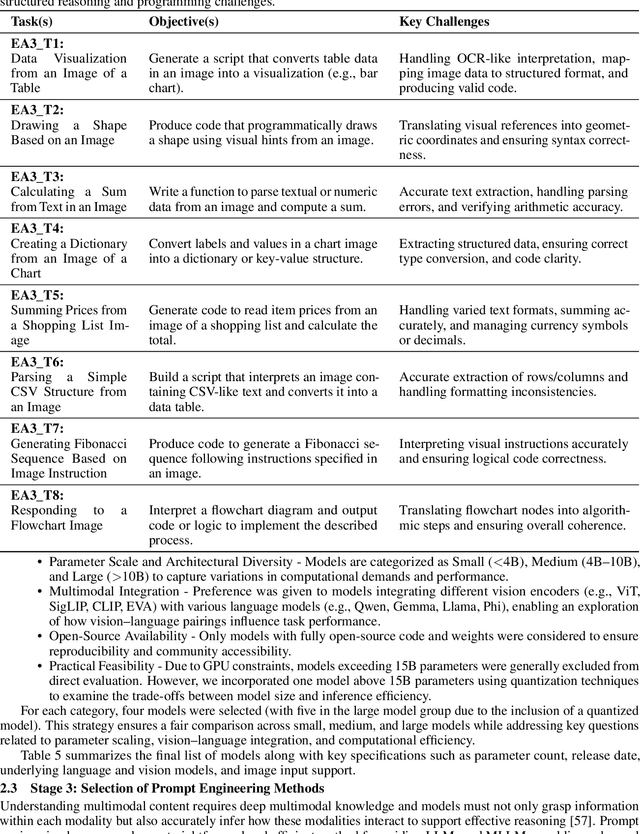
Multimodal Large Language Models (MLLMs) are set to transform how machines process and generate human-like responses by integrating diverse modalities such as text, images, and code. Yet, effectively harnessing their capabilities hinges on optimal prompt engineering. We present a comprehensive experimental evaluation of seven prompt engineering methods applied to 13 open-source MLLMs over 24 tasks spanning Reasoning and Compositionality, Multimodal Understanding and Alignment, Complex Code Generation and Execution, and Knowledge Retrieval and Integration. Our approach stratifies models by parameter count into Small (<4B), Medium (4B-10B), and Large (>10B) categories and compares prompting techniques including Zero-Shot, One-Shot, Few-Shot, Chain-of-Thought, Analogical, Generated Knowledge, and Tree-of-Thought. While Large MLLMs excel in structured tasks such as code generation, achieving accuracies up to 96.88% under Few-Shot prompting, all models struggle with complex reasoning and abstract understanding, often yielding accuracies below 60% and high hallucination rates. Structured reasoning prompts frequently increased hallucination up to 75% in small models and led to longer response times (over 20 seconds in Large MLLMs), while simpler prompting methods provided more concise and efficient outputs. No single prompting method uniformly optimises all task types. Instead, adaptive strategies combining example-based guidance with selective structured reasoning are essential to enhance robustness, efficiency, and factual accuracy. Our findings offer practical recommendations for prompt engineering and support more reliable deployment of MLLMs across applications including AI-assisted coding, knowledge retrieval, and multimodal content understanding.
The Ultimate Guide to Fine-Tuning LLMs from Basics to Breakthroughs: An Exhaustive Review of Technologies, Research, Best Practices, Applied Research Challenges and Opportunities
Aug 23, 2024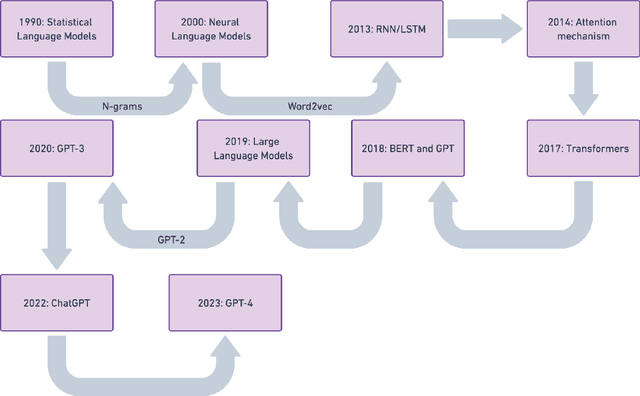
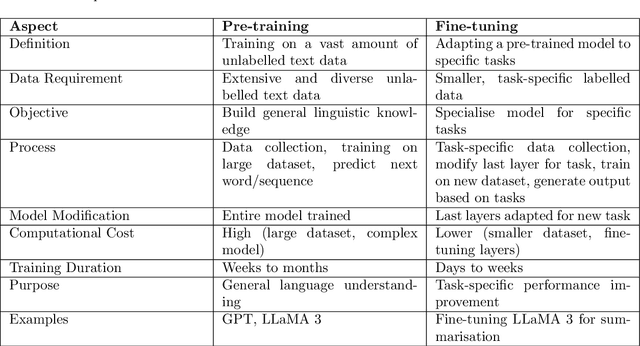
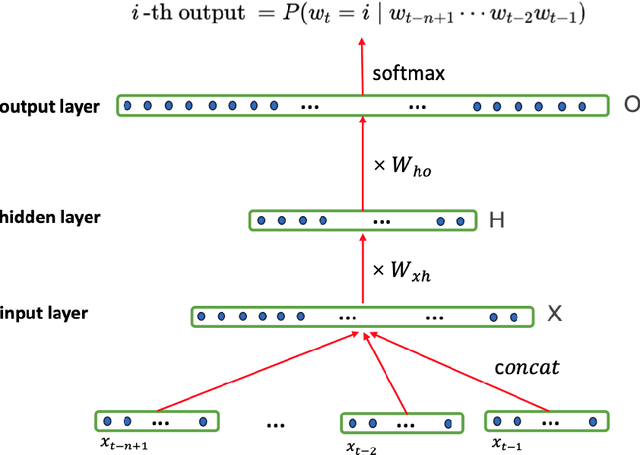
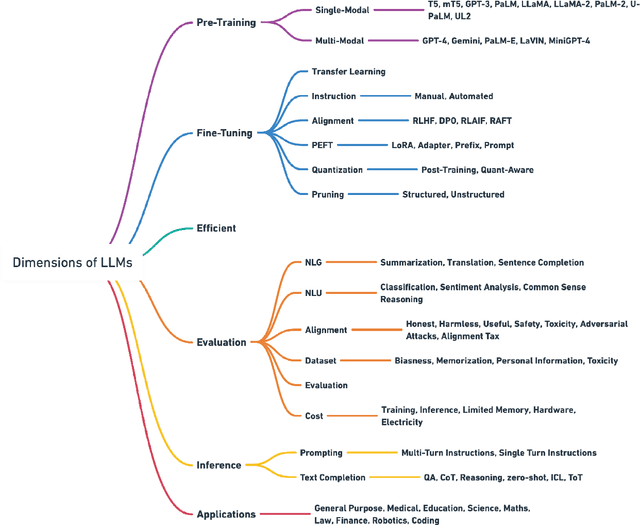
This report examines the fine-tuning of Large Language Models (LLMs), integrating theoretical insights with practical applications. It outlines the historical evolution of LLMs from traditional Natural Language Processing (NLP) models to their pivotal role in AI. A comparison of fine-tuning methodologies, including supervised, unsupervised, and instruction-based approaches, highlights their applicability to different tasks. The report introduces a structured seven-stage pipeline for fine-tuning LLMs, spanning data preparation, model initialization, hyperparameter tuning, and model deployment. Emphasis is placed on managing imbalanced datasets and optimization techniques. Parameter-efficient methods like Low-Rank Adaptation (LoRA) and Half Fine-Tuning are explored for balancing computational efficiency with performance. Advanced techniques such as memory fine-tuning, Mixture of Experts (MoE), and Mixture of Agents (MoA) are discussed for leveraging specialized networks and multi-agent collaboration. The report also examines novel approaches like Proximal Policy Optimization (PPO) and Direct Preference Optimization (DPO), which align LLMs with human preferences, alongside pruning and routing optimizations to improve efficiency. Further sections cover validation frameworks, post-deployment monitoring, and inference optimization, with attention to deploying LLMs on distributed and cloud-based platforms. Emerging areas such as multimodal LLMs, fine-tuning for audio and speech, and challenges related to scalability, privacy, and accountability are also addressed. This report offers actionable insights for researchers and practitioners navigating LLM fine-tuning in an evolving landscape.
Building Trust in Conversational AI: A Comprehensive Review and Solution Architecture for Explainable, Privacy-Aware Systems using LLMs and Knowledge Graph
Aug 13, 2023Conversational AI systems have emerged as key enablers of human-like interactions across diverse sectors. Nevertheless, the balance between linguistic nuance and factual accuracy has proven elusive. In this paper, we first introduce LLMXplorer, a comprehensive tool that provides an in-depth review of over 150 Large Language Models (LLMs), elucidating their myriad implications ranging from social and ethical to regulatory, as well as their applicability across industries. Building on this foundation, we propose a novel functional architecture that seamlessly integrates the structured dynamics of Knowledge Graphs with the linguistic capabilities of LLMs. Validated using real-world AI news data, our architecture adeptly blends linguistic sophistication with factual rigour and further strengthens data security through Role-Based Access Control. This research provides insights into the evolving landscape of conversational AI, emphasizing the imperative for systems that are efficient, transparent, and trustworthy.