 Add to Chrome
 Add to Firefox
 Add to Edge
CSB: A Counting and Sampling tool for Bit-vectors
Jul 05, 2026
Satisfiability modulo theory (SMT) solvers have significantly advanced automated reasoning due to their effectiveness in solving problems across various fields. With the advancement in SMT solvers, there is growing interest in exploring capabilities beyond mere satisfiability, similar to the progression observed in Boolean satisfiability solvers that expanded into counting and sampling. In this study, we investigate the following question: Can we rely on modern CNF model counters and CNF samplers to extend modern SMT solvers to handle the problems of counting and sampling over bit-vectors? The main contribution of this work is the development of an efficient and user-friendly tool, csb, that solves a bunch of problems around model counting and sampling on the theory of bit-vectors, namely exact and approximate projected and non-projected model counting, along with the almost-uniform and uniform-like sampling. In the case of exact counting, projected counting, and uniform sampling. Our tool csb converts the bit-vector formula into a CNF formula using bit-blasting techniques before applying CNF model counters or samplers to perform counting or sampling. Our experiments demonstrate significant performance improvements over existing methods.
* This is the authors' version of the article published in Acta Informatica

Approximate SMT Counting Beyond Discrete Domains
Jul 24, 2025Satisfiability Modulo Theory (SMT) solvers have advanced automated reasoning, solving complex formulas across discrete and continuous domains. Recent progress in propositional model counting motivates extending SMT capabilities toward model counting, especially for hybrid SMT formulas. Existing approaches, like bit-blasting, are limited to discrete variables, highlighting the challenge of counting solutions projected onto the discrete domain in hybrid formulas. We introduce pact, an SMT model counter for hybrid formulas that uses hashing-based approximate model counting to estimate solutions with theoretical guarantees. pact makes a logarithmic number of SMT solver calls relative to the projection variables, leveraging optimized hash functions. pact achieves significant performance improvements over baselines on a large suite of benchmarks. In particular, out of 14,202 instances, pact successfully finished on 603 instances, while Baseline could only finish on 13 instances.
Model Counting in the Wild
Aug 13, 2024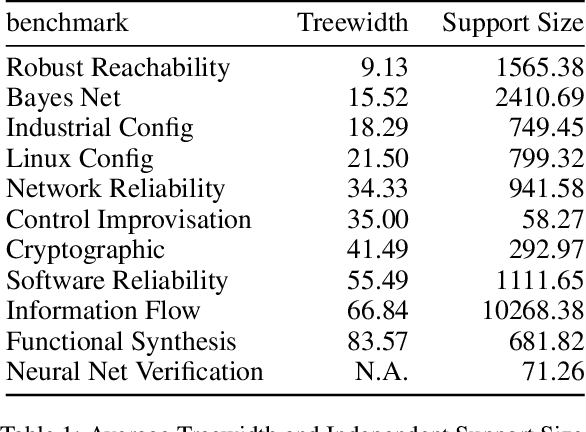
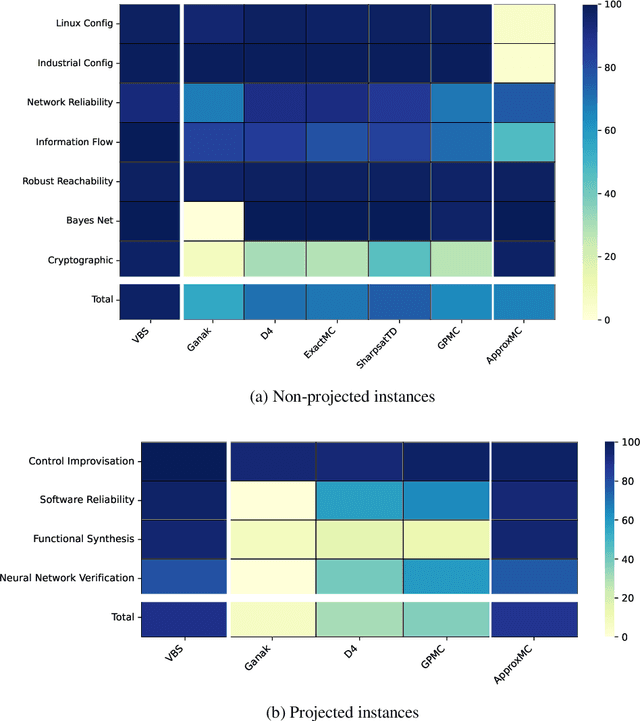
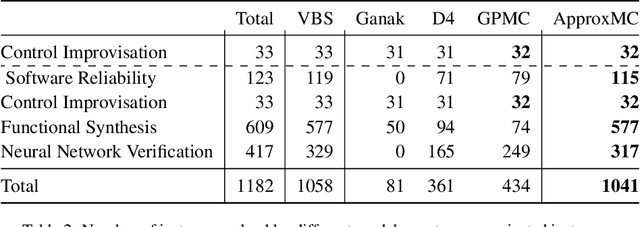
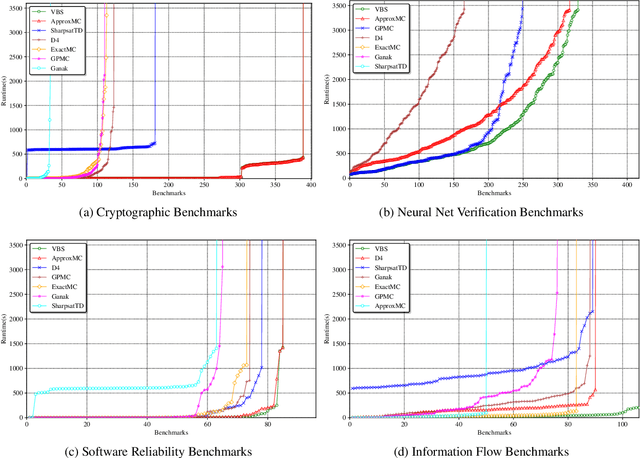
Model counting is a fundamental problem in automated reasoning with applications in probabilistic inference, network reliability, neural network verification, and more. Although model counting is computationally intractable from a theoretical perspective due to its #P-completeness, the past decade has seen significant progress in developing state-of-the-art model counters to address scalability challenges. In this work, we conduct a rigorous assessment of the scalability of model counters in the wild. To this end, we surveyed 11 application domains and collected an aggregate of 2262 benchmarks from these domains. We then evaluated six state-of-the-art model counters on these instances to assess scalability and runtime performance. Our empirical evaluation demonstrates that the performance of model counters varies significantly across different application domains, underscoring the need for careful selection by the end user. Additionally, we investigated the behavior of different counters with respect to two parameters suggested by the model counting community, finding only a weak correlation. Our analysis highlights the challenges and opportunities for portfolio-based approaches in model counting.
Explaining SAT Solving Using Causal Reasoning
Jun 09, 2023The past three decades have witnessed notable success in designing efficient SAT solvers, with modern solvers capable of solving industrial benchmarks containing millions of variables in just a few seconds. The success of modern SAT solvers owes to the widely-used CDCL algorithm, which lacks comprehensive theoretical investigation. Furthermore, it has been observed that CDCL solvers still struggle to deal with specific classes of benchmarks comprising only hundreds of variables, which contrasts with their widespread use in real-world applications. Consequently, there is an urgent need to uncover the inner workings of these seemingly weak yet powerful black boxes. In this paper, we present a first step towards this goal by introducing an approach called CausalSAT, which employs causal reasoning to gain insights into the functioning of modern SAT solvers. CausalSAT initially generates observational data from the execution of SAT solvers and learns a structured graph representing the causal relationships between the components of a SAT solver. Subsequently, given a query such as whether a clause with low literals blocks distance (LBD) has a higher clause utility, CausalSAT calculates the causal effect of LBD on clause utility and provides an answer to the question. We use CausalSAT to quantitatively verify hypotheses previously regarded as "rules of thumb" or empirical findings such as the query above. Moreover, CausalSAT can address previously unexplored questions, like which branching heuristic leads to greater clause utility in order to study the relationship between branching and clause management. Experimental evaluations using practical benchmarks demonstrate that CausalSAT effectively fits the data, verifies four "rules of thumb", and provides answers to three questions closely related to implementing modern solvers.