 Add to Chrome
 Add to Firefox
 Add to Edge
Smooth Feedback Motion Planning with Reduced Curvature
Apr 02, 2026
Feedback motion planning over cell decompositions provides a robust method for generating collision-free robot motion with formal guarantees. However, existing algorithms often produce paths with unnecessary bending, leading to slower motion and higher control effort. This paper presents a computationally efficient method to mitigate this issue for a given simplicial decomposition. A heuristic is introduced that systematically aligns and assigns local vector fields to produce more direct trajectories, complemented by a novel geometric algorithm that constructs a maximal star-shaped chain of simplexes around the goal. This creates a large ``funnel'' in which an optimal, direct-to-goal control law can be safely applied. Simulations demonstrate that our method generates measurably more direct paths, reducing total bending by an average of 91.40\% and LQR control effort by an average of 45.47\%. Furthermore, comparative analysis against sampling-based and optimization-based planners confirms the time efficacy and robustness of our approach. While the proposed algorithms work over any finite-dimensional simplicial complex embedded in the collision-free subset of the configuration space, the practical application focuses on low-dimensional ($d\le3$) configuration spaces, where simplicial decomposition is computationally tractable.

Impact Invariant Trajectory Optimization of 5-Link Biped Robot Using Hybrid Optimization
Dec 31, 2022
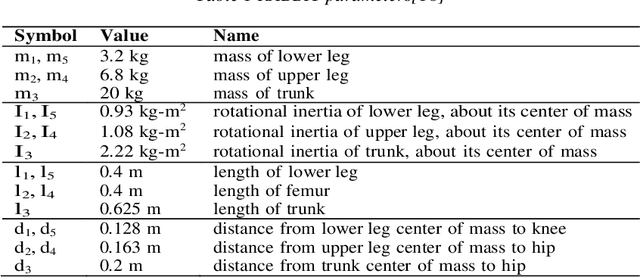
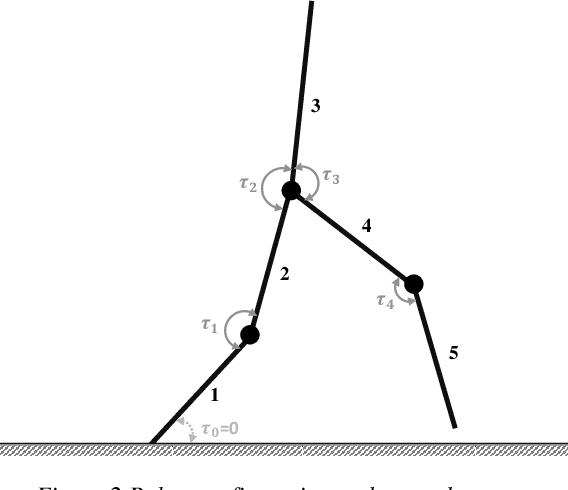
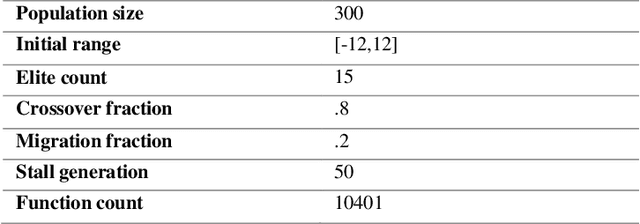
Bipedal robots have received much attention because of the variety of motion maneuvers that they can produce, and the many applications they have in various areas including rehabilitation. One of these motion maneuvers is walking. In this study, we presented a framework for the trajectory optimization of a 5-link (planar) Biped Robot using hybrid optimization. The walking is modeled with two phases of single-stance (support) phase and the collision phase. The dynamic equations of the robot in each phase are extracted by the Lagrange method. It is assumed that the robot heel strike to the ground is full plastic. The gait is optimized with a method called hybrid optimization. The objective function of this problem is considered to be the integral of torque-squared along the trajectory, and also various constraints such as zero dynamics are satisfied without any approximation. Furthermore, in a new framework, there is presented a constraint called impact invariance, which ensures the periodicity of the time-varying trajectories. On the other hand, other constraints provide better and more human-like movement.
Optimal Motion Generation of the Bipedal Under-Actuated Planar Robot for Stair Climbing
Dec 31, 2022The importance of humanoid robots in today's world is undeniable, one of the most important features of humanoid robots is the ability to maneuver in environments such as stairs that other robots can not easily cross. A suitable algorithm to generate the path for the bipedal robot to climb is very important. In this paper, an optimization-based method to generate an optimal stairway for under-actuated bipedal robots without an ankle actuator is presented. The generated paths are based on zero and non-zero dynamics of the problem, and according to the satisfaction of the zero dynamics constraint in the problem, tracking the path is possible, in other words, the problem can be dynamically feasible. The optimization method used in the problem is a gradient-based method that has a suitable number of function evaluations for computational processing. This method can also be utilized to go down the stairs.