 Add to Chrome
 Add to Firefox
 Add to Edge
A versatile machine learning workflow for high-throughput analysis of supported metal catalyst particles
Oct 02, 2024
Accurate and efficient characterization of nanoparticles (NPs), particularly regarding particle size distribution, is essential for advancing our understanding of their structure-property relationships and facilitating their design for various applications. In this study, we introduce a novel two-stage artificial intelligence (AI)-driven workflow for NP analysis that leverages prompt engineering techniques from state-of-the-art single-stage object detection and large-scale vision transformer (ViT) architectures. This methodology was applied to transmission electron microscopy (TEM) and scanning TEM (STEM) images of heterogeneous catalysts, enabling high-resolution, high-throughput analysis of particle size distributions for supported metal catalysts. The model's performance in detecting and segmenting NPs was validated across diverse heterogeneous catalyst systems, including various metals (Cu, Ru, Pt, and PtCo), supports (silica ($\text{SiO}_2$), $\gamma$-alumina ($\gamma$-$\text{Al}_2\text{O}_3$), and carbon black), and particle diameter size distributions with means and standard deviations of 2.9 $\pm$ 1.1 nm, 1.6 $\pm$ 0.2 nm, 9.7 $\pm$ 4.6 nm, and 4 $\pm$ 1.0 nm. Additionally, the proposed machine learning (ML) approach successfully detects and segments overlapping NPs anchored on non-uniform catalytic support materials, providing critical insights into their spatial arrangements and interactions. Our AI-assisted NP analysis workflow demonstrates robust generalization across diverse datasets and can be readily applied to similar NP segmentation tasks without requiring costly model retraining.

A Deep Learning Approach for Semantic Segmentation of Unbalanced Data in Electron Tomography of Catalytic Materials
Jan 18, 2022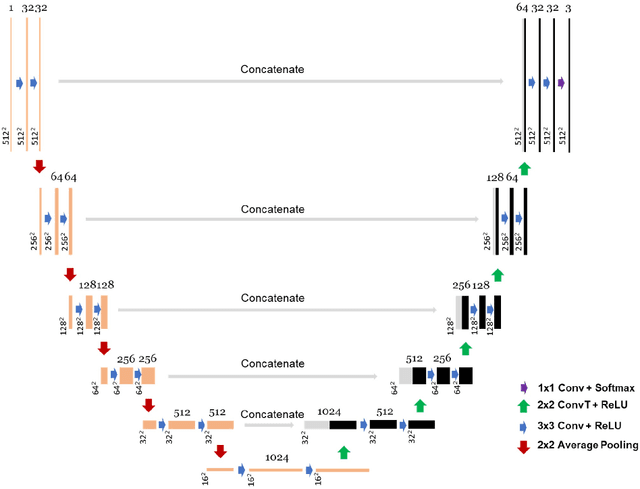
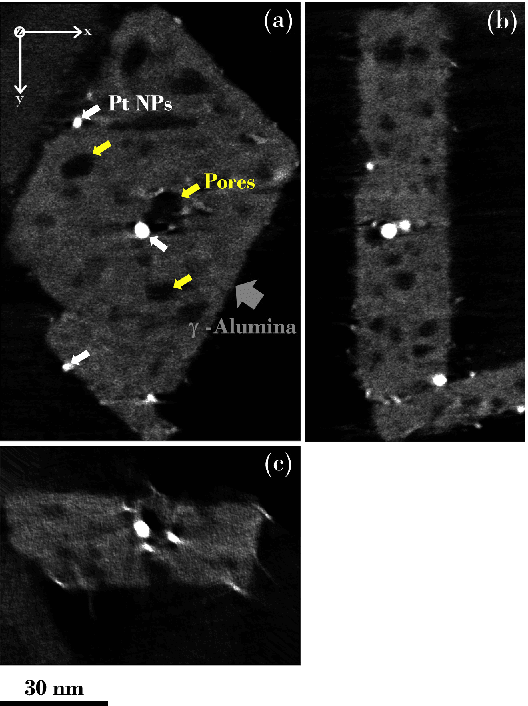
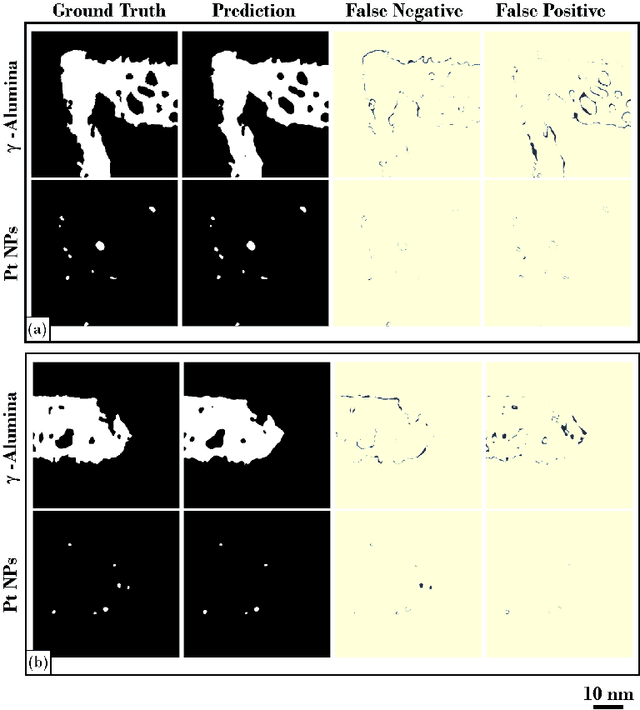
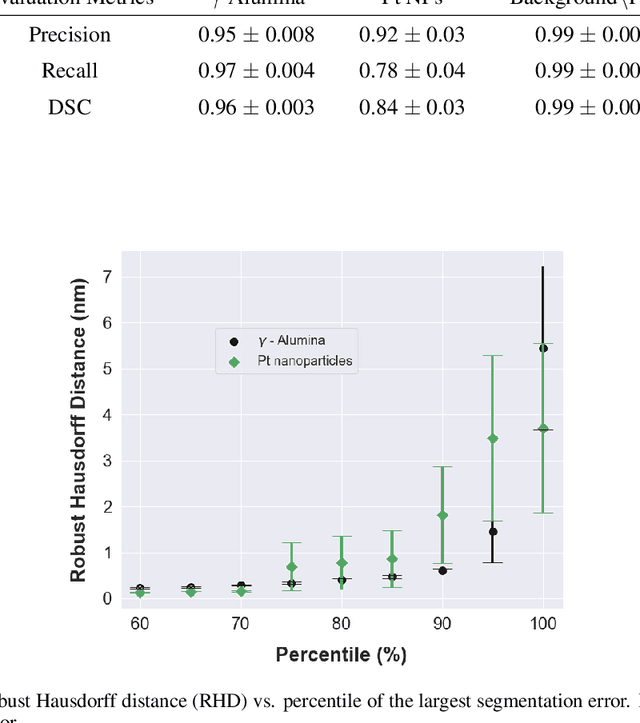
Heterogeneous catalysts possess complex surface and bulk structures, relatively poor intrinsic contrast, and often a sparse distribution of the catalytic nanoparticles (NPs), posing a significant challenge for image segmentation, including the current state-of-the-art deep learning methods. To tackle this problem, we apply a deep learning-based approach for the multi-class semantic segmentation of a $\gamma$-Alumina/Pt catalytic material in a class imbalance situation. Specifically, we used the weighted focal loss as a loss function and attached it to the U-Net's fully convolutional network architecture. We assessed the accuracy of our results using Dice similarity coefficient (DSC), recall, precision, and Hausdorff distance (HD) metrics on the overlap between the ground-truth and predicted segmentations. Our adopted U-Net model with the weighted focal loss function achieved an average DSC score of 0.96 $\pm$ 0.003 in the $\gamma$-Alumina support material and 0.84 $\pm$ 0.03 in the Pt NPs segmentation tasks. We report an average boundary-overlap error of less than 2 nm at the 90th percentile of HD for $\gamma$-Alumina and Pt NPs segmentations. The complex surface morphology of the $\gamma$-Alumina and its relation to the Pt NPs were visualized in 3D by the deep learning-assisted automatic segmentation of a large data set of high-angle annular dark-field (HAADF) scanning transmission electron microscopy (STEM) tomography reconstructions.