 Add to Chrome
 Add to Firefox
 Add to Edge
L-TGVN: Leveraging Longitudinal Priors for Personalized Rapid MRI
Jun 03, 2026
MRI provides excellent soft-tissue contrast without ionizing radiation, but long acquisition times increase patient discomfort while also raising exam costs and limiting scanner throughput. A common approach to reduce scan time is to acquire fewer measurements, which yields an ill-posed linear inverse problem; recovering diagnostic-quality images therefore requires incorporating prior knowledge beyond the measured data. In follow-up exams, the most recent prior scan of a patient can provide a highly informative subject-specific context, but practical use is complicated by temporal changes (including pathology progression), misalignment between scans, and protocol drift across acquisitions. In this work, we introduce L-TGVN, a Longitudinal Trust-Guided Variational Network that leverages prior scans as side information to reconstruct the current scan from heavily undersampled measurements. Crucially, L-TGVN constrains the influence of prior scans to be consistent with the acquired measurements. Unlike many existing longitudinal reconstruction methods, it does not require explicit pre-registration between prior and current scans. It further accommodates differences in acquisition protocols across visits (e.g., changes in sequence parameters). We evaluate L-TGVN against matched-capacity baselines, including prior-guided methods and methods that do not use longitudinal priors, and observe consistent improvements in standard quantitative metrics together with better preservation of fine structures at challenging accelerations. Source code is available at github.com/sodicksonlab/L-TGVN.

A Trust-Guided Approach to MR Image Reconstruction with Side Information
Jan 06, 2025


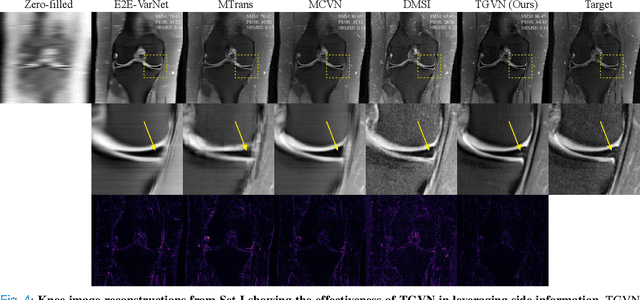
Reducing MRI scan times can improve patient care and lower healthcare costs. Many acceleration methods are designed to reconstruct diagnostic-quality images from limited sets of acquired $\textit{k}$-space data. This task can be framed as a linear inverse problem (LIP), where, as a result of undersampling, the forward operator may become rank-deficient or exhibit small singular values. This results in ambiguities in reconstruction, in which multiple generally incorrect or non-diagnostic images can map to the same acquired data. To address such ambiguities, it is crucial to incorporate prior knowledge, for example in the form of regularization. Another form of prior knowledge less commonly used in medical imaging is contextual side information garnered from other sources than the current acquisition. Here, we propose the $\textbf{T}$rust-$\textbf{G}$uided $\textbf{V}$ariational $\textbf{N}$etwork $\textbf{(TGVN)}$, a novel end-to-end deep learning framework that effectively integrates side information into LIPs. TGVN eliminates undesirable solutions from the ambiguous space of the forward operator while remaining faithful to the acquired data. We demonstrate its effectiveness in multi-coil, multi-contrast MR image reconstruction, where incomplete or low-quality measurements from one contrast are used as side information to reconstruct high-quality images of another contrast from heavily under-sampled data. Our method is robust across different contrasts, anatomies, and field strengths. Compared to baselines that also utilize side information, TGVN achieves superior image quality at challenging under-sampling levels, drastically speeding up acquisition while minimizing hallucinations. Our approach is also versatile enough to incorporate many different types of side information (including previous scans or even text) into any LIP.