 Add to Chrome
 Add to Firefox
 Add to Edge
Hierarchic-EEG2Text: Assessing EEG-To-Text Decoding across Hierarchical Abstraction Levels
Feb 24, 2026
An electroencephalogram (EEG) records the spatially averaged electrical activity of neurons in the brain, measured from the human scalp. Prior studies have explored EEG-based classification of objects or concepts, often for passive viewing of briefly presented image or video stimuli, with limited classes. Because EEG exhibits a low signal-to-noise ratio, recognizing fine-grained representations across a large number of classes remains challenging; however, abstract-level object representations may exist. In this work, we investigate whether EEG captures object representations across multiple hierarchical levels, and propose episodic analysis, in which a Machine Learning (ML) model is evaluated across various, yet related, classification tasks (episodes). Unlike prior episodic EEG studies that rely on fixed or randomly sampled classes of equal cardinality, we adopt hierarchy-aware episode sampling using WordNet to generate episodes with variable classes of diverse hierarchy. We also present the largest episodic framework in the EEG domain for detecting observed text from EEG signals in the PEERS dataset, comprising $931538$ EEG samples under $1610$ object labels, acquired from $264$ human participants (subjects) performing controlled cognitive tasks, enabling the study of neural dynamics underlying perception, decision-making, and performance monitoring. We examine how the semantic abstraction level affects classification performance across multiple learning techniques and architectures, providing a comprehensive analysis. The models tend to improve performance when the classification categories are drawn from higher levels of the hierarchy, suggesting sensitivity to abstraction. Our work highlights abstraction depth as an underexplored dimension of EEG decoding and motivates future research in this direction.

Evaluating Fast Adaptability of Neural Networks for Brain-Computer Interface
Apr 14, 2024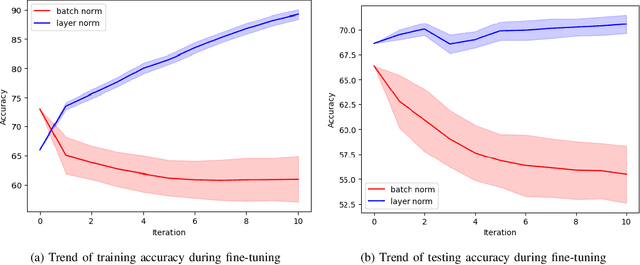
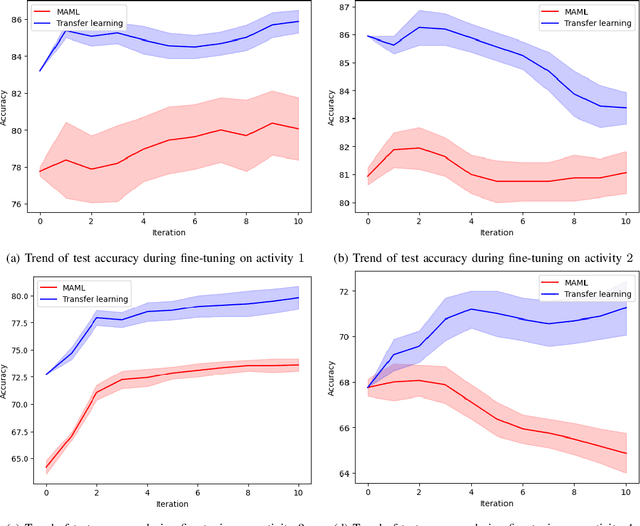
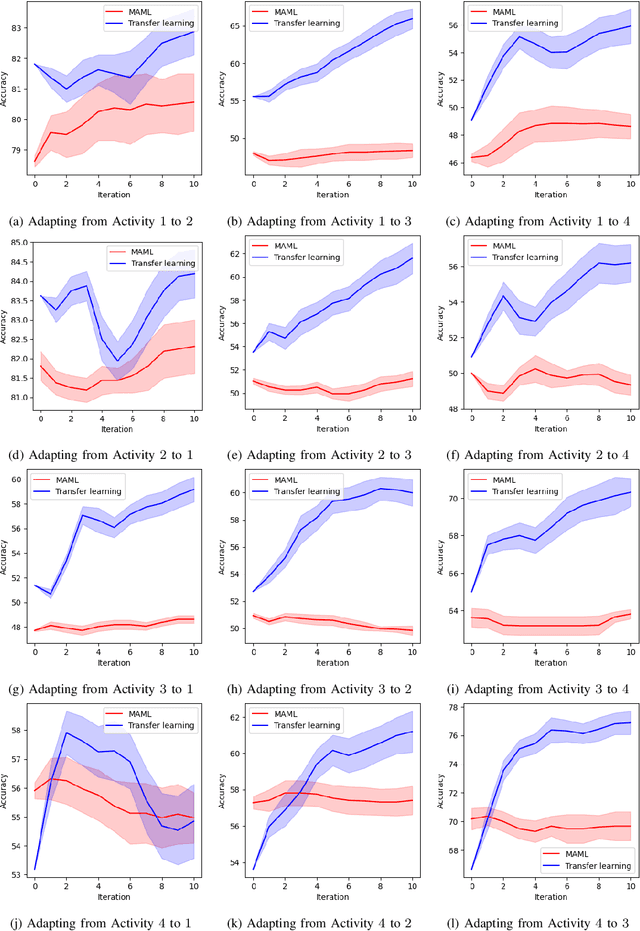
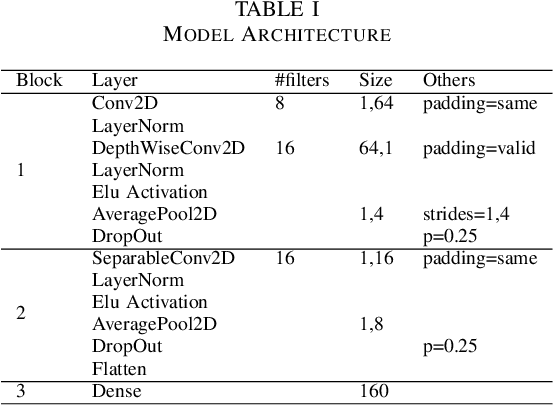
Electroencephalography (EEG) classification is a versatile and portable technique for building non-invasive Brain-computer Interfaces (BCI). However, the classifiers that decode cognitive states from EEG brain data perform poorly when tested on newer domains, such as tasks or individuals absent during model training. Researchers have recently used complex strategies like Model-agnostic meta-learning (MAML) for domain adaptation. Nevertheless, there is a need for an evaluation strategy to evaluate the fast adaptability of the models, as this characteristic is essential for real-life BCI applications for quick calibration. We used motor movement and imaginary signals as input to Convolutional Neural Networks (CNN) based classifier for the experiments. Datasets with EEG signals typically have fewer examples and higher time resolution. Even though batch-normalization is preferred for Convolutional Neural Networks (CNN), we empirically show that layer-normalization can improve the adaptability of CNN-based EEG classifiers with not more than ten fine-tuning steps. In summary, the present work (i) proposes a simple strategy to evaluate fast adaptability, and (ii) empirically demonstrate fast adaptability across individuals as well as across tasks with simple transfer learning as compared to MAML approach.