 Add to Chrome
 Add to Firefox
 Add to Edge
Incremental (k, z)-Clustering on Graphs
Feb 09, 2026
Given a weighted undirected graph, a number of clusters $k$, and an exponent $z$, the goal in the $(k, z)$-clustering problem on graphs is to select $k$ vertices as centers that minimize the sum of the distances raised to the power $z$ of each vertex to its closest center. In the dynamic setting, the graph is subject to adversarial edge updates, and the goal is to maintain explicitly an exact $(k, z)$-clustering solution in the induced shortest-path metric. While efficient dynamic $k$-center approximation algorithms on graphs exist [Cruciani et al. SODA 2024], to the best of our knowledge, no prior work provides similar results for the dynamic $(k,z)$-clustering problem. As the main result of this paper, we develop a randomized incremental $(k, z)$-clustering algorithm that maintains with high probability a constant-factor approximation in a graph undergoing edge insertions with a total update time of $\tilde O(k m^{1+o(1)}+ k^{1+\frac{1}λ} m)$, where $λ\geq 1$ is an arbitrary fixed constant. Our incremental algorithm consists of two stages. In the first stage, we maintain a constant-factor bicriteria approximate solution of size $\tilde{O}(k)$ with a total update time of $m^{1+o(1)}$ over all adversarial edge insertions. This first stage is an intricate adaptation of the bicriteria approximation algorithm by Mettu and Plaxton [Machine Learning 2004] to incremental graphs. One of our key technical results is that the radii in their algorithm can be assumed to be non-decreasing while the approximation ratio remains constant, a property that may be of independent interest. In the second stage, we maintain a constant-factor approximate $(k,z)$-clustering solution on a dynamic weighted instance induced by the bicriteria approximate solution. For this subproblem, we employ a dynamic spanner algorithm together with a static $(k,z)$-clustering algorithm.

Dynamic Consistent $k$-Center Clustering with Optimal Recourse
Dec 04, 2024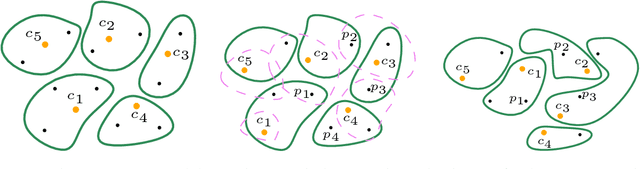
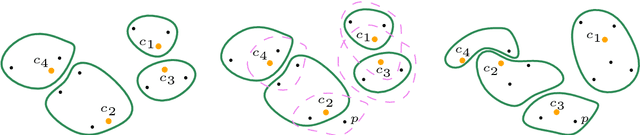

Given points from an arbitrary metric space and a sequence of point updates sent by an adversary, what is the minimum recourse per update (i.e., the minimum number of changes needed to the set of centers after an update), in order to maintain a constant-factor approximation to a $k$-clustering problem? This question has received attention in recent years under the name consistent clustering. Previous works by Lattanzi and Vassilvitskii [ICLM '17] and Fichtenberger, Lattanzi, Norouzi-Fard, and Svensson [SODA '21] studied $k$-clustering objectives, including the $k$-center and the $k$-median objectives, under only point insertions. In this paper we study the $k$-center objective in the fully dynamic setting, where the update is either a point insertion or a point deletion. Before our work, {\L}\k{a}cki, Haeupler, Grunau, Rozho\v{n}, and Jayaram [SODA '24] gave a deterministic fully dynamic constant-factor approximation algorithm for the $k$-center objective with worst-case recourse of $2$ per update. In this work, we prove that the $k$-center clustering problem admits optimal recourse bounds by developing a deterministic fully dynamic constant-factor approximation algorithm with worst-case recourse of $1$ per update. Moreover our algorithm performs simple choices based on light data structures, and thus is arguably more direct and faster than the previous one which uses a sophisticated combinatorial structure. Additionally, we develop a new deterministic decremental algorithm and a new deterministic incremental algorithm, both of which maintain a $6$-approximate $k$-center solution with worst-case recourse of $1$ per update. Our incremental algorithm improves over the $8$-approximation algorithm by Charikar, Chekuri, Feder, and Motwani [STOC '97]. Finally, we remark that since all three of our algorithms are deterministic, they work against an adaptive adversary.
Dynamic algorithms for k-center on graphs
Jul 28, 2023In this paper we give the first efficient algorithms for the $k$-center problem on dynamic graphs undergoing edge updates. In this problem, the goal is to partition the input into $k$ sets by choosing $k$ centers such that the maximum distance from any data point to the closest center is minimized. It is known that it is NP-hard to get a better than $2$ approximation for this problem. While in many applications the input may naturally be modeled as a graph, all prior works on $k$-center problem in dynamic settings are on metrics. In this paper, we give a deterministic decremental $(2+\epsilon)$-approximation algorithm and a randomized incremental $(4+\epsilon)$-approximation algorithm, both with amortized update time $kn^{o(1)}$ for weighted graphs. Moreover, we show a reduction that leads to a fully dynamic $(2+\epsilon)$-approximation algorithm for the $k$-center problem, with worst-case update time that is within a factor $k$ of the state-of-the-art upper bound for maintaining $(1+\epsilon)$-approximate single-source distances in graphs. Matching this bound is a natural goalpost because the approximate distances of each vertex to its center can be used to maintain a $(2+\epsilon)$-approximation of the graph diameter and the fastest known algorithms for such a diameter approximation also rely on maintaining approximate single-source distances.