 Add to Chrome
 Add to Firefox
 Add to Edge
Lightweight GenAI for Network Traffic Synthesis: Fidelity, Augmentation, and Classification
Mar 26, 2026
Accurate Network Traffic Classification (NTC) is increasingly constrained by limited labeled data and strict privacy requirements. While Network Traffic Generation (NTG) provides an effective means to mitigate data scarcity, conventional generative methods struggle to model the complex temporal dynamics of modern traffic or/and often incur significant computational cost. In this article, we address the NTG task using lightweight Generative Artificial Intelligence (GenAI) architectures, including transformer-based, state-space, and diffusion models designed for practical deployment. We conduct a systematic evaluation along four axes: (i) (synthetic) traffic fidelity, (ii) synthetic-only training, (iii) data augmentation under low-data regimes, and (iv) computational efficiency. Experiments on two heterogeneous datasets show that lightweight GenAI models preserve both static and temporal traffic characteristics, with transformer and state-space models closely matching real distributions across a complete set of fidelity metrics. Classifiers trained solely on synthetic traffic achieve up to 87% F1-score on real data. In low-data settings, GenAI-driven augmentation improves NTC performance by up to +40%, substantially reducing the gap with full-data training. Overall, transformer-based models provide the best trade-off between fidelity and efficiency, enabling high-quality, privacy-aware traffic synthesis with modest computational overhead.

Mapping the Landscape of Generative AI in Network Monitoring and Management
Feb 12, 2025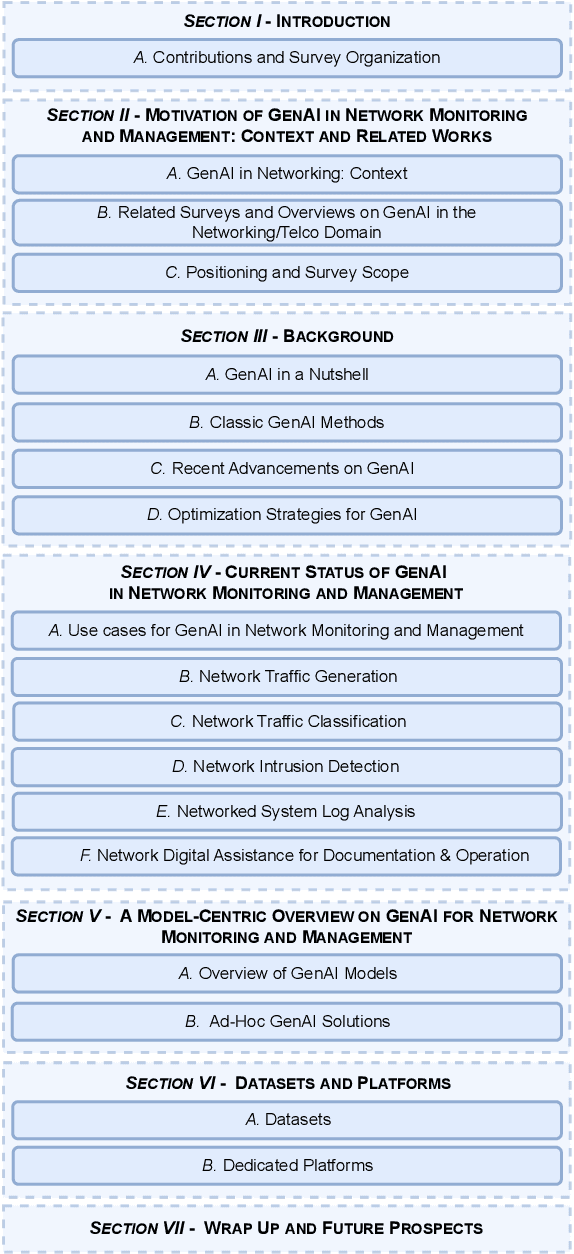
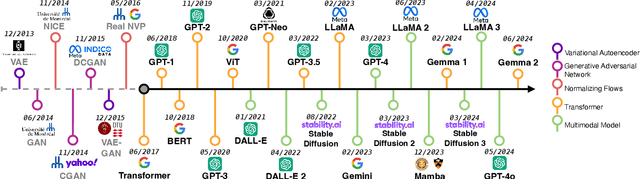
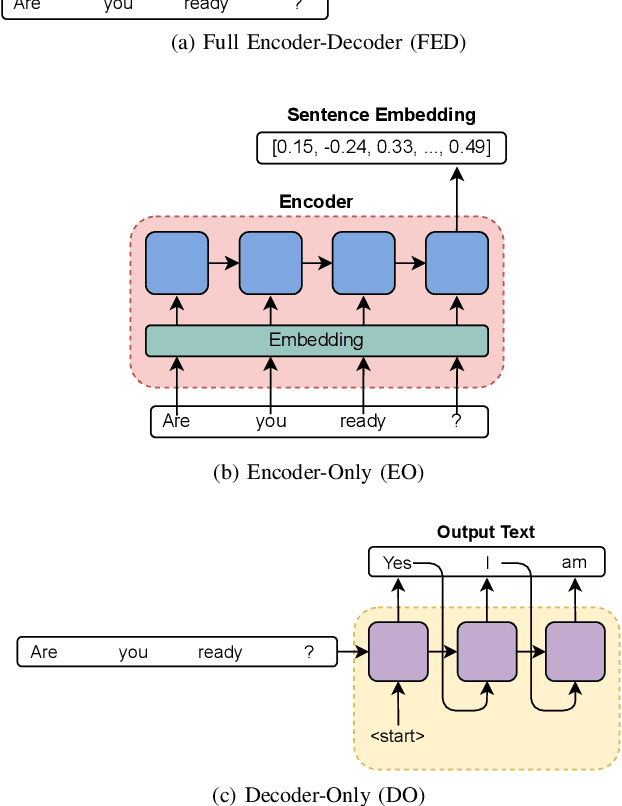
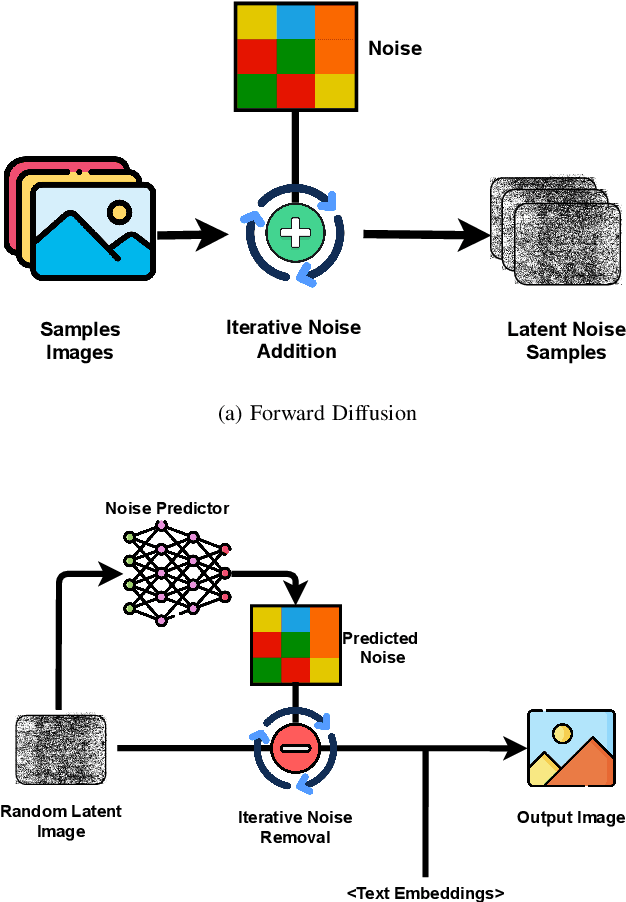
Generative Artificial Intelligence (GenAI) models such as LLMs, GPTs, and Diffusion Models have recently gained widespread attention from both the research and the industrial communities. This survey explores their application in network monitoring and management, focusing on prominent use cases, as well as challenges and opportunities. We discuss how network traffic generation and classification, network intrusion detection, networked system log analysis, and network digital assistance can benefit from the use of GenAI models. Additionally, we provide an overview of the available GenAI models, datasets for large-scale training phases, and platforms for the development of such models. Finally, we discuss research directions that potentially mitigate the roadblocks to the adoption of GenAI for network monitoring and management. Our investigation aims to map the current landscape and pave the way for future research in leveraging GenAI for network monitoring and management.
A First Look at Class Incremental Learning in Deep Learning Mobile Traffic Classification
Jul 09, 2021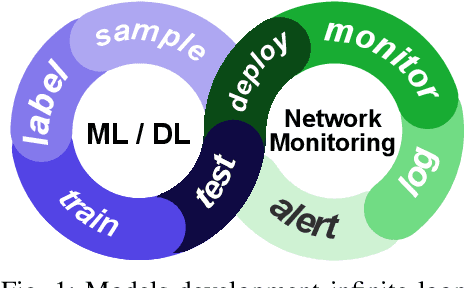
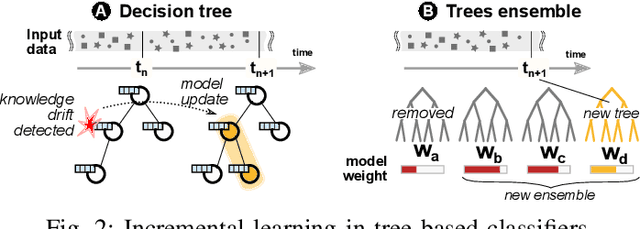
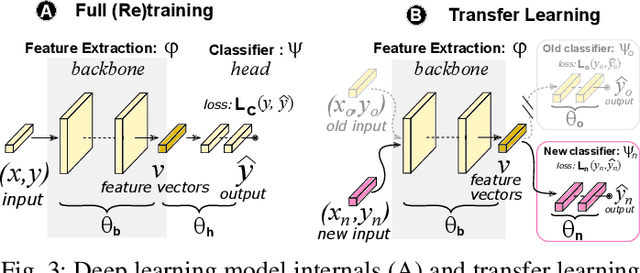
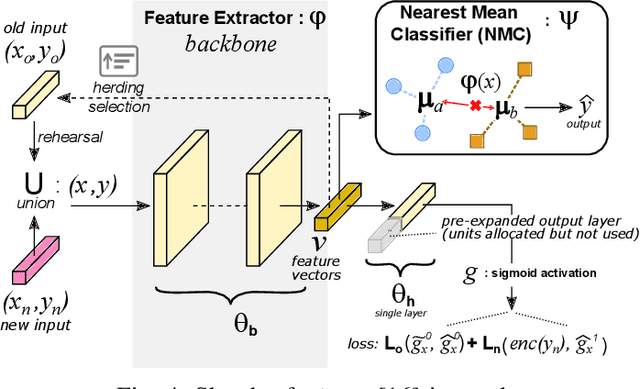
The recent popularity growth of Deep Learning (DL) re-ignited the interest towards traffic classification, with several studies demonstrating the accuracy of DL-based classifiers to identify Internet applications' traffic. Even with the aid of hardware accelerators (GPUs, TPUs), DL model training remains expensive, and limits the ability to operate frequent model updates necessary to fit to the ever evolving nature of Internet traffic, and mobile traffic in particular. To address this pain point, in this work we explore Incremental Learning (IL) techniques to add new classes to models without a full retraining, hence speeding up model's updates cycle. We consider iCarl, a state of the art IL method, and MIRAGE-2019, a public dataset with traffic from 40 Android apps, aiming to understand "if there is a case for incremental learning in traffic classification". By dissecting iCarl internals, we discuss ways to improve its design, contributing a revised version, namely iCarl+. Despite our analysis reveals their infancy, IL techniques are a promising research area on the roadmap towards automated DL-based traffic analysis systems.