 Add to Chrome
 Add to Firefox
 Add to Edge
Impact of Atmospheric Turbulence and Pointing Error on Earth Observation
May 21, 2026
Earth Observation (EO) imagery is often degraded by atmospheric turbulence and pointing jitter; yet, these effects are rarely considered in datasets used to train AI-based detection models. Based on prior work, this paper presents an enhanced image simulator that enables the incorporation of vertical-path atmospheric turbulence and satellite pointing jitter, arising from platform and sensor vibrations, to generate physically realistic distorted images. As a case study, vessel detection is evaluated using YOLOv8 and RetinaNet on images generated by the proposed simulator under different levels of turbulence and pointing errors. Results show that YOLOv8 recall decreases from 91% under ideal conditions to 60% in the presence of weak turbulence, and falls below 40% under strong turbulence or jitter. In contrast, RetinaNet demonstrates greater robustness, maintaining approximately 75% recall across degraded conditions. These results highlight the importance of incorporating realistic physical degradations into EO training datasets to ensure reliable performance of AI-based models in operational environments, as demonstrated in maritime surveillance applications.

Scheduling Agile Earth Observation Satellites with Onboard Processing and Real-Time Monitoring
Jun 13, 2025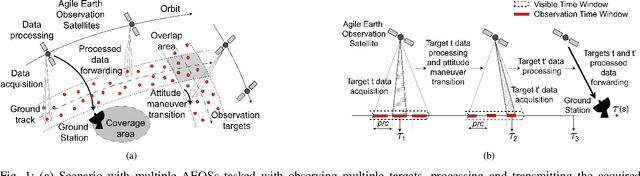
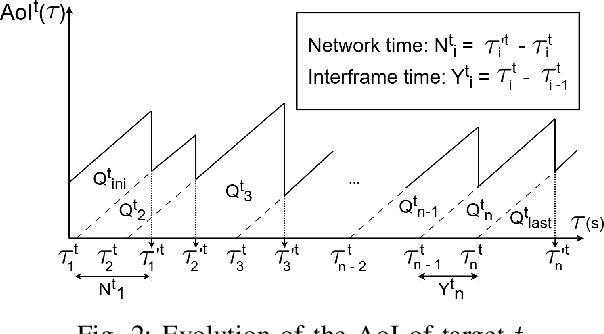
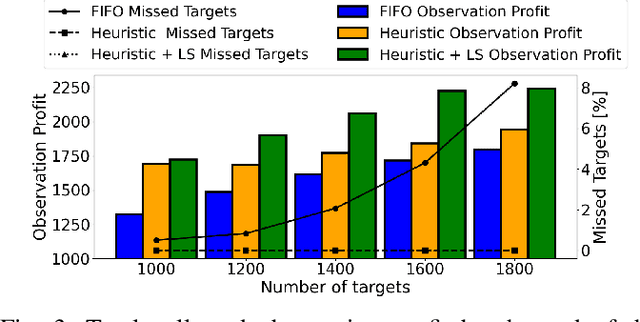
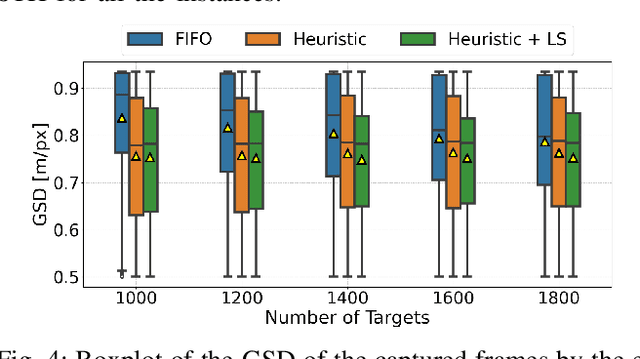
The emergence of Agile Earth Observation Satellites (AEOSs) has marked a significant turning point in the field of Earth Observation (EO), offering enhanced flexibility in data acquisition. Concurrently, advancements in onboard satellite computing and communication technologies have greatly enhanced data compression efficiency, reducing network latency and congestion while supporting near real-time information delivery. In this paper, we address the Agile Earth Observation Satellite Scheduling Problem (AEOSSP), which involves determining the optimal sequence of target observations to maximize overall observation profit. Our approach integrates onboard data processing for real-time remote monitoring into the multi-satellite optimization problem. To this end, we define a set of priority indicators and develop a constructive heuristic method, further enhanced with a Local Search (LS) strategy. The results show that the proposed algorithm provides high-quality information by increasing the resolution of the collected frames by up to 10% on average, while reducing the variance in the monitoring frequency of the targets within the instance by up to 83%, ensuring more up-to-date information across the entire set compared to a First-In First-Out (FIFO) method.