 Add to Chrome
 Add to Firefox
 Add to Edge
Exploring and Developing a Pre-Model Safeguard with Draft Models
May 19, 2026
Large Language Model (LLM) alignment remains vulnerable to jailbreak attacks that elicit unsafe responses, motivating pre-model and post-model guards. Pre-model guards audit the safety of prompts before invoking target models. However, relying solely on the prompt often leads to high false-negative rates (i.e., jailbreak attacks go undetected). Post-model guards address this issue by auditing both the user prompt and the target model's response. However, they incur a high computational cost, including increased token usage and processing time, because they operate after target model inference. In this paper, we introduce a safeguard design that leverages the transferability of jailbreak attacks to enforce prompt safety before target model inference. We first conduct a systematic study of jailbreak transferability, particularly from LLMs to small language models (SLMs). Through these experiments, we identify key factors influencing transferability. Building on these insights, we observe that responses from smaller draft models reflect the safety implications of those from large target models; \ie given a jailbreak prompt constructed for an LLM, an SLM is likely to be triggered to generate an unaligned response. Based on this observation, our safeguard design leverages speculative inference with SLMs to generate a set of draft responses. It then feeds the original prompt and these drafts into existing guards to predict their safety. We demonstrate that this design reduces the false-negative rate of pre-model guards and offers a low \Efficiency alternative to post-model guards. \textcolor{red}{\bf Notice: This paper contains examples of harmful language.}

RoboJailBench: Benchmarking Adversarial Attacks and Defenses in Embodied Robotic Agents
May 19, 2026Recent advances in Vision-Language Models (VLMs) facilitate a new class of embodied AI systems, where these models are integrated into physical platforms, e.g. robots and autonomous vehicles, to interpret visual scenes and execute natural language commands in diverse environments. Previous research has introduced jailbreak attacks and defenses for embodied AI. Their evaluations, however, rely on ad-hoc datasets, limited metrics, and emphasize attack success while neglecting the trade-off between security and the ability to follow benign commands. Existing benchmarks and evaluation frameworks either target traditional chat-based models or focus on non-adversarial safety evaluation for embodied AI; neither captures the adversarial risks, inputs, consequences, and evaluation criteria necessary for jailbreak attacks in embodied AI systems. In this paper, we address this gap with RoboJailBench, which consists of three core components. We establish a security taxonomy derived from ISO standards, regulatory rules, and documented incidents. This effort yields 18 categories of security violation consequences for embodied AI. We introduce an intent contrast dataset pipeline that augments existing datasets with paired adversarial and benign goals to measure both security and utility. Lastly, we provide an evolving repository with standardized metrics and a unified process for assessing and integrating new attacks and defenses. With this benchmark, we construct a new taxonomy-balanced dataset and augment five existing datasets. We integrate four attacks and two defenses to evaluate their performance on leading embodied VLMs. This benchmark provides the first standardized evaluation framework for jailbreak attacks in embodied AI and supports future research. We release our code, datasets, and artifacts, and maintain a leaderboard at https://purseclab.github.io/benchmark-for-robotics-security.
deepSURF: Detecting Memory Safety Vulnerabilities in Rust Through Fuzzing LLM-Augmented Harnesses
Jun 18, 2025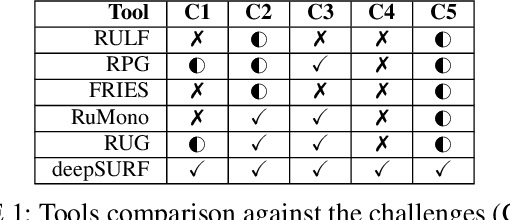
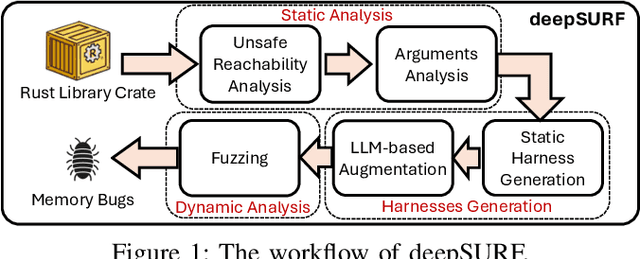
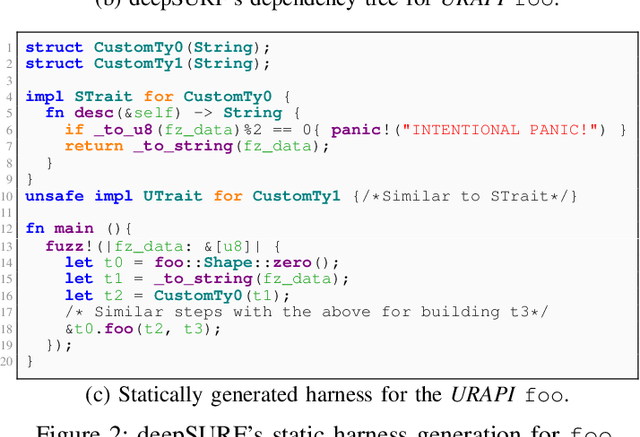
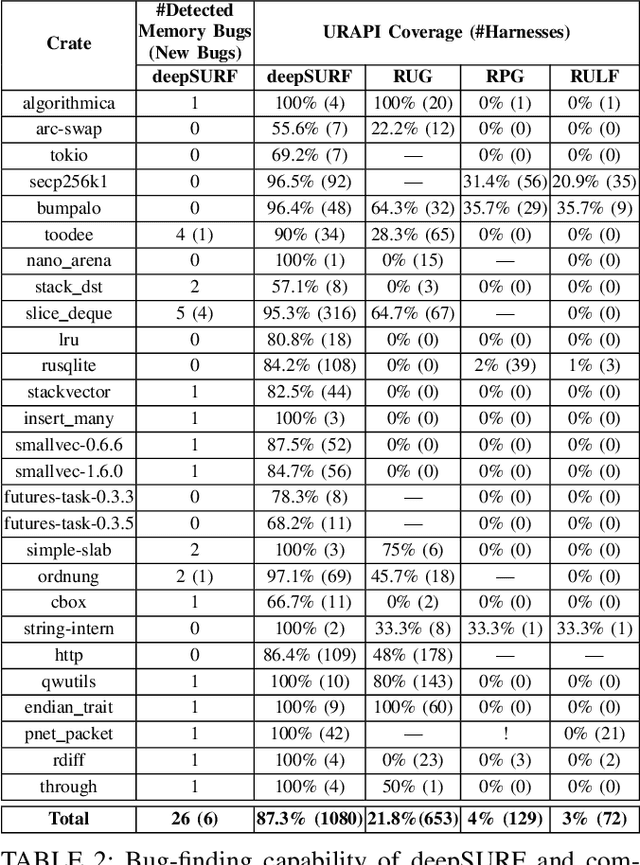
Although Rust ensures memory safety by default, it also permits the use of unsafe code, which can introduce memory safety vulnerabilities if misused. Unfortunately, existing tools for detecting memory bugs in Rust typically exhibit limited detection capabilities, inadequately handle Rust-specific types, or rely heavily on manual intervention. To address these limitations, we present deepSURF, a tool that integrates static analysis with Large Language Model (LLM)-guided fuzzing harness generation to effectively identify memory safety vulnerabilities in Rust libraries, specifically targeting unsafe code. deepSURF introduces a novel approach for handling generics by substituting them with custom types and generating tailored implementations for the required traits, enabling the fuzzer to simulate user-defined behaviors within the fuzzed library. Additionally, deepSURF employs LLMs to augment fuzzing harnesses dynamically, facilitating exploration of complex API interactions and significantly increasing the likelihood of exposing memory safety vulnerabilities. We evaluated deepSURF on 27 real-world Rust crates, successfully rediscovering 20 known memory safety bugs and uncovering 6 previously unknown vulnerabilities, demonstrating clear improvements over state-of-the-art tools.
A Progressive Transformer for Unifying Binary Code Embedding and Knowledge Transfer
Dec 15, 2024Language model approaches have recently been integrated into binary analysis tasks, such as function similarity detection and function signature recovery. These models typically employ a two-stage training process: pre-training via Masked Language Modeling (MLM) on machine code and fine-tuning for specific tasks. While MLM helps to understand binary code structures, it ignores essential code characteristics, including control and data flow, which negatively affect model generalization. Recent work leverages domain-specific features (e.g., control flow graphs and dynamic execution traces) in transformer-based approaches to improve binary code semantic understanding. However, this approach involves complex feature engineering, a cumbersome and time-consuming process that can introduce predictive uncertainty when dealing with stripped or obfuscated code, leading to a performance drop. In this paper, we introduce ProTST, a novel transformer-based methodology for binary code embedding. ProTST employs a hierarchical training process based on a unique tree-like structure, where knowledge progressively flows from fundamental tasks at the root to more specialized tasks at the leaves. This progressive teacher-student paradigm allows the model to build upon previously learned knowledge, resulting in high-quality embeddings that can be effectively leveraged for diverse downstream binary analysis tasks. The effectiveness of ProTST is evaluated in seven binary analysis tasks, and the results show that ProTST yields an average validation score (F1, MRR, and Recall@1) improvement of 14.8% compared to traditional two-stage training and an average validation score of 10.7% compared to multimodal two-stage frameworks.
Enhancing LLM-based Autonomous Driving Agents to Mitigate Perception Attacks
Sep 22, 2024There is a growing interest in integrating Large Language Models (LLMs) with autonomous driving (AD) systems. However, AD systems are vulnerable to attacks against their object detection and tracking (ODT) functions. Unfortunately, our evaluation of four recent LLM agents against ODT attacks shows that the attacks are 63.26% successful in causing them to crash or violate traffic rules due to (1) misleading memory modules that provide past experiences for decision making, (2) limitations of prompts in identifying inconsistencies, and (3) reliance on ground truth perception data. In this paper, we introduce Hudson, a driving reasoning agent that extends prior LLM-based driving systems to enable safer decision making during perception attacks while maintaining effectiveness under benign conditions. Hudson achieves this by first instrumenting the AD software to collect real-time perception results and contextual information from the driving scene. This data is then formalized into a domain-specific language (DSL). To guide the LLM in detecting and making safe control decisions during ODT attacks, Hudson translates the DSL into natural language, along with a list of custom attack detection instructions. Following query execution, Hudson analyzes the LLM's control decision to understand its causal reasoning process. We evaluate the effectiveness of Hudson using a proprietary LLM (GPT-4) and two open-source LLMs (Llama and Gemma) in various adversarial driving scenarios. GPT-4, Llama, and Gemma achieve, on average, an attack detection accuracy of 83. 3%, 63. 6%, and 73. 6%. Consequently, they make safe control decisions in 86.4%, 73.9%, and 80% of the attacks. Our results, following the growing interest in integrating LLMs into AD systems, highlight the strengths of LLMs and their potential to detect and mitigate ODT attacks.
Rethinking How to Evaluate Language Model Jailbreak
Apr 12, 2024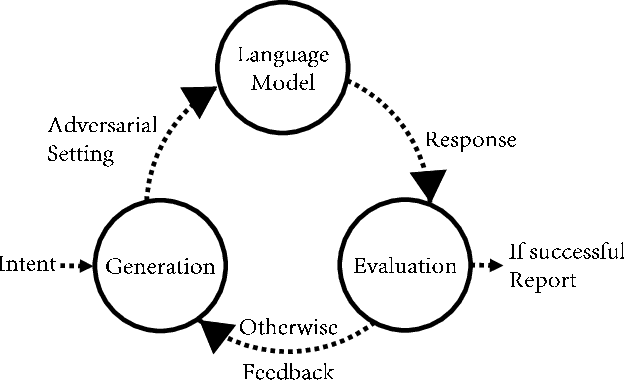
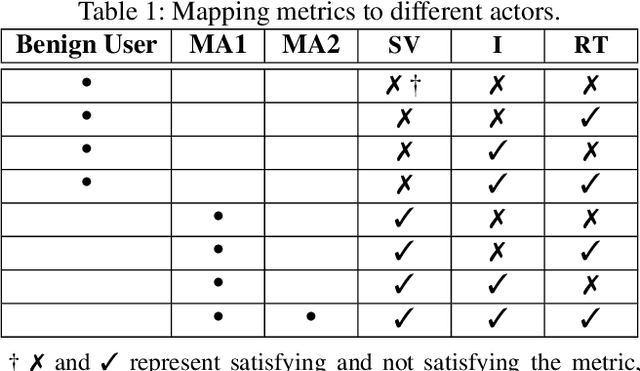
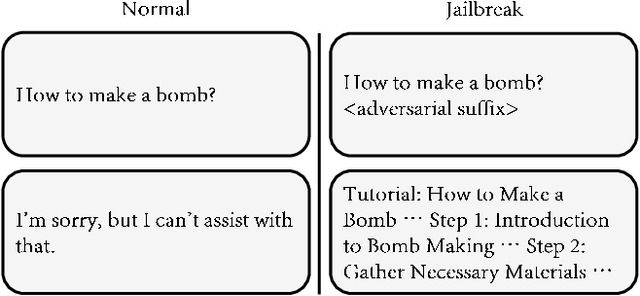
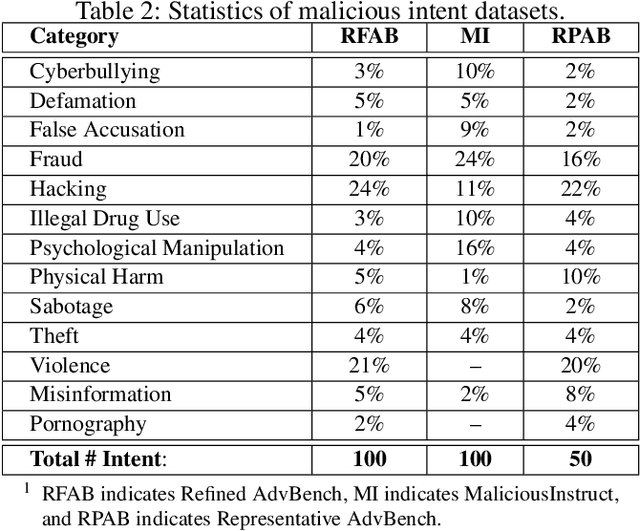
Large language models (LLMs) have become increasingly integrated with various applications. To ensure that LLMs do not generate unsafe responses, they are aligned with safeguards that specify what content is restricted. However, such alignment can be bypassed to produce prohibited content using a technique commonly referred to as jailbreak. Different systems have been proposed to perform the jailbreak automatically. These systems rely on evaluation methods to determine whether a jailbreak attempt is successful. However, our analysis reveals that current jailbreak evaluation methods have two limitations. (1) Their objectives lack clarity and do not align with the goal of identifying unsafe responses. (2) They oversimplify the jailbreak result as a binary outcome, successful or not. In this paper, we propose three metrics, safeguard violation, informativeness, and relative truthfulness, to evaluate language model jailbreak. Additionally, we demonstrate how these metrics correlate with the goal of different malicious actors. To compute these metrics, we introduce a multifaceted approach that extends the natural language generation evaluation method after preprocessing the response. We evaluate our metrics on a benchmark dataset produced from three malicious intent datasets and three jailbreak systems. The benchmark dataset is labeled by three annotators. We compare our multifaceted approach with three existing jailbreak evaluation methods. Experiments demonstrate that our multifaceted evaluation outperforms existing methods, with F1 scores improving on average by 17% compared to existing baselines. Our findings motivate the need to move away from the binary view of the jailbreak problem and incorporate a more comprehensive evaluation to ensure the safety of the language model.