 Add to Chrome
 Add to Firefox
 Add to Edge
FSFVE: Few Shot Compressed Face Video Enhancement
Jul 13, 2026
Videocalling has become a popular form of communication in the world today, with many companies providing free services for it. However, there are still millions of people around the world that experience poor quality videocalls due to limitations in bandwidth. This despite, most people having the required hardware. In this paper we present a novel framework for enhancing highly compressed videocalls. We show, that with as little as 10 frames of the face, we can rapidly (in under 100 seconds) train a model to enhance that instance of the videocall. The model can be trained either prior to or during the call, enhancing the rest of the call by producing better quality video. The video conferencing application need not be modified - it can be off the shelf with our system as a layer on top that trains quickly then simply lets the video conferencing application (e.g. Zoom) run as usual, where our system intercepts and improves images before they are displayed. The model is designed to run in realtime on low-compute devices such as a typical laptop CPU. Experimentally, we show that the model significantly improves quality of compressed face video both quantitatively as well as perceptually. Code can be found at https://github.com/varun-jois/FSFVE.

Reference-Based Face Super-Resolution Using the Spatial Transformer
Jul 13, 2026Face super-resolution is the task of increasing the resolution of an image containing a face thereby adding finer detail. It is a ubiquitous task in many computer vision applications and quite often the user isn't even aware that it is being performed. However, doing it with high fidelity is challenging as it is an ill-posed problem. In this paper we present a reference-based solution for face super-resolution that uses higher resolution reference images to aid in the task. We show an alignment module based on the spatial transformer that is considerably more stable than the popular deformable convolutions. We also show an aggregation function that can take good quality information from the reference images when available or suppress the function when such information is unavailable. Finally, we show that our relatively smaller model can achieve state of the art results on multiple datasets. The source code is available at https://github.com/varun-jois/FSRST.
RTFVE: Realtime Face Video Enhancement
Jul 13, 2026There's been a surge in adoption of video conferencing applications for both personal and business use cases. However, the bandwidth limitations faced by many users worldwide may restrict the optimal use of such applications. Although deep learning offers a solution for enhancing low bit rate videos, most models today are either hard to incorporate with modern compression standards or require specialized hardware to run such as significant GPUs making these models impractical. To address these issues, we introduce the Realtime Face Video Enhancement (RTFVE) model which can be easily incorporated with any video decoder and can run in realtime on ordinary CPUs. Experiments show that our model improves perceptual quality over the compressed video baseline at multiple low bitrate settings. The source code will be made available at https://github.com/varun-jois/RTFVE.
Deflecting Adversarial Attacks with Pixel Deflection
Mar 30, 2018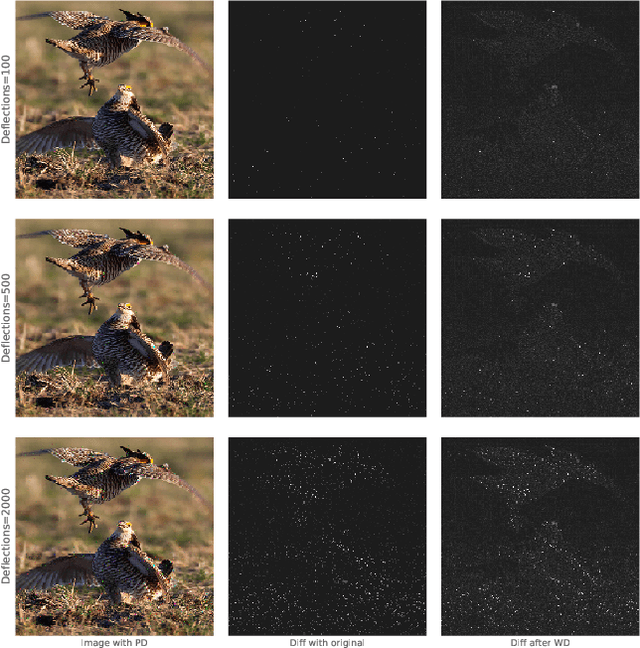
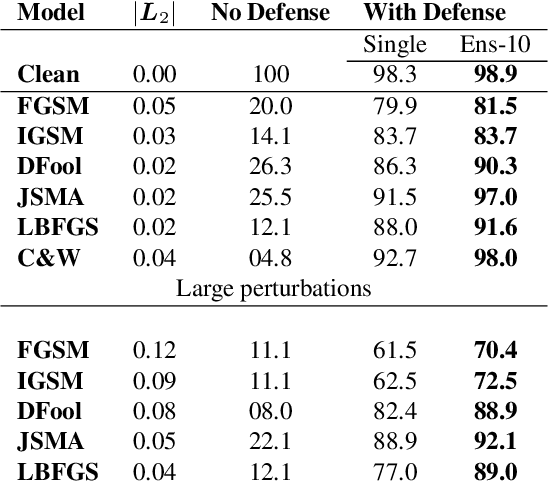
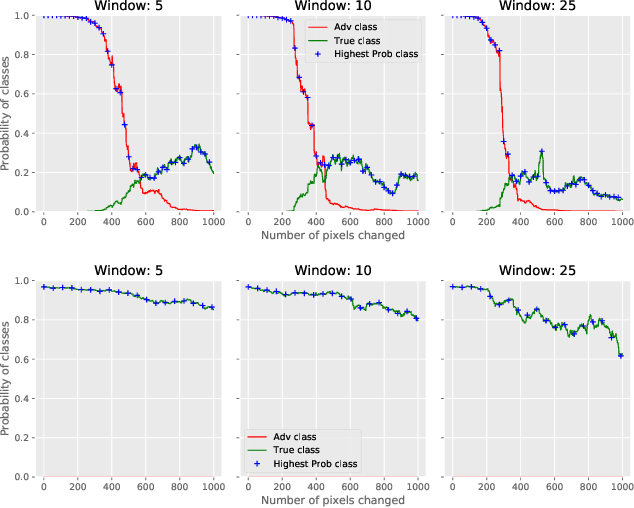
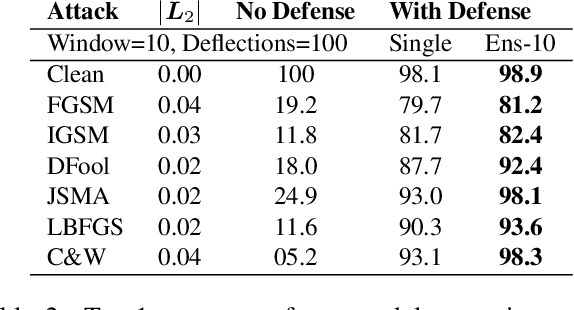
CNNs are poised to become integral parts of many critical systems. Despite their robustness to natural variations, image pixel values can be manipulated, via small, carefully crafted, imperceptible perturbations, to cause a model to misclassify images. We present an algorithm to process an image so that classification accuracy is significantly preserved in the presence of such adversarial manipulations. Image classifiers tend to be robust to natural noise, and adversarial attacks tend to be agnostic to object location. These observations motivate our strategy, which leverages model robustness to defend against adversarial perturbations by forcing the image to match natural image statistics. Our algorithm locally corrupts the image by redistributing pixel values via a process we term pixel deflection. A subsequent wavelet-based denoising operation softens this corruption, as well as some of the adversarial changes. We demonstrate experimentally that the combination of these techniques enables the effective recovery of the true class, against a variety of robust attacks. Our results compare favorably with current state-of-the-art defenses, without requiring retraining or modifying the CNN.
Protecting JPEG Images Against Adversarial Attacks
Mar 02, 2018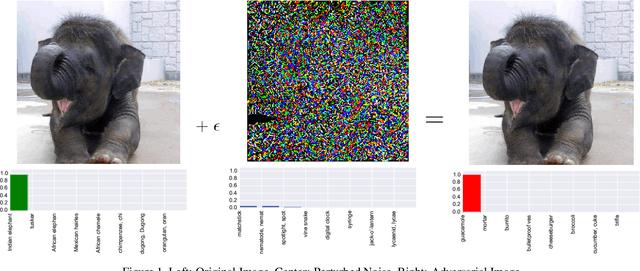
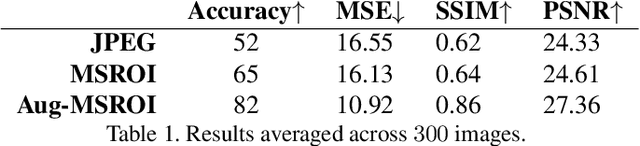
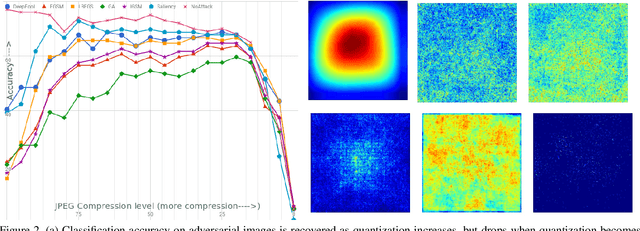
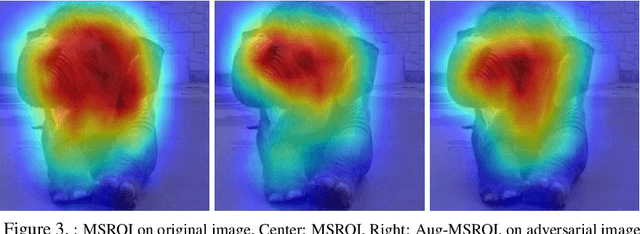
As deep neural networks (DNNs) have been integrated into critical systems, several methods to attack these systems have been developed. These adversarial attacks make imperceptible modifications to an image that fool DNN classifiers. We present an adaptive JPEG encoder which defends against many of these attacks. Experimentally, we show that our method produces images with high visual quality while greatly reducing the potency of state-of-the-art attacks. Our algorithm requires only a modest increase in encoding time, produces a compressed image which can be decompressed by an off-the-shelf JPEG decoder, and classified by an unmodified classifier
Semantic Perceptual Image Compression using Deep Convolution Networks
Mar 29, 2017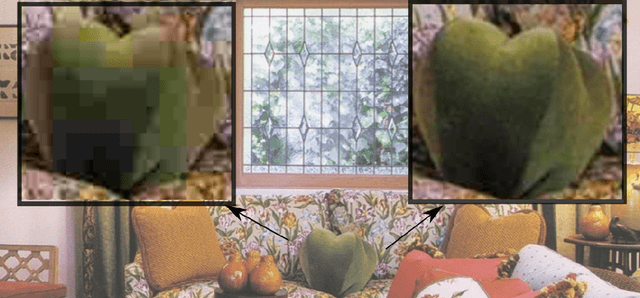
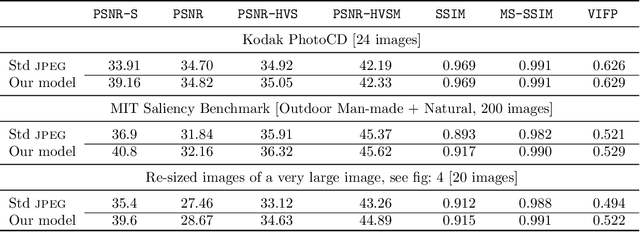
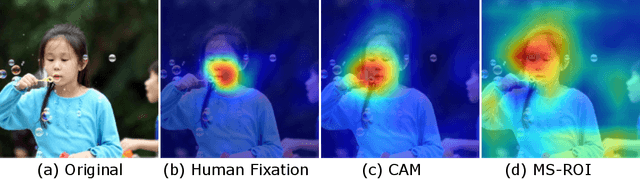
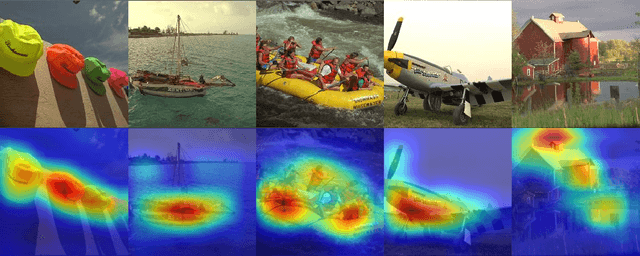
It has long been considered a significant problem to improve the visual quality of lossy image and video compression. Recent advances in computing power together with the availability of large training data sets has increased interest in the application of deep learning cnns to address image recognition and image processing tasks. Here, we present a powerful cnn tailored to the specific task of semantic image understanding to achieve higher visual quality in lossy compression. A modest increase in complexity is incorporated to the encoder which allows a standard, off-the-shelf jpeg decoder to be used. While jpeg encoding may be optimized for generic images, the process is ultimately unaware of the specific content of the image to be compressed. Our technique makes jpeg content-aware by designing and training a model to identify multiple semantic regions in a given image. Unlike object detection techniques, our model does not require labeling of object positions and is able to identify objects in a single pass. We present a new cnn architecture directed specifically to image compression, which generates a map that highlights semantically-salient regions so that they can be encoded at higher quality as compared to background regions. By adding a complete set of features for every class, and then taking a threshold over the sum of all feature activations, we generate a map that highlights semantically-salient regions so that they can be encoded at a better quality compared to background regions. Experiments are presented on the Kodak PhotoCD dataset and the MIT Saliency Benchmark dataset, in which our algorithm achieves higher visual quality for the same compressed size.