 Add to Chrome
 Add to Firefox
 Add to Edge
Machine Learning-Based Detection of MCP Attacks
Apr 12, 2026
The Model Context Protocol (MCP) is a new and emerging technology that extends the functionality of large language models, improving workflows but also exposing users to a new attack surface. Several studies have highlighted related security flaws, but MCP attack detection remains underexplored. To address this research gap, this study develops and evaluates a range of supervised machine learning approaches, including both traditional and deep-learning models. We evaluated the systems on the detection of malicious MCP tool descriptions in two scenarios: (1) a binary classification task distinguishing malicious from benign tools, and (2) a multiclass classification task identifying the attack type while separating benign from malicious tools. In addition to the machine learning models, we compared a rule-based approach that serves as a baseline. The results indicate that several of the developed models achieved 100\% F1-score on the binary classification task. In the multiclass scenario, the SVC and BERT models performed best, achieving F1 scores of 90.56\% and 88.33\%, respectively. Confusion matrices were also used to visualize the full distribution of predictions often missed by traditional metrics, providing additional insight for selecting the best-fitting solution in real-world scenarios. This study presents an addition to the MCP defence area, showing that machine learning models can perform exceptionally well in separating malicious and benign data points. To apply the solution in a live environment, a middleware was developed to classify which MCP tools are safe to use before execution, and block the ones that are not safe. Furthermore, the study shows that these models can outperform traditional rule-based solutions currently in use in the field.

Hierarchical Delay Attribution Classification using Unstructured Text in Train Management Systems
Feb 06, 2024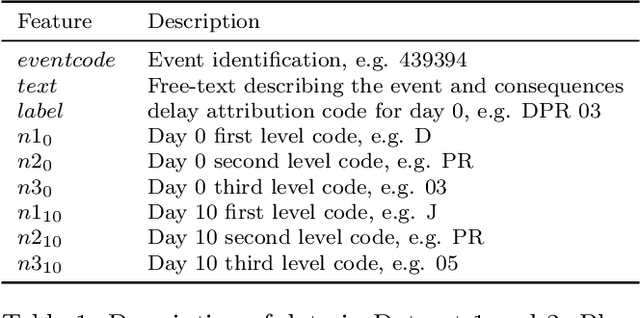
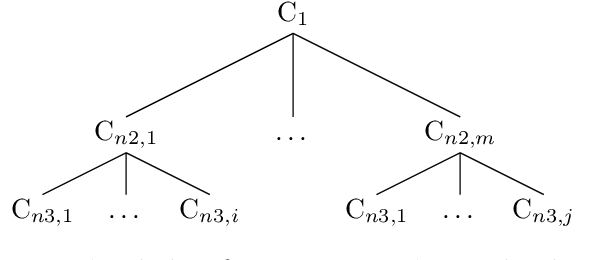
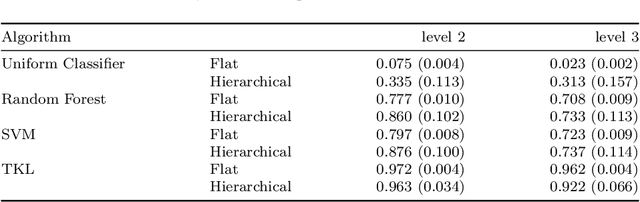
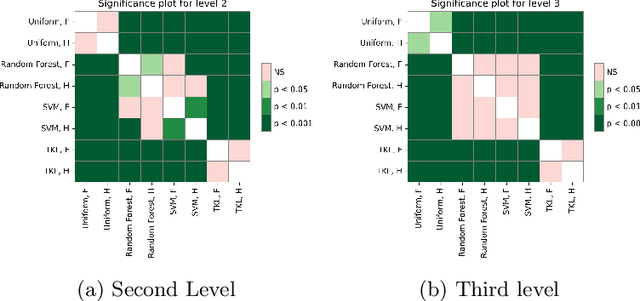
EU directives stipulate a systematic follow-up of train delays. In Sweden, the Swedish Transport Administration registers and assigns an appropriate delay attribution code. However, this delay attribution code is assigned manually, which is a complex task. In this paper, a machine learning-based decision support for assigning delay attribution codes based on event descriptions is investigated. The text is transformed using TF-IDF, and two models, Random Forest and Support Vector Machine, are evaluated against a random uniform classifier and the classification performance of the Swedish Transport Administration. Further, the problem is modeled as both a hierarchical and flat approach. The results indicate that a hierarchical approach performs better than a flat approach. Both approaches perform better than the random uniform classifier but perform worse than the manual classification.