 Add to Chrome
 Add to Firefox
 Add to Edge
Efficient Crawling for Scalable Web Data Acquisition (Extended Version)
Feb 12, 2026
Journalistic fact-checking, as well as social or economic research, require analyzing high-quality statistics datasets (SDs, in short). However, retrieving SD corpora at scale may be hard, inefficient, or impossible, depending on how they are published online. To improve open statistics data accessibility, we present a focused Web crawling algorithm that retrieves as many targets, i.e., resources of certain types, as possible, from a given website, in an efficient and scalable way, by crawling (much) less than the full website. We show that optimally solving this problem is intractable, and propose an approach based on reinforcement learning, namely using sleeping bandits. We propose SB-CLASSIFIER, a crawler that efficiently learns which hyperlinks lead to pages that link to many targets, based on the paths leading to the links in their enclosing webpages. Our experiments on websites with millions of webpages show that our crawler is highly efficient, delivering high fractions of a site's targets while crawling only a small part.

Multimodal Machine Learning for Extraction of Theorems and Proofs in the Scientific Literature
Jul 18, 2023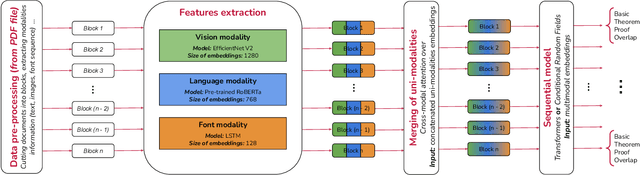
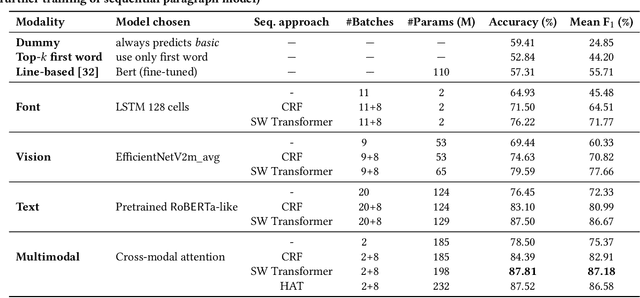
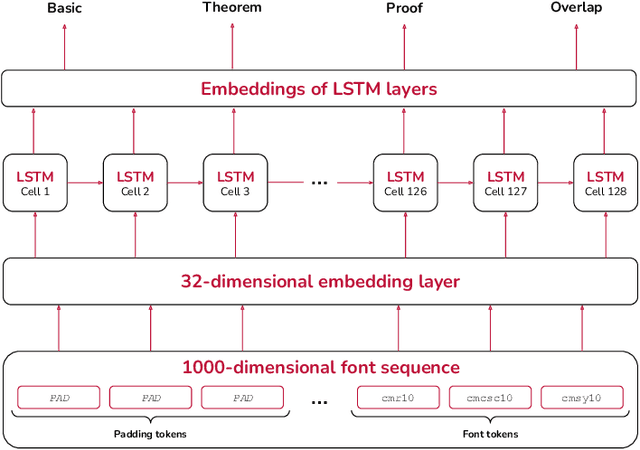
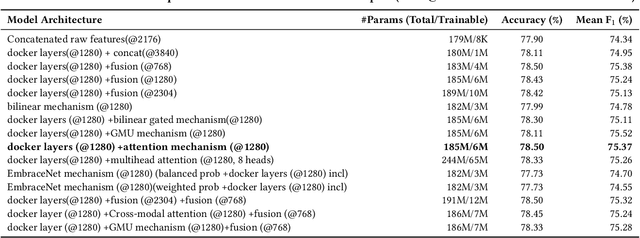
Scholarly articles in mathematical fields feature mathematical statements such as theorems, propositions, etc., as well as their proofs. Extracting them from the PDF representation of the articles requires understanding of scientific text along with visual and font-based indicators. We pose this problem as a multimodal classification problem using text, font features, and bitmap image rendering of the PDF as different modalities. In this paper we propose a multimodal machine learning approach for extraction of theorem-like environments and proofs, based on late fusion of features extracted by individual unimodal classifiers, taking into account the sequential succession of blocks in the document. For the text modality, we pretrain a new language model on a 11 GB scientific corpus; experiments shows similar performance for our task than a model (RoBERTa) pretrained on 160 GB, with faster convergence while requiring much less fine-tuning data. Font-based information relies on training a 128-cell LSTM on the sequence of font names and sizes within each block. Bitmap renderings are dealt with using an EfficientNetv2 deep network tuned to classify each image block. Finally, a simple CRF-based approach uses the features of the multimodal model along with information on block sequences. Experimental results show the benefits of using a multimodal approach vs any single modality, as well as major performance improvements using the CRF modeling of block sequences.