 Add to Chrome
 Add to Firefox
 Add to Edge
Actively Learning Joint Contours of Multiple Computer Experiments
Dec 15, 2025
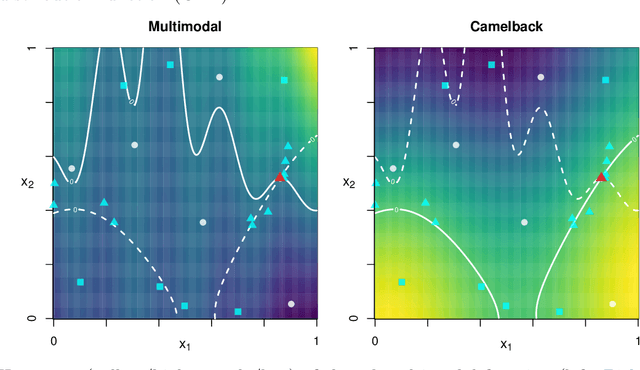
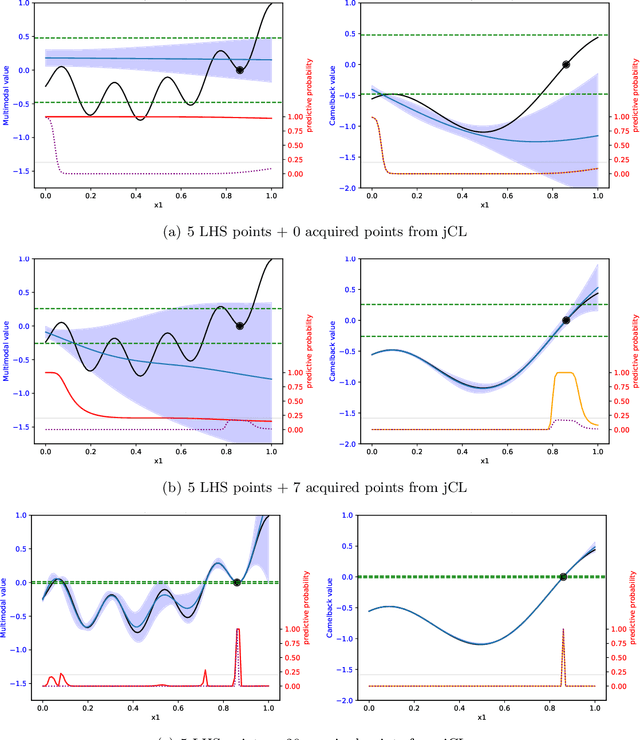
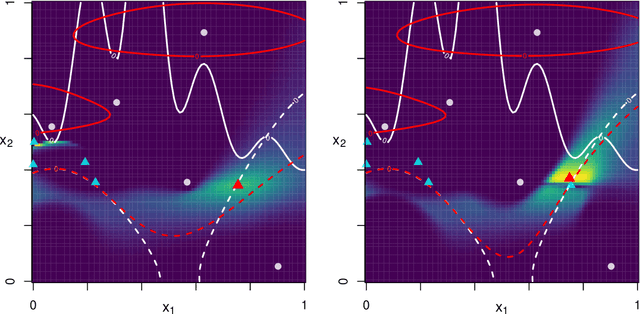
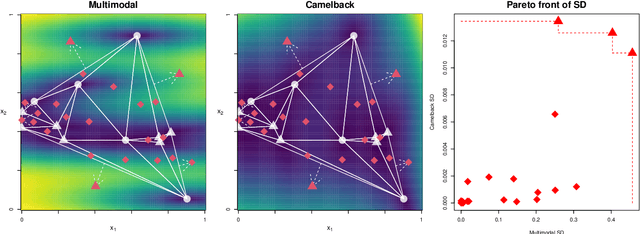
Contour location$\unicode{x2014}$the process of sequentially training a surrogate model to identify the design inputs that result in a pre-specified response value from a single computer experiment$\unicode{x2014}$is a well-studied active learning problem. Here, we tackle a related but distinct problem: identifying the input configuration that returns pre-specified values of multiple independent computer experiments simultaneously. Motivated by computer experiments of the rotational torques acting upon a vehicle in flight, we aim to identify stable flight conditions which result in zero torque forces. We propose a "joint contour location" (jCL) scheme that strikes a strategic balance between exploring the multiple response surfaces while exploiting learning of the intersecting contours. We employ both shallow and deep Gaussian process surrogates, but our jCL procedure is applicable to any surrogate that can provide posterior predictive distributions. Our jCL designs significantly outperform existing (single response) CL strategies, enabling us to efficiently locate the joint contour of our motivating computer experiments.

Voronoi Candidates for Bayesian Optimization
Feb 07, 2024

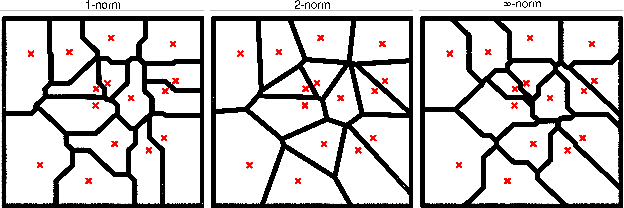
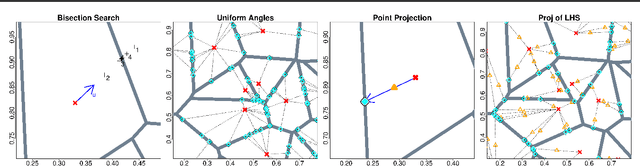
Bayesian optimization (BO) offers an elegant approach for efficiently optimizing black-box functions. However, acquisition criteria demand their own challenging inner-optimization, which can induce significant overhead. Many practical BO methods, particularly in high dimension, eschew a formal, continuous optimization of the acquisition function and instead search discretely over a finite set of space-filling candidates. Here, we propose to use candidates which lie on the boundary of the Voronoi tessellation of the current design points, so they are equidistant to two or more of them. We discuss strategies for efficient implementation by directly sampling the Voronoi boundary without explicitly generating the tessellation, thus accommodating large designs in high dimension. On a battery of test problems optimized via Gaussian processes with expected improvement, our proposed approach significantly improves the execution time of a multi-start continuous search without a loss in accuracy.