 Add to Chrome
 Add to Firefox
 Add to Edge
Bridging the Modality Gap in Forensic Image Retrieval
Jun 10, 2026
Automated image retrieval plays an increasingly critical role in modern forensic analysis, supporting investigative workflows that rely on efficient comparison of visual evidence. While prior work has focused primarily on developing and optimizing multimodal retrieval systems, limited attention has been paid to evaluating the forensic applicability of these technologies across diverse real-world scenarios. In this study, we present a unified retrieval framework adapted to four key forensic tasks: (1) tattoo image retrieval given a tattoo query image; (2) tattoo retrieval guided by human-expert textual descriptions, modelling the common situation where a witness verbally describes a tattoo; (3) tattoo retrieval from hand-drawn sketches; and (4) face retrieval from forensic face sketches. Our system leverages a multimodal large language model (MLLM) to automatically generate structured textual descriptions for all queries and gallery images, followed by sentence-transformer embedding for text-based comparison. We evaluate retrieval using visual-only embeddings, text-only embeddings and a multimodal fusion strategy that combines text- and image-based similarity scores derived from state-of-the-art visual feature extractors relevant to each task. The fusion of modalities consistently improves retrieval precision and robustness, especially in scenarios where visual information is limited or noisy (e.g., sketches, partial tattoos, or fragmented witness statements). This work highlights the forensic value of a unified multimodal retrieval pipeline and demonstrates how modern MLLMs can operationalize challenging forensic tasks that traditionally rely on manual expert analysis. Our results position multimodal retrieval as a promising tool for supporting investigative workflows involving tattoos, facial composites, and witness descriptions.

Does Melania Trump have a body double from the perspective of automatic face recognition?
Sep 06, 2021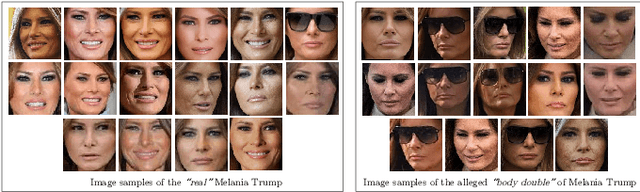
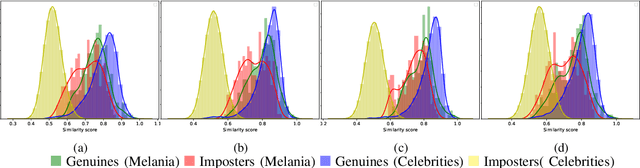
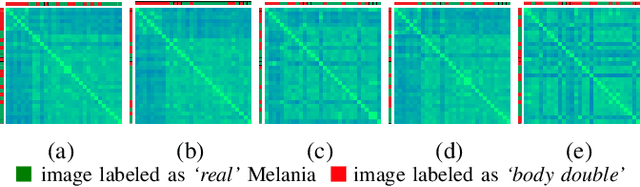
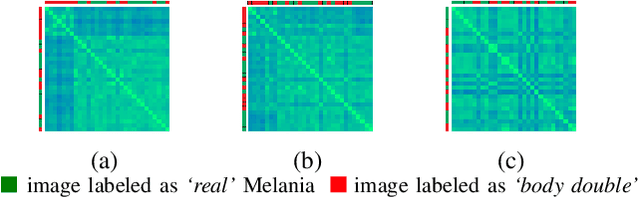
In this paper, we explore whether automatic face recognition can help in verifying widespread misinformation on social media, particularly conspiracy theories that are based on the existence of body doubles. The conspiracy theory addressed in this paper is the case of the Melania Trump body double. We employed four different state-of-the-art descriptors for face recognition to verify the integrity of the claim of the studied conspiracy theory. In addition, we assessed the impact of different image quality metrics on the variation of face recognition results. Two sets of image quality metrics were considered: acquisition-related metrics and subject-related metrics.