 Add to Chrome
 Add to Firefox
 Add to Edge
Saliency Map-Guided Knowledge Discovery for Subclass Identification with LLM-Based Symbolic Approximations
Nov 10, 2025
This paper proposes a novel neuro-symbolic approach for sensor signal-based knowledge discovery, focusing on identifying latent subclasses in time series classification tasks. The approach leverages gradient-based saliency maps derived from trained neural networks to guide the discovery process. Multiclass time series classification problems are transformed into binary classification problems through label subsumption, and classifiers are trained for each of these to yield saliency maps. The input signals, grouped by predicted class, are clustered under three distinct configurations. The centroids of the final set of clusters are provided as input to an LLM for symbolic approximation and fuzzy knowledge graph matching to discover the underlying subclasses of the original multiclass problem. Experimental results on well-established time series classification datasets demonstrate the effectiveness of our saliency map-driven method for knowledge discovery, outperforming signal-only baselines in both clustering and subclass identification.

Exploring the Properties and Evolution of Neural Network Eigenspaces during Training
Jun 18, 2021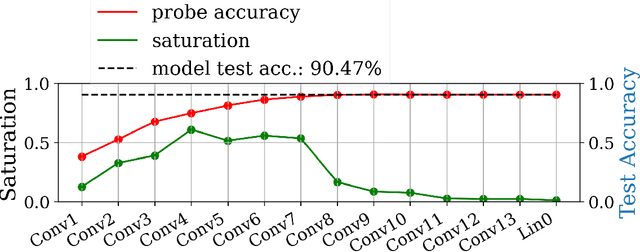
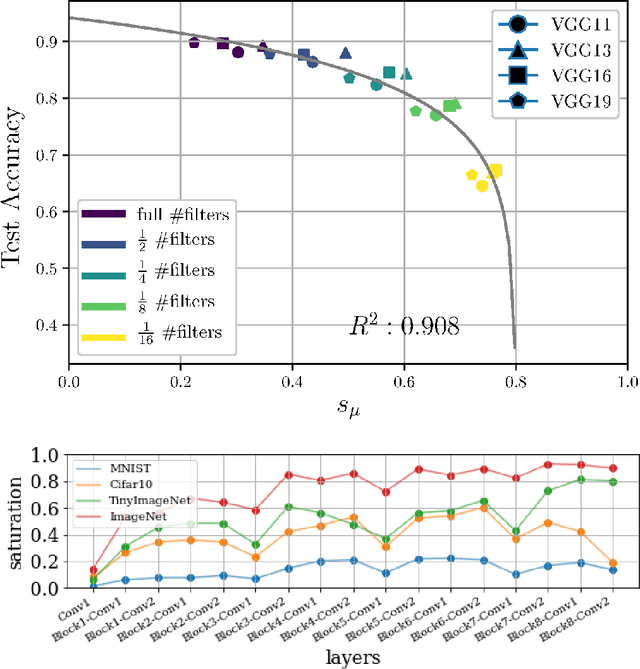
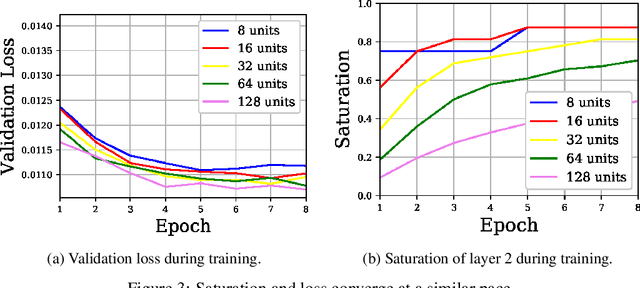
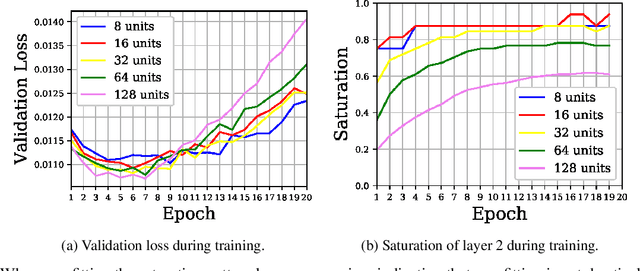
In this work we explore the information processing inside neural networks using logistic regression probes \cite{probes} and the saturation metric \cite{featurespace_saturation}. We show that problem difficulty and neural network capacity affect the predictive performance in an antagonistic manner, opening the possibility of detecting over- and under-parameterization of neural networks for a given task. We further show that the observed effects are independent from previously reported pathological patterns like the ``tail pattern'' described in \cite{featurespace_saturation}. Finally we are able to show that saturation patterns converge early during training, allowing for a quicker cycle time during analysis