 Add to Chrome
 Add to Firefox
 Add to Edge
Extending 2D foundational DINOv3 representations to 3D segmentation of neonatal brain MR images
Feb 27, 2026
Precise volumetric delineation of hippocampal structures is essential for quantifying neurodevelopmental trajectories in pre-term and term infants, where subtle morphological variations may carry prognostic significance. While foundation encoders trained on large-scale visual data offer discriminative representations, their 2D formulation is a limitation with respect to the $3$D organization of brain anatomy. We propose a volumetric segmentation strategy that reconciles this tension through a structured window-based disassembly-reassembly mechanism: the global MRI volume is decomposed into non-overlapping 3D windows or sub-cubes, each processed via a separate decoding arm built upon frozen high-fidelity features, and subsequently reassembled prior to a ground-truth correspendence using a dense-prediction head. This architecture preserves constant a decoder memory footprint while forcing predictions to lie within an anatomically consistent geometry. Evaluated on the ALBERT dataset for hippocampal segmentation, the proposed approach achieves a Dice score of 0.65 for a single 3D window. The method demonstrates that volumetric anatomical structure could be recovered from frozen 2D foundation representations through structured compositional decoding, and offers a principled and generalizable extension for foundation models for 3D medical applications.

Multimodal HIE Lesion Segmentation in Neonates: A Comparative Study of Loss Functions
Feb 13, 2025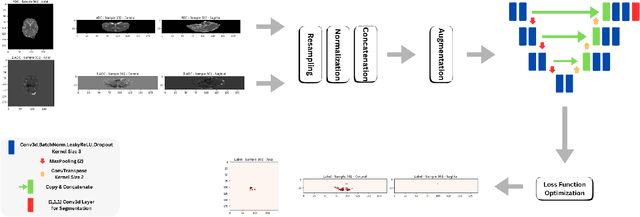
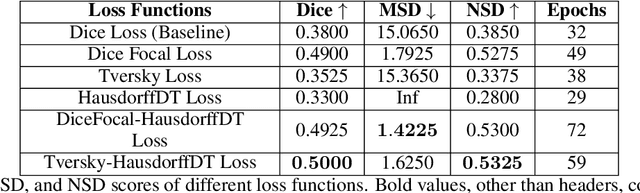

Segmentation of Hypoxic-Ischemic Encephalopathy (HIE) lesions in neonatal MRI is a crucial but challenging task due to diffuse multifocal lesions with varying volumes and the limited availability of annotated HIE lesion datasets. Using the BONBID-HIE dataset, we implemented a 3D U-Net with optimized preprocessing, augmentation, and training strategies to overcome data constraints. The goal of this study is to identify the optimal loss function specifically for the HIE lesion segmentation task. To this end, we evaluated various loss functions, including Dice, Dice-Focal, Tversky, Hausdorff Distance (HausdorffDT) Loss, and two proposed compound losses -- Dice-Focal-HausdorffDT and Tversky-HausdorffDT -- to enhance segmentation performance. The results show that different loss functions predict distinct segmentation masks, with compound losses outperforming standalone losses. Tversky-HausdorffDT Loss achieves the highest Dice and Normalized Surface Dice scores, while Dice-Focal-HausdorffDT Loss minimizes Mean Surface Distance. This work underscores the significance of task-specific loss function optimization, demonstrating that combining region-based and boundary-aware losses leads to more accurate HIE lesion segmentation, even with limited training data.