 Add to Chrome
 Add to Firefox
 Add to Edge
When Trivia Is Not Trivial: Everyday Knowledge Failures in Multilingual LLMs
Jul 23, 2026
Quiz rooms, trivia nights, and quiz shows challenge human knowledge across a wide range of topics, from canonical facts to everyday culture. In this paper, we examine whether large language models (LLMs) can perform competitively in such settings, using quiz-style questions to test them on both common and niche topics. We introduce TriviaRoomQA, a multilingual benchmark designed to evaluate everyday, culturally grounded, and long-tail knowledge across 288 topics. The benchmark contains 3,300 parallel multiple-choice questions in six European languages and additional 5,340 French-only questions for a more fine-grained case study. We evaluate 30 open-weight LLMs from European, Asian, and North American providers, covering models from 7 to 70B parameters. We find that models are strong on knowledge-intensive topics such as history, geography, and mathematics, but substantially weaker on everyday popular-culture topics such as celebrities, music, movies, and news. Moreover, model performance varies across languages even for the same underlying questions, suggesting that access to factual knowledge is not always language-independent. In sum, our dataset and experiments demonstrate an important knowledge gap which is not captured by existing academic-based saturated benchmarks.

In the LLM era, Word Sense Induction remains unsolved
Mar 12, 2026In the absence of sense-annotated data, word sense induction (WSI) is a compelling alternative to word sense disambiguation, particularly in low-resource or domain-specific settings. In this paper, we emphasize methodological problems in current WSI evaluation. We propose an evaluation on a SemCor-derived dataset, respecting the original corpus polysemy and frequency distributions. We assess pre-trained embeddings and clustering algorithms across parts of speech, and propose and evaluate an LLM-based WSI method for English. We evaluate data augmentation sources (LLM-generated, corpus and lexicon), and semi-supervised scenarios using Wiktionary for data augmentation, must-link constraints, number of clusters per lemma. We find that no unsupervised method (whether ours or previous) surpasses the strong "one cluster per lemma" heuristic (1cpl). We also show that (i) results and best systems may vary across POS, (ii) LLMs have troubles performing this task, (iii) data augmentation is beneficial and (iv) capitalizing on Wiktionary does help. It surpasses previous SOTA system on our test set by 3.3\%. WSI is not solved, and calls for a better articulation of lexicons and LLMs' lexical semantics capabilities.
Injecting Wiktionary to improve token-level contextual representations using contrastive learning
Feb 12, 2024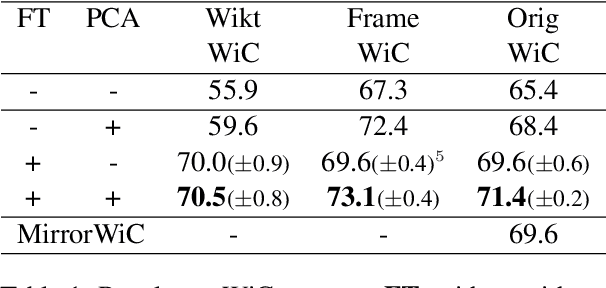

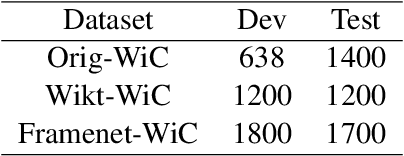
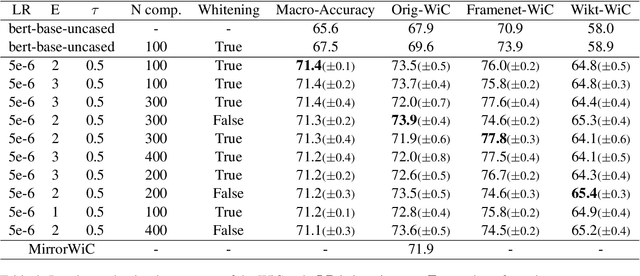
While static word embeddings are blind to context, for lexical semantics tasks context is rather too present in contextual word embeddings, vectors of same-meaning occurrences being too different (Ethayarajh, 2019). Fine-tuning pre-trained language models (PLMs) using contrastive learning was proposed, leveraging automatically self-augmented examples (Liu et al., 2021b). In this paper, we investigate how to inject a lexicon as an alternative source of supervision, using the English Wiktionary. We also test how dimensionality reduction impacts the resulting contextual word embeddings. We evaluate our approach on the Word-In-Context (WiC) task, in the unsupervised setting (not using the training set). We achieve new SoTA result on the original WiC test set. We also propose two new WiC test sets for which we show that our fine-tuning method achieves substantial improvements. We also observe improvements, although modest, for the semantic frame induction task. Although we experimented on English to allow comparison with related work, our method is adaptable to the many languages for which large Wiktionaries exist.